Scientists want to test how different materials burn on the Moon
NASA is planning to intentionally start a fire on the surface of the Moon, and this isn’t madness — it’s one of the most important safety experiments for future lunar bases. The Flammability of Materials on the Moon mission will test for the first time how fire behaves under lunar gravity conditions. The thing is, materials considered non-flammable on Earth could catch fire on the Moon and burn far longer than we’re used to. Yes, the Moon uniquely affects not only the human body but also materials.
How Fire Behaves in Zero Gravity and on Earth
On Earth, fire works on a simple principle: hot gas rises upward, and fresh cool air rich in oxygen flows in from below to replace it. This continuous convection flow is the reason fire has its familiar elongated teardrop shape and doesn’t go out as long as there is fuel.
In complete weightlessness, everything is different. Without gravity, hot gas doesn’t rise, and the flame can’t “pull” oxygen toward itself. Instead of the familiar tongue of fire, you get a sphere that feeds only on the airflow already circulating in the cabin. NASA has studied these fiery spheres for decades in special drop towers and on unmanned cargo spacecraft near the ISS.
However, zero gravity is one thing, and the Moon is quite another, where gravity is approximately one-sixth of Earth’s. This creates an environment that is very difficult to reproduce in a laboratory and that could prove genuinely dangerous.
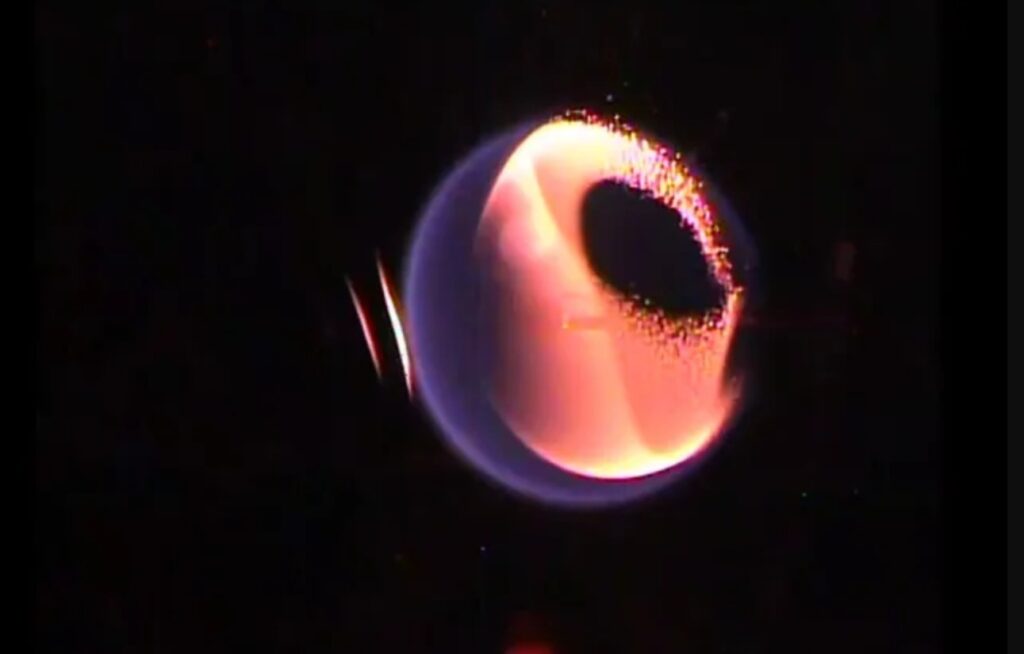
This is approximately how fire burns on the ISS. Image source: space.com
Why Lunar Gravity Is More Dangerous for Fire Safety
You might think that the less gravity there is, the weaker the fire. But in reality, it’s not that simple. On Earth, when certain materials burn, the convection flow is so powerful that fresh oxygen reaches the flame too quickly, and the chemical combustion reactions simply can’t keep up. This creates an effect where the airflow essentially blows out the fire, like a birthday person blowing out candles on a cake.
On the Moon, gravity produces convection, but significantly slower convection. Oxygen still reaches the flame, but not fast enough to cause the effect mentioned above. As a result, the chemical combustion reactions have time to sustain the fire, and a material that would be considered non-flammable on Earth could blaze on the Moon.
NASA researchers directly state in their report that lunar gravity may be more fire-hazardous because flame spread rates depend on gravitational peaks under partial gravity conditions. Put simply, the Moon falls into the “zone of greatest flammability” — not zero gravity and not Earth gravity, but precisely that intermediate range where fire is most comfortable.
How NASA Has Tested Materials for Decades
To assess fire safety of materials, NASA uses the standard NASA-STD-6001B. The essence of the test is simple: a six-inch flame is applied to a material sample, and if the fire spreads more than six inches upward or the material drops burning droplets, it is considered unsuitable for space.
The problem is that this test is conducted exclusively under Earth gravity conditions. As NASA researchers themselves note, the standard is built on an assumption: if a material passes testing at 1G, it is safe in space as well. But for lunar gravity, this assumption has never been verified experimentally.
Previously, NASA conducted the Saffire (Spacecraft Fire Safety) series of experiments — six missions from 2016 to 2024, in which researchers ignited materials inside unmanned Cygnus cargo spacecraft after they undocked from the ISS. These experiments allowed, for the first time, the study of large fires in microgravity conditions. But Saffire took place in weightlessness, not in partial gravity. Drop towers provide only 5 seconds of weightlessness, parabolic flights — about 25 seconds. For studying fire behavior on the Moon, this is categorically insufficient.
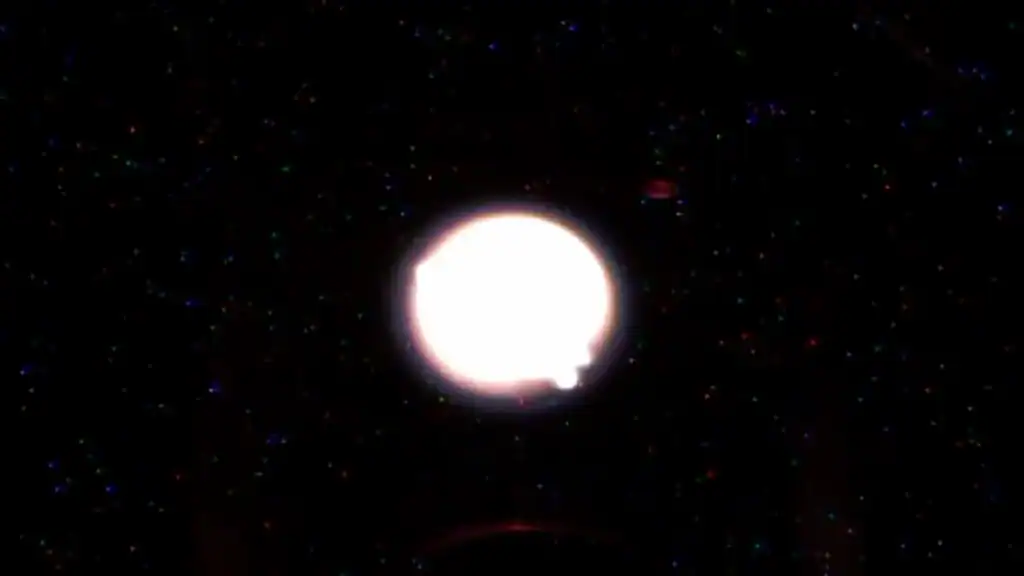
An engineer conducts a standard material flammability test in a NASA laboratory
The First Controlled Fire on the Moon
To close this gap, NASA engineers developed the Flammability of Materials on the Moon (FM2) mission. The launch is scheduled for late 2026 as part of the Commercial Lunar Payload Services (CLPS) program.
A sealed robotic combustion chamber will be delivered to the lunar surface. Inside it, an automated system will sequentially ignite four solid fuel samples. Cameras, radiometers, and oxygen sensors will track the fire’s behavior in real time: its shape, spread rate, thermal radiation, and oxygen consumption.
The mission’s main advantage is observation time. Unlike the few seconds in a drop tower, on the Moon, fire can be observed for minutes, capturing the steady-state burning regime. This is the first experiment in history involving controlled combustion on the surface of another celestial body.
The chamber is completely isolated from the landing module — this is important both for the lander’s safety and for data purity. Essentially, it is a compact laboratory that operates autonomously and transmits results back to Earth.
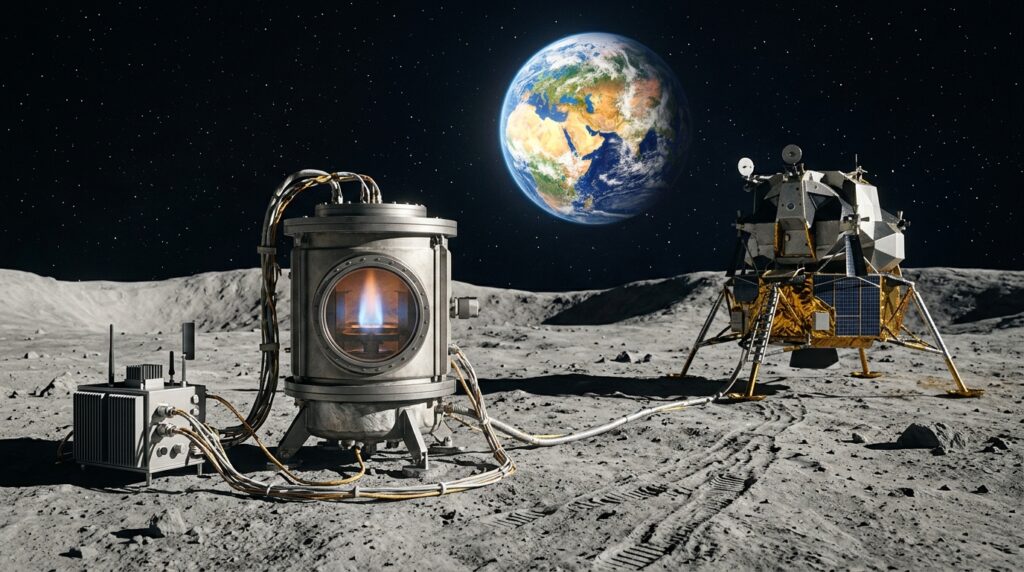
This is what the combustion chamber on the lunar surface next to the landing module might look like
Why This Is Needed Before Landing Humans on the Moon
The timing of the experiment is no coincidence. After the successful Artemis 2 flight, NASA is actively preparing the Artemis 3 and Artemis 4 missions, which are expected to return humans to the lunar surface. Astronauts will work and live in enclosed habitable modules with oxygen-enriched atmospheres. Such an environment simplifies life support systems but makes any fire significantly more dangerous.
History reminds us how serious this threat is. In February 1997, aboard the Russian orbital station Mir, an oxygen generator caught fire in the Kvant-1 module. Flames with molten metal burned for several minutes, filling the station with thick toxic smoke and cutting off access to one of the two Soyuz rescue spacecraft. Six crew members, including American astronaut Jerry Linenger, found themselves in a critical situation. The fire was extinguished, but the incident changed the approach to fire safety on the ISS.
The FM2 mission should answer a key question: do materials we trust on Earth remain safe on the Moon? The results will influence the selection of materials for walls, cables, fabrics, spacesuits, and all elements of future lunar habitats. Researchers acknowledge that full-scale qualification tests on the Moon will only become possible with a permanent human presence. But even the initial FM2 data could serve as an anchor for computer models that engineers will rely on when designing lunar bases.
The bottom line is that Earth safety standards don’t necessarily work beyond Earth. FM2 is a verification without which building lunar bases would be simply reckless. If computer models are confirmed and some “safe” materials do indeed turn out to be flammable, engineers will have to revise fire safety standards that have been used for decades. And it’s better to find this out before people are living in a lunar habitat.