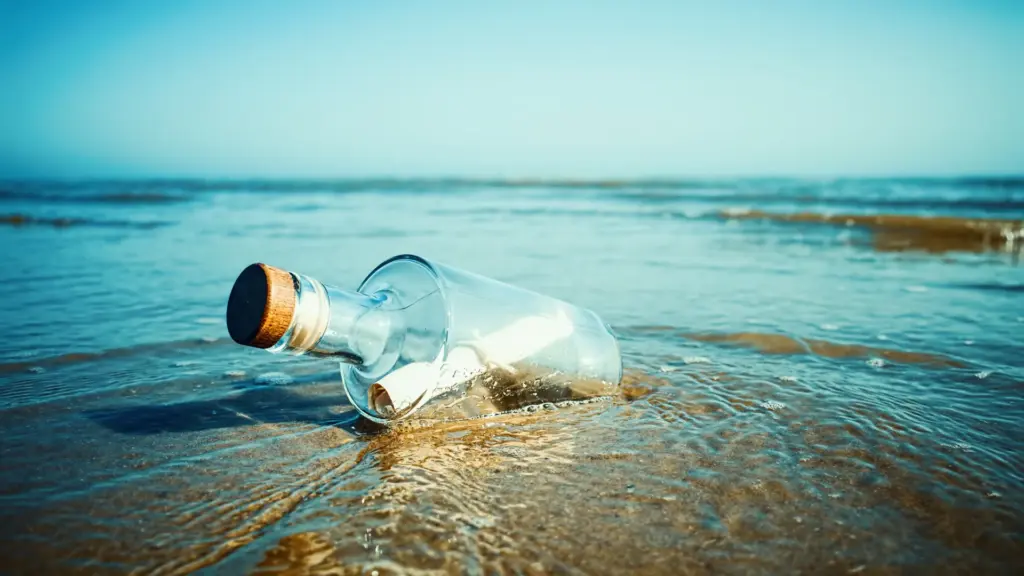
Mathematicians tried to calculate the probability of finding a message in a bottle, and they succeeded
A message in a bottle is one of the most romantic images in culture. For example, in 2021 I wrote about how a bottle with a letter from the sunken Titanic was found on the coast of Canada. But have you ever wondered how realistic it is to find such a bottle? And what if it’s over a hundred years old? Mathematicians from New Zealand and Ireland decided to calculate the probability, and they arrived at a quite specific answer, relying on data from oceanographic experiments and statistics of real discoveries.
The Chance of Finding a Bottle with a Message in the Ocean
The first part of the problem is estimating what proportion of message bottles ever end up in someone’s hands. This is where so-called “drift experiments” come to the rescue. According to Live Science, for decades oceanographers have been throwing thousands of bottles into the sea to study currents, and then recording how many of them were recovered.
Results vary depending on the region. In experiments from the 1960s in the North Atlantic, the proportion of recovered bottles was 14% for the Gulf of Mexico, 8% for the Caribbean Sea, and 7% for the coast of Brazil. A more recent study from the 2000s between Canada and Greenland yielded 5%. Specialists from the German Federal Maritime and Hydrographic Agency estimate the overall probability of discovering a message bottle at roughly 1 in 10 — that is, about 10%.
This figure is an averaged estimate, but it aligns well with various experiments. For further calculations, the authors used it as the baseline probability of event “A”: someone finds a message bottle.
Why Old Message Bottles Are Found So Rarely
Now the second part of the problem: if a bottle is found, what is the probability that it is over 100 years old? Here the authors relied on data from Wikipedia, where documented cases of message bottle discoveries are collected — but only those older than 25 years, because younger finds usually don’t make the news.
The logic is simple: the older the bottle, the lower the chances it survived. Glass cracks, paper inside decomposes, the bottle gets buried under sedimentary deposits on the ocean floor or smashed against rocks. By plotting a graph of the number of finds versus age, the authors saw a clear downward trend — and drew a trend line through it.
Using the resulting equation, they estimated the number of found bottles in the “youngest” category (0 to 25 years) — approximately 46. Summing up all age groups, the authors arrived at a total number of found bottles: about 106. Of these, only 12 turned out to be over 100 years old. This gives a probability of roughly 12 out of 106, meaning approximately 1 in 10 found bottles turns out to be a century old.
The Bottle’s Chance of Surviving and the Chance of Finding It
Now we have two estimates:
- The probability that a message bottle will be found at all — 1/10;
- The probability that the found bottle turns out to be over 100 years old — also roughly 1/10.
The events are independent: first the bottle must survive and be found, and then it also has to be old enough. By the multiplication rule of probabilities: (1/10) × (1/10) = 1/100.
In other words, out of every 100 message bottles sent into the ocean, only one will be found and turn out to be a century old. That doesn’t sound so rare — until we translate it into the language of a specific person.
Can You Find a Message in a Bottle?
Let’s say there are 100,000 message bottles drifting in the world’s oceans right now — this is a hypothetical but reasonable estimate for the calculation. According to the formula above, about 1,000 of them will eventually be found and turn out to be over a century old.
Now divide those 1,000 bottles by 8 billion people on Earth. That gives roughly a 1 in 8 million chance that you specifically will find a century-old message in a bottle. For comparison: the probability of being struck by lightning in a given year is estimated at about 1 in a million, meaning finding an antique bottle with a note is 8 times less likely than being struck by lightning.
Of course, this calculation is simplified. If you live on the ocean coast and walk the beach every day, your chances are significantly higher than those of someone living in Moscow or Astana. But as an average estimate for a random person on the planet, the figure is quite illustrative.
What Lies Behind the Probability Calculation for Finding a Message in a Bottle
This calculation is not a rigorous scientific study, but rather an elegant exercise in applied statistics. The authors honestly note that data on bottle discoveries is incomplete: only cases covered by the media make it into the statistics, and younger finds (under 25 years) had to be estimated through extrapolation.
Nevertheless, the methodology itself is transparent and reproducible: take real data on the percentage of recovered bottles from oceanographic experiments, add statistics on the age of finds, and multiply the probabilities. The result does not claim absolute precision, but provides an understandable order of magnitude.
The most interesting thing here is not the specific number, but the approach itself. Breaking a complex question into two simple parts, estimating each separately, and combining them through multiplication — this is a basic technique of probability theory that works for a wide variety of problems: from risk assessment to predicting rare events. And a message in a bottle is simply a beautiful excuse to demonstrate it.
So if you ever find a bottle with an old letter inside on the beach — know that you got about as lucky as eight lottery winners simultaneously. And yes, reading the note is definitely worth it.