Sitting up straight may subtly improve your mood and help you make more calculated decisions, according to a recent study from McGill University published in the British Journal of Psychology. The researchers used an ingenious method to avoid a long-standing flaw in “power pose” research: instead of telling participants to sit upright, they tricked them into it — and still observed measurable effects on emotion and risk-taking behavior.
What you need to know
- Nearly 200 participants were unknowingly guided into upright or slouched postures by the height of a tablet stand, eliminating the self-suggestion bias that plagued earlier “power pose” studies.
- Those who sat upright earned more virtual money in a risk-reward game — not by being reckless, but by taking more calculated risks and stopping before losses.
- Post-experiment surveys showed the upright group reported higher feelings of pride and better overall mood compared to the slouching group.
- The researchers caution that the measured effect was modest and that good posture alone will not produce dramatic cognitive improvements.

Upright posture may subtly boost confidence and mood, a new study suggests.
Why scientists have long doubted the “power pose”
The concept of a “power pose” — standing tall, shoulders back, chin up — has been popular in psychology for years. Earlier studies claimed that adopting such a posture could instantly make a person feel more confident. However, the scientific community has treated those findings with skepticism.
The core problem was methodological: researchers directly asked volunteers to sit or stand in specific ways. Participants could easily guess what the experiment was testing and might have acted more confidently simply to meet perceived expectations. To obtain genuinely reliable data, an experiment needed to make people straighten up without them realizing it was the point.
How the researchers tricked people into sitting upright
The McGill team recruited nearly 200 participants and told them the study was about testing a new mobile app on a tablet — a deliberately mundane cover story. The real variable was hidden in the workspace setup.
Half the participants were given a tablet placed on a low table, forcing them to hunch over the screen. The other half used a tablet mounted on a tall, adjustable stand that naturally guided them into an upright position. A camera monitored each volunteer, and software objectively recorded neck angle throughout the session.
Crucially, participants had no idea that posture — not the app — was the true subject of the study. This design elegantly removed the self-suggestion bias that had undermined previous research.
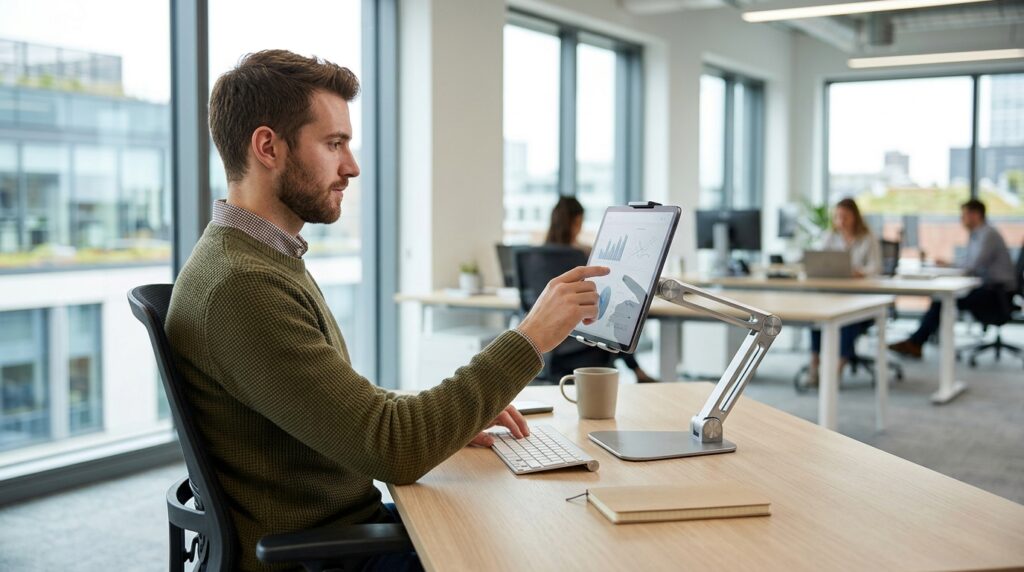
A specially positioned tablet stand helped participants maintain an upright posture without realizing it was the focus of the study.
Upright posture led to smarter risk-taking
After spending time in their assigned postures, participants played a virtual balloon game. The rules were simple: the more you inflate the balloon, the more virtual money you earn — but if it pops, you lose everything from that round.
The results were striking. People who had been sitting upright earned more. They took risks more often by continuing to inflate the balloon, but they also stopped in time, before it burst. According to the researchers, a straight back did not make them reckless. Instead, their risk-taking became more calculated and effective.
Post-experiment surveys reinforced the finding: participants who sat upright more frequently reported feelings of pride and were in a better overall mood compared to those who had been hunched over a low table.

Upright posture was associated with better mood and more effective decision-making in the study.
Important caveats: don’t expect miracles
The study’s authors, whose findings were reported by McGill University, emphasize that good posture should not be expected to produce instant transformations. Simply straightening your back will not turn you into a brilliant investor, and the effect observed under laboratory conditions was described as modest.
Nevertheless, the research adds to evidence that our physical environment subtly but consistently shapes how we think. According to the study, basic workspace ergonomics can influence several things at once:
- Physical comfort and the absence of pain at the end of the day;
- Baseline mood and feelings of pride in one’s work;
- The brain’s ability to assess risks soberly and make balanced decisions.
A comfortable chair or a monitor stand may be among the simplest ways to give your brain a slight performance edge — though, as this study makes clear, the benefits are real but modest, and further research will be needed to understand how well these lab findings translate to everyday life.