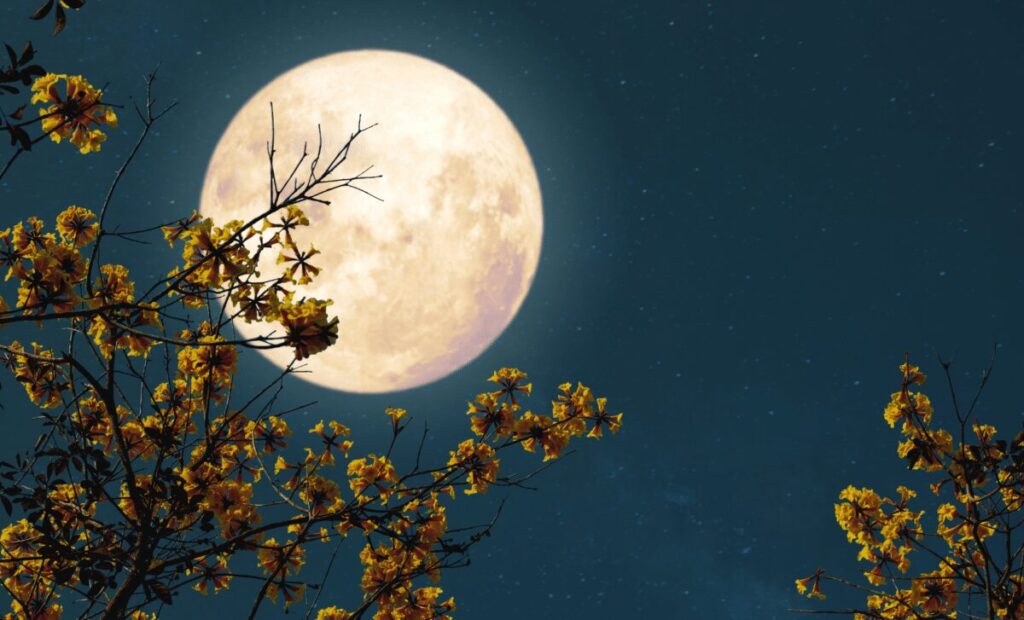
Scientists explain why the double full moon in May 2026 is a rare phenomenon. Image source: dailygalaxy.com
In May 2026, a rare astronomical event will occur — two full moons in a single calendar month. The first will happen on May 1, the second on the 31st. This phenomenon is called a “Blue Moon,” and it only repeats once every two to three years. In the full moon calendar for 2026, this is one of the most unusual coincidences.
Two Full Moons in May 2026: Dates and Exact Times
The first full moon of May will occur on the 1st. According to astronomical services, the peak phase falls at 17:23 UTC — for Moscow, that’s 20:23. This full moon is called the Flower Moon because May is the time of mass blooming.
The second full moon will occur on May 31 at 08:45 UTC (11:45 Moscow time). This is the full moon that earns the status of a Blue Moon — the name given to the second full moon falling within the same calendar month.
This coincidence is possible thanks to simple arithmetic. Lunar phases cycle through at a rate of about 29.5 days from one full moon to the next. If a full moon falls on the first or second day of the month, the next one manages to fit within the same month before it ends. May has 31 days, so both full moons just barely fit.
Why the Blue Moon Doesn’t Change Color in the Sky
Despite its name, the Moon on May 31 will not change its color. It will look exactly like a regular full moon — yellowish near the horizon and whitish high in the sky. The term “Blue Moon” is a calque from the English idiom “once in a blue moon,” which means “very rarely.”
Interestingly, the Moon can actually take on a bluish tint, but for an entirely different reason. If small particles of a certain size accumulate in the atmosphere — for example, volcanic ash or smoke from large-scale wildfires — they scatter red light waves and allow blue ones to pass through. This is exactly what happened after the eruption of Krakatoa in 1883: eyewitnesses indeed saw the Moon with a bluish hue. But this has nothing to do with the May 2026 full moon.
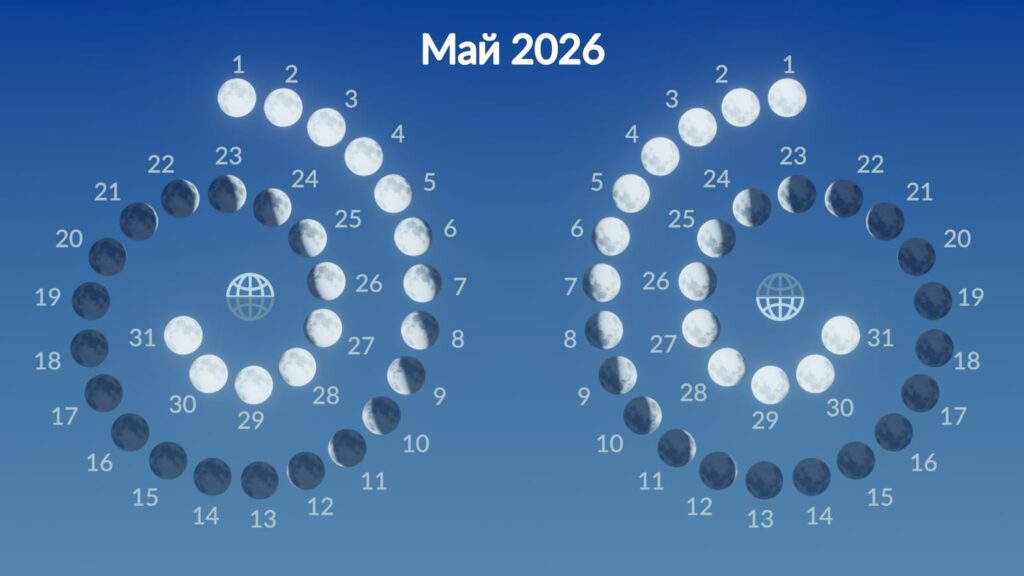
Lunar phases in the Northern and Southern Hemispheres in May 2026. Image source: starwalk.space
What Does Blue Moon Mean and Where Did the Term Come From
The term “Blue Moon” has two recognized definitions. The first is a calendar Blue Moon: the second full moon within a single calendar month. This is exactly what will happen in May 2026. The second definition is a seasonal Blue Moon: the third full moon in an astronomical season that happens to contain four full moons instead of three.
Curiously, the now more widely known “calendar” definition arose from a mistake. In 1946, amateur astronomer James Hugh Pruett wrote an article for Sky & Telescope magazine in which he misinterpreted the traditional (seasonal) definition from the Farmer’s Almanac. His simplified interpretation — “the second full moon in a month” — was so easy to understand that the media quickly picked it up, and it became the accepted standard.
Both definitions describe the same essence: an “extra” full moon that doesn’t fit into the usual rhythm — one full moon per month or three per season.
How Often Does a Blue Moon and Double Full Moon Occur
A Blue Moon is an infrequent phenomenon, but not extremely rare. On average, a calendar Blue Moon occurs roughly once every 2.5 years. The previous one was on August 31, 2023, and the next one after May 2026 is expected on December 31, 2028.
In 2026, due to the Blue Moon, the total number of full moons for the year will be 13 instead of the usual 12. This happens because 12 lunar cycles take approximately 354 days — 11 days fewer than a calendar year. Over two to three years, this difference accumulates and “pushes” an additional full moon into one of the months.
Here are the upcoming dates of calendar Blue Moons:
- May 31, 2026
- December 31, 2028
- September 30, 2031
- July 31, 2034
There are also years when a Blue Moon happens twice — if February has no full moons at all, while January and March each have two. The nearest such year is 2037.
Why the May Full Moon Is Called the Flower Moon
The first full moon of May — the Flower Moon — got its name from the tradition of North American Indigenous peoples, for whom May was a time of abundant blooming.
However, different peoples associated May with different natural phenomena. The Cree called this time the “Budding Moon,” the Dakota and Lakota called it the “Planting Moon,” and the Celts called it the “Hare Moon” (or Grass Moon). All these names reflected one thing: the Moon served as a natural calendar used to determine when to sow, when to harvest, and when to prepare for winter.
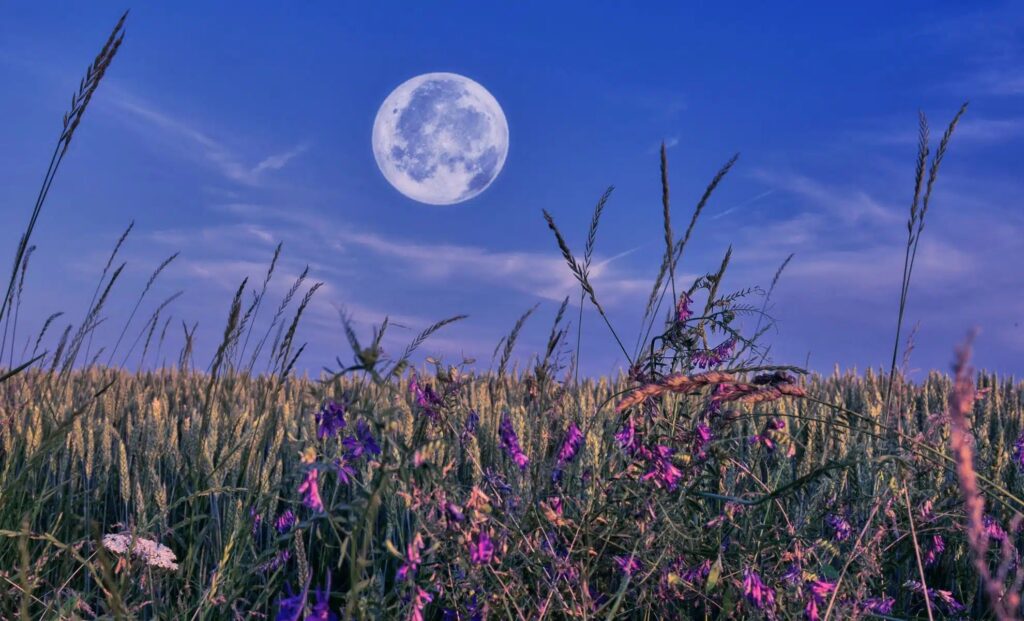
The May full moon coincides with peak spring blooming in the Northern Hemisphere. Image source: dailygalaxy.com
An interesting detail: both May 2026 full moons will be so-called Micromoons. In short, a Micromoon is a full moon during which the Moon is farther than usual from Earth. Visually, it appears about 7% smaller than an average full moon and 12–14% smaller than a Supermoon. The difference is slight and almost imperceptible to the naked eye, but for astronomers it’s a curious coincidence: two full moons in one month, and both at maximum distance.
When and How to Observe the Full Moons in May 2026
No equipment is needed to observe the full Moon — it is perfectly visible to the naked eye and is even too bright for a telescope. The full Moon rises approximately at sunset in the east and sets around sunrise in the west.
The first full moon on May 1 is best observed in the evening when the Moon rises above the horizon. It will be located in the constellation Libra. The second full moon on May 31 will peak at 11:45 Moscow time, meaning during the day. This doesn’t mean the spectacle will be lost: the Moon is visible during the day much more often than people think, and it appears full not only at the exact moment of peak phase. It can be observed on the night of May 30–31 and the night of May 31–June 1. At that time, the Blue Moon will be near the bright star Antares in the constellation Scorpius.
The most spectacular time for photographs is the moment of moonrise, when it is low above the horizon. That’s when the lunar illusion takes effect: due to atmospheric effects, the disk appears larger, even though the actual size of the Moon in the sky barely changes, and it takes on a warm golden hue. If there is an interesting landscape on the horizon — buildings, trees, hills — you can get a striking shot even with a smartphone camera.