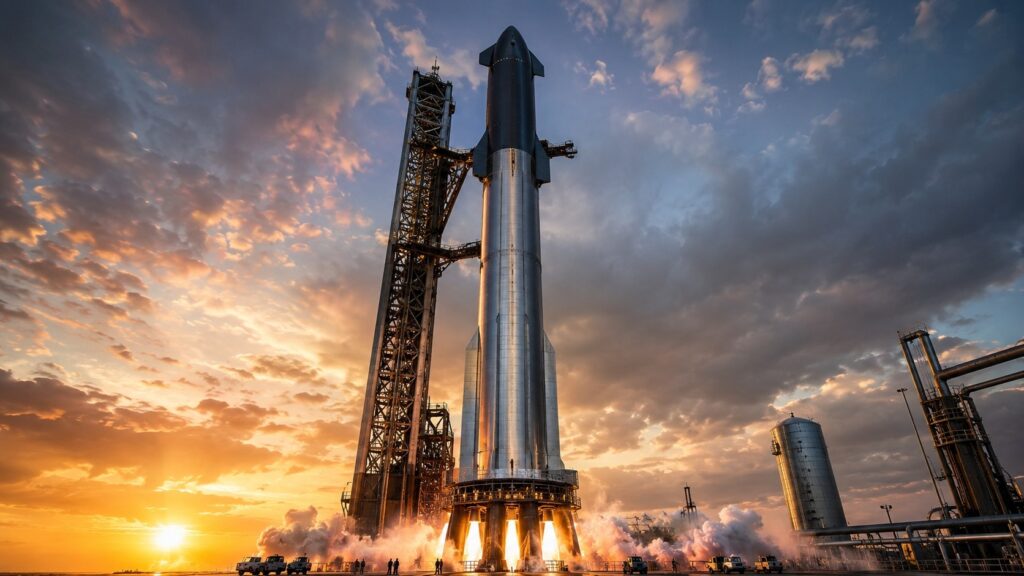
SpaceX deliberately broke Starship before its test flight
SpaceX is about to send Starship V3 on its maiden flight. This is the tallest and most powerful rocket ever built by humanity. When fully stacked, the Starship spacecraft and Super Heavy booster reach a height of 124 meters — longer than a football field and 26 meters taller than NASA’s Space Launch System rocket, which recently launched the Artemis 2 mission. The test flight will be suborbital, lasting about an hour, but during that time engineers will need to verify a whole host of critically important technologies.
What’s New in the Starship V3 Rocket
The new Starship V3 version features more than just cosmetic changes. According to the official SpaceX website, the rocket has been overhauled in its propulsion section: new Raptor 3 rocket engines have been installed, fuel tanks have been enlarged, and the reaction control system for in-flight maneuvering has been upgraded. The engine ignition method itself has also changed, which should also improve reliability.
Changes have also affected the Starship launch pad. Fuel storage capacity has been increased and additional pumps have been added to fuel the rocket faster. This is important because during the early stages of Starship testing, the launch pad suffered serious damage after a SpaceX Starship launch. Since then, the infrastructure has undergone a long path of modernization.
Starship Suborbital Flight Plan
If everything goes according to plan, the test will take roughly an hour. The rocket will follow a suborbital trajectory, meaning it will rise into space but won’t achieve a full orbit around Earth.
Here’s how the Starship flight should proceed:
- Launch and separation: the Starship spacecraft will detach from the Super Heavy booster;
- Booster return: Super Heavy will turn around and perform a controlled water landing in the Gulf of Mexico;
- Satellite deployment: Starship will release 22 mock next-generation Starlink satellites;
- Heat shield inspection: two mock satellites will scan the spacecraft’s heat shield, which SpaceX deliberately damaged for the experiment.
SpaceX is famous for its ability to return rockets to the launch pad, but this time the booster won’t be caught by the giant tower. The company directly explained the reason: Starship V3 is a “substantially redesigned vehicle,” and risking expensive infrastructure on the very first test of a new generation is too dangerous. Therefore, Super Heavy will simply land on water.
Why SpaceX Damaged Starship’s Heat Shield
One of the most fascinating aspects of the upcoming flight is the heat shield experiment. SpaceX deliberately compromised the integrity of Starship’s heat shield to test how the spacecraft handles damage during atmospheric reentry.
The logic here is straightforward. If the rocket is intended for reuse (and that is indeed the ultimate goal), it’s essential to understand what level of heat shield wear is acceptable between flights. The two mock satellites deployed during the mission will scan the shield’s condition, collecting data in real time.
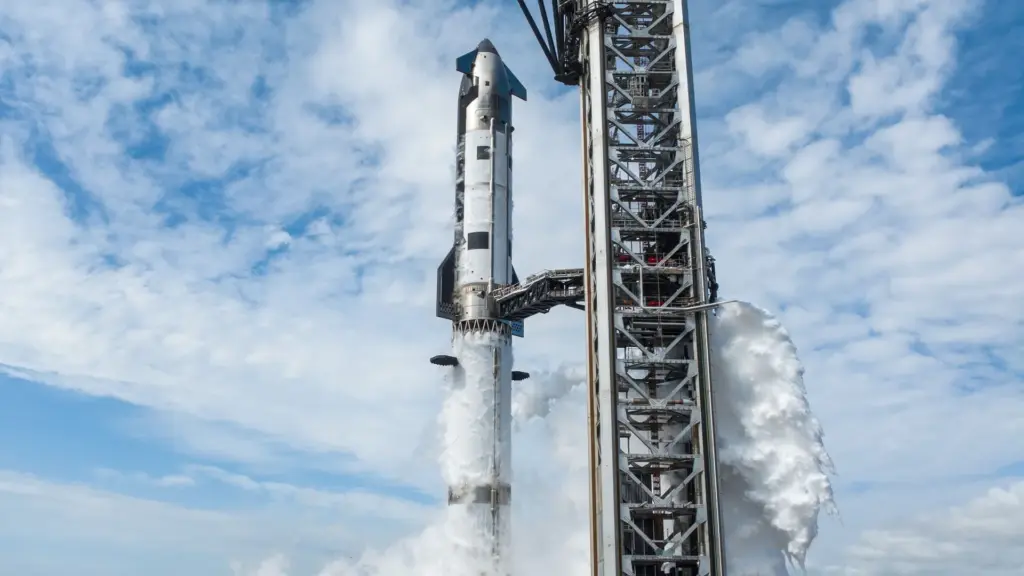
Starship’s heat shield tiles must withstand extreme heating during atmospheric reentry
This experiment is part of a broader strategy. SpaceX states that all changes to the Starship spacecraft are aimed at unlocking the vehicle’s key capabilities, including full and rapid reusability, in-space fuel transfer, deployment of Starlink satellites and orbital data centers, as well as delivering people and cargo to the Moon and Mars.
Starship Spacecraft in the Artemis Program
NASA’s plans to return humans to the Moon depend on the SpaceX Starship rocket. The agency selected the lunar variant of Starship as the commercial landing module for the Artemis 4 mission.
The lunar mission architecture works like this: astronauts fly to the Moon in the Orion capsule, which was already tested during the Artemis 2 mission, dock with the commercial landing module in lunar orbit, descend to the surface, and then return to Orion for the trip home. Next year, NASA plans to test docking Orion with one or both commercial lander variants in low Earth orbit.
But SpaceX has a competitor: Jeff Bezos’s Blue Origin is developing its own Blue Moon landing module. NASA has stated directly that the readiness of the landing module will determine which commercial partner will carry astronauts to the lunar surface in 2028.
When Will Starship Launch
The exact Starship V3 launch date still depends on system readiness and weather conditions. But even if the flight goes perfectly, actual lunar missions are still a long way off. The Artemis program is behind schedule and over budget. At the time of writing, NASA still doesn’t have suitable spacesuits for a lunar landing — they are being developed by yet another commercial contractor.

The lunar variant of Starship is expected to deliver astronauts to the lunar surface as part of the Artemis program
Still, the Starship test flight itself is already a major step forward. Each such test gives SpaceX something that simply cannot be obtained on Earth: how the new engines behave, how the redesigned heat shield responds, what the updated control system shows. Even if something goes wrong, the Starship V3 test flight results will be critically important for the entire program going forward.
One thing is certain: a rocket as tall as a 40-story building, capable of carrying dozens of tons to orbit and designed for full reusability, is a powerful proof of concept that will determine how humanity will fly into space in the coming decades.