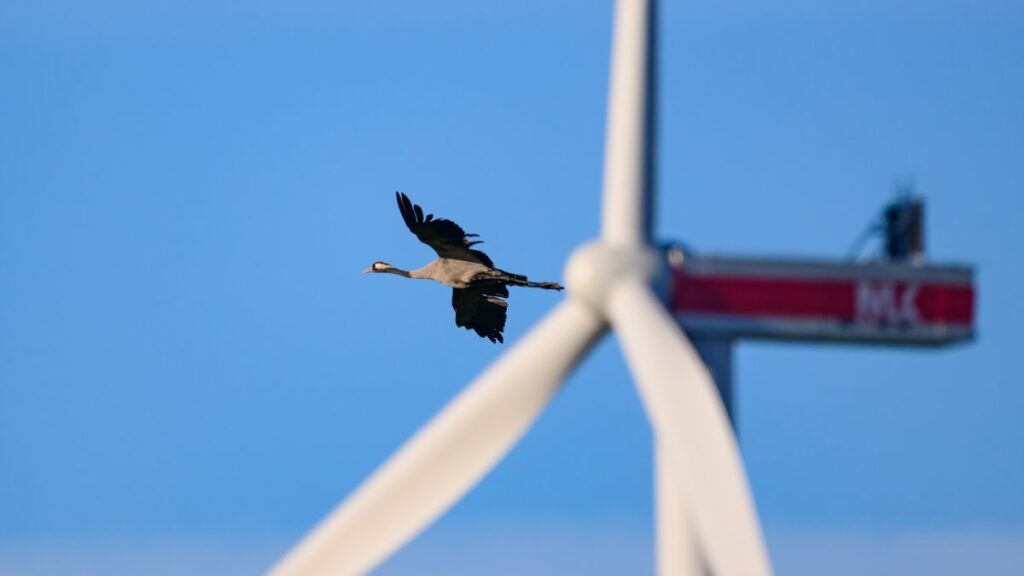
Birds are afraid of wind turbines painted like venomous snakes: a simple solution saves millions of lives
Who would have thought, but wind turbines are actually a major problem for winged animals — birds and bats. They kill unsuspecting animals in considerable numbers. And this is sad, especially for endangered species. But scientists have found a surprisingly simple and cheap solution — all it takes is choosing certain paint colors for the blades.
How Many Birds Die From Wind Turbines Each Year
Wind energy is one of the key tools in fighting climate change and transitioning to renewable energy. But the spinning blades (especially white ones, which are most commonly used worldwide) have a side effect that’s uncomfortable to discuss: their giant rotating blades unintentionally kill two to six birds and four to seven bats per megawatt per year.
That may seem like a small number. But considering that hundreds of thousands of turbines operate worldwide, it adds up to an impressive mortality rate. According to the American Bird Conservancy, in the US alone in 2021, collisions with wind turbines killed approximately 1.17 million birds. And that’s an enormous number from just one country!
The problem is especially serious for rare species. For example, ecologically important seabirds and raptors that reproduce slowly and whose populations cannot quickly recover from losses. For endangered species, every death counts.
Why Birds Fear the Coloring of Venomous Animals
A new study has shown: wind turbine blades painted to resemble venomous snakes and frogs make birds keep a safe distance. It’s amusing that the natural “warning system” hardwired into birds’ brains over millions of years of evolution can protect them from collisions with wind turbines.
To understand the scientists’ idea, it’s worth recalling one curious mechanism. Aposematism is the way an animal communicates to potential predators that it is dangerous and shouldn’t be attacked. Such warning signals take the form of bright coloring, sounds, smells, or other noticeable characteristics indicating that the potential prey is venomous, tastes bad, has sharp spines, or an aggressive temperament.
Simply put, bright contrasting stripes in nature are a universal sign saying “Don’t touch!” Such coloring often works not as decoration, but as a survival tool. Certain color combinations repeat again and again across unrelated species: black with yellow (wasps, poison dart frogs, fire salamanders), black with red (ladybugs (yes, yes — they are toxic, but only if you’re a threat), coral snakes).
Laboratory experiments show that many bird species, even very young ones, avoid bright colors characteristic of aposematic (warning) coloring. This means they don’t necessarily need to learn to stay away from prey with such colors — the reaction may be partially innate. It’s this ancient “firmware” in birds’ brains that scientists decided to exploit. By the way, did you know that birds can see more colors than humans?
Scientists Tested Striped Turbine Blades
According to a study published in the journal Behavioral Ecology, birds and bats significantly more often avoid wind turbines whose blades are painted in colors characteristic of venomous coral snakes and poison dart frogs.
A team of scientists from the University of Helsinki and the University of Exeter conducted a laboratory experiment. They placed test birds in front of a video screen in a controlled laboratory environment and showed them videos of spinning blades in different color schemes and at different speeds. Among the options were classic white blades, one black blade, red-and-white striped blades, and a new biomimetic pattern — red-black-yellow stripes.
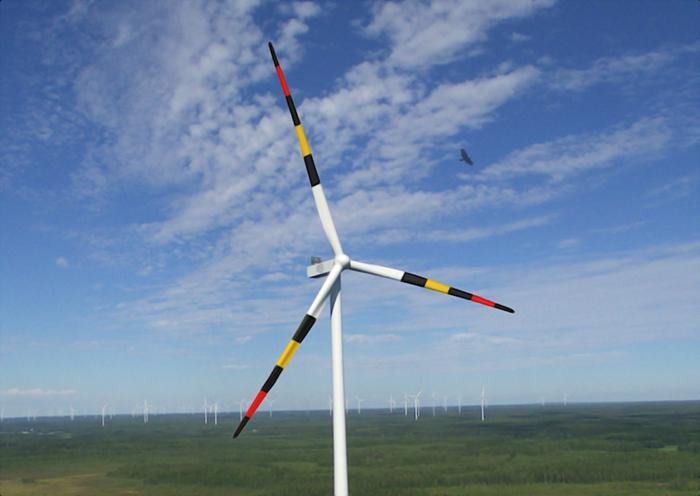
New biomimetic pattern for wind generator blades — red-black-yellow stripes.
For this purpose, they used a special touchscreen designed for birds, which allows studying their behavior and ecology through “games” that model real scenarios without putting the birds in danger.
White Turbine Blades Turned Out to Be the Most Dangerous for Birds
The results were unambiguous. In virtually every trial, birds were far more willing to approach white blades than any of the colored variants. The greatest avoidance was triggered by the new biomimetic striped pattern — that very red-black-yellow one copying the coloring of venomous animals.
Black-red-yellow striped blades caused the strongest avoidance response — significantly stronger than painting one blade black (a method currently used in Norway) or red stripes (used in Germany).
For context: at the Smøla wind farm in Norway, painting one blade black reduced bird deaths by more than 70%. The “snake” pattern in the lab repelled birds even more strongly — but these are still laboratory data, not field trial results.
Why Birds Don’t See Wind Turbine Blades
A logical question arises: if birds have such sharp vision, why do they crash into enormous structures? It comes down to the “motion blur” effect. This is a visual phenomenon in which a fast-moving object appears to the eye as an almost invisible blur. If you’ve ever seen hummingbird wings or helicopter blades in flight, you’re familiar with this effect.
White blades against a light sky merge into a transparent disc. The bird simply doesn’t perceive them as an obstacle. Additionally, birds have a narrow binocular field of vision in front — they mainly use lateral monocular vision to detect predators, conspecifics, and prey, which is why they don’t collide with each other in flight. But in presumably open airspace, birds don’t always perceive obstacles directly in front of them.
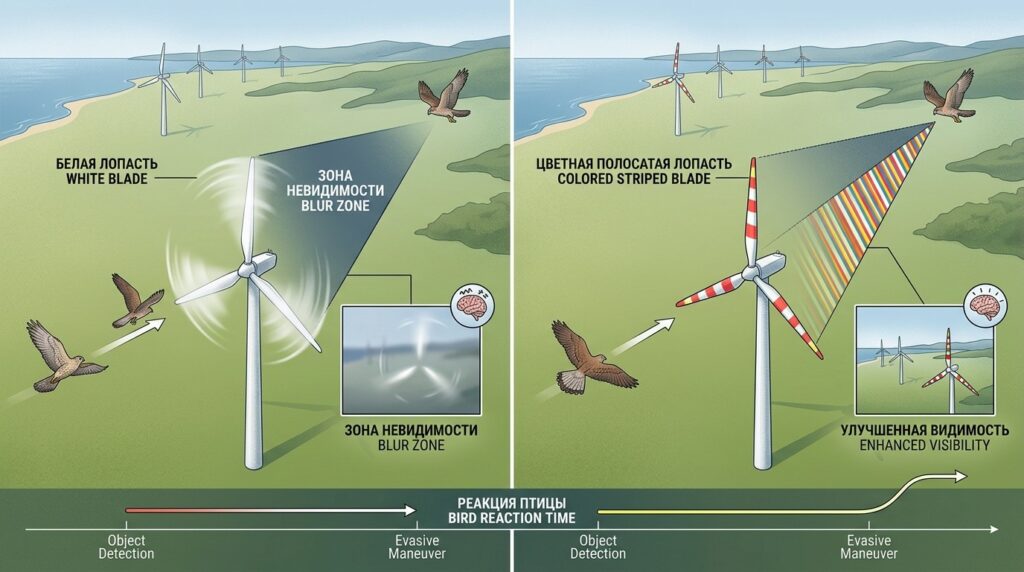
Diagram: white blades blend with the sky, while striped ones remain visible
Bright contrasting stripes work for two reasons. First, they break up the blur and make the blades physically visible. Second, in nature many aposematic species use contrasting colors and striped patterns to warn birds of danger.
What’s Stopping Us From Repainting All Wind Turbines in the World
If the results are confirmed in field conditions across different countries and with different bird species, this could become a significant change for the entire wind energy industry. But it’s important to understand that completely preventing animal deaths from wind turbines is impossible.
Moreover, as encouraging as such a simple and effective solution may be, problems could arise. Researchers warn that overly bright colors could also cause harm by scaring birds away from feeding territories even where there’s no immediate collision risk.
Another interesting point: implementing the new design may require regulatory changes. For example, current Finnish aviation legislation requires white blades, and heritage protection authorities prefer light-colored turbines to minimize visual impact on the landscape — creating quite a contradiction.
At the same time, avoiding critical bird habitats and migration routes remains the most effective way to prevent bird deaths from turbines. Painting the blades is a supplementary measure, not a replacement for proper wind farm placement.
The study authors believe that implementing evolutionarily informed color schemes could become a simple and cheap way to make the technology safer. They also propose developing similar approaches for other man-made objects dangerous to birds — power lines and building window glass.
The idea of using millions of years of evolution to solve a modern engineering problem is brilliant in my opinion. If field trials confirm the laboratory data, the next generation of wind turbines could not only become more environmentally friendly in energy production, but also stop being a trap for birds — and all thanks to just a few cans of paint in the right color.