The world’s largest solar-powered airplane fell from the sky
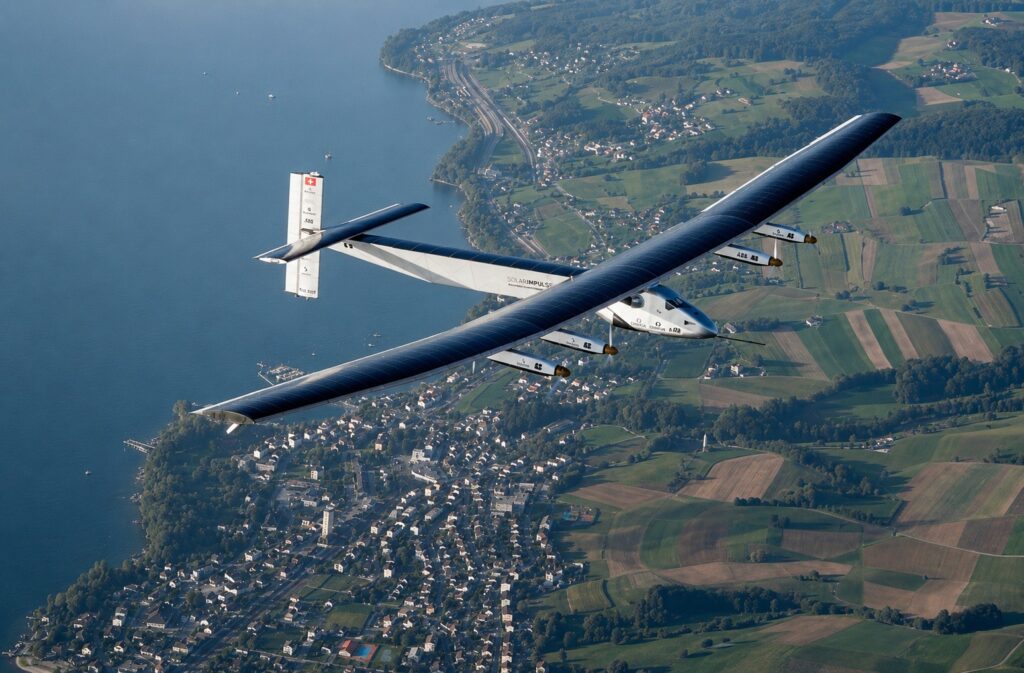
In 2016, the Solar Impulse 2 solar airplane survived the Pacific Ocean, monsoons, and heat over deserts and completed a round-the-world journey. It proved that perpetual flight is possible as long as there is sunlight. But recently, during a test flight, this marvel of engineering suddenly plunged into the water. Did the solar panels fail? Or is the problem deeper, rooted in the same fragile carbon fiber that made it light but couldn’t save its life? On May 4, 2026, the legend sank to the bottom of the Gulf of Mexico.
Solar Impulse 2 Crashed in the Gulf of Mexico
According to the U.S. National Transportation Safety Board (NTSB), the aircraft took off at dawn on May 4 from Stennis Airfield in Mississippi. The flight was fully autonomous, with no one on board. Shortly after takeoff, the aircraft lost electrical power and could not maintain altitude. Without energy, the fragile carbon fiber airplane simply nosedived into the waters of St. Louis Bay, in the international waters of the Gulf of Mexico.
The carbon frame was completely destroyed. The NTSB investigation is still ongoing, and the final report will be published later. But the fact itself is already irreversible: a unique machine that existed as a single copy is lost forever.
History of the Solar Impulse Solar Airplane
The Solar Impulse project was conceived in 2003 by Swiss explorer Bertrand Piccard, a member of one of the world’s most famous dynasties of pioneers. His grandfather, Auguste Piccard, was the first to ascend into the stratosphere in 1931. His father, Jacques Piccard, in 1960 was the first to descend to the bottom of the Mariana Trench — the deepest point of the World Ocean, where the human body experiences enormous pressure.
Bertrand didn’t plan to build a commercial airplane. He wanted to prove that solar energy could power a full-sized airplane around the planet, thereby drawing attention to clean technologies. The first prototype, Solar Impulse 1, made its debut flight in 2009 and then completed several flights across Europe and through the United States.
Construction of the second version began in 2011. Solar Impulse 2 turned out to be astonishing: a wingspan of 72 meters — larger than a Boeing 747 — yet the aircraft weighed only about 2,300 kg, roughly the same as an ordinary SUV. The secret was in the carbon fiber frame. On the upper surface of the wings were 17,248 photovoltaic panels with a peak output of 66 kW, powering four electric motors and four lithium-ion batteries weighing nearly 640 kg. The unpressurized cabin with an oxygen supply allowed the single pilot to fly at altitudes up to 12,000 meters, while a basic autopilot made it possible to sleep in 20-minute intervals.
How Solar Impulse 2 Flew Around the Entire Globe
In 2016, Solar Impulse 2 made history as the first piloted solar-powered airplane to complete a round-the-world flight. The journey took 16.5 months: Piccard and Solar Impulse Foundation co-founder André Borschberg took turns at the controls, making 17 intermediate stops. The route went through Asia, across the Pacific Ocean, the United States, the Atlantic, and back to Abu Dhabi, where the expedition had started on March 9, 2015.
The flight speed ranged from 50 to 100 km/h; at night, the airplane slowed down to conserve battery charge. In this way, the engineers demonstrated that a solar airplane can fly day after day, literally recharging from the sun. In essence, Solar Impulse 2 showed that sustained flight without fuel is possible, albeit slow.
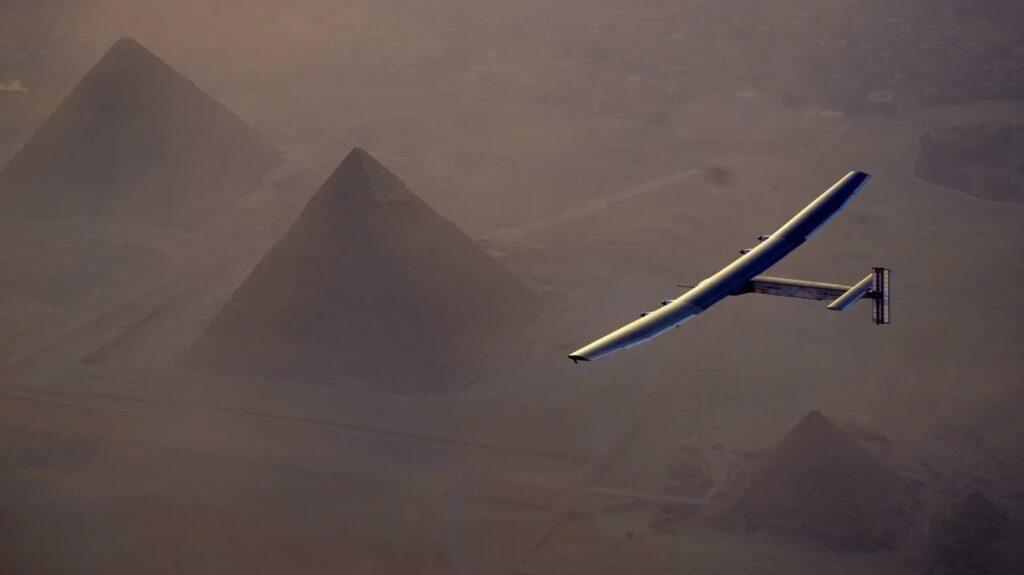
In 2016, the Solar Impulse 2 aircraft completed a round-the-world journey, including flying over the Pyramids of Giza
Military Solar-Powered Drone
In 2019, the Solar Impulse Foundation sold the airplane to the Spanish-American company Skydweller Aero. The deal amount was not disclosed, but the new owner’s plans were radically different from the original mission. Instead of promoting clean technologies, Skydweller set about transforming the solar airplane into an autonomous reconnaissance drone equipped with radars, optical cameras, communications interception systems, and telecommunications equipment.
The company significantly modified the aircraft. In 2023, Solar Impulse 2 made its first autonomous flight in Spain. In 2024, it completed the world’s first fully unmanned autonomous flight of a solar airplane at Stennis Airfield in Mississippi. And in the fall of 2025, Skydweller reported a 72-hour flight on solar power alone, transmitting data and images over the open ocean. The U.S. Navy and Southern Command considered the aircraft a cheap alternative to satellites for monitoring drug trafficking and smuggling at sea.
Skydweller’s ultimate ambition is to create an entire fleet of unmanned solar airplanes capable of flying nonstop in tropical latitudes from Miami to Rio de Janeiro. However, the crash of the prototype on May 4 dealt a serious blow to those plans.
Why the Wreckage of Solar Impulse 2 Is Lost
One of the most bitter consequences of the crash is the derailment of an agreement about the airplane’s future. According to the sales contract with Skydweller, after testing was completed, Solar Impulse 2 was supposed to return to Switzerland and become an exhibit at the Swiss Museum of Transport in Lucerne. Piccard and Borschberg had long dreamed that their machine would inspire engineers and environmentalists for decades to come. Now the aircraft lies at the bottom of the Gulf of Mexico, and those plans are canceled forever.
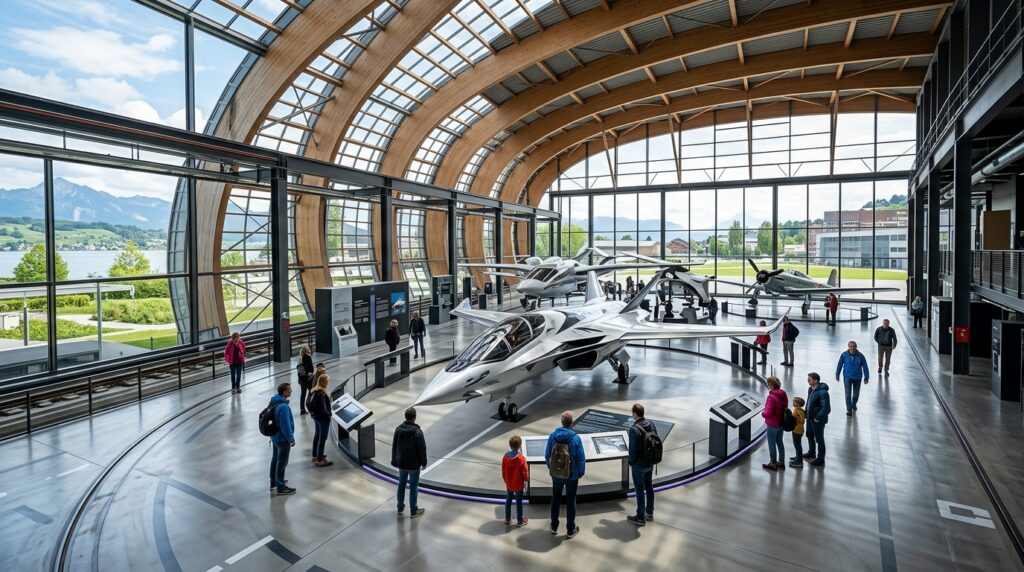
The Swiss Museum of Transport in Lucerne, where Solar Impulse 2 was planned to be exhibited
The airplane’s creators reacted with restraint but obvious bitterness:
We learned about the crash of the Skydweller drone from social media. The Solar Impulse team is saddened by the loss of an important technological flagship, — Piccard and Borschberg wrote in a statement for Popular Science.
At the same time, they emphasized that by the time of the crash, Skydweller had modified the aircraft so extensively that it was no longer quite the same Solar Impulse that had flown around the world.
Development of Solar-Powered Airplanes
Solar Impulse 2 no longer exists — it is destroyed and lost. However, its contribution to the history of technology and environmental awareness hasn’t gone anywhere. In 2013, even before the round-the-world flight, Bertrand Piccard said that the first prototype used 2007 technology, while the second used the technology of tomorrow. Ten years later, this seems even more accurate: solar cells, batteries, and autonomous flight systems tested on Solar Impulse formed the foundation for a new generation of drones.
Solar Impulse 2 proved that sustained solar-powered flight is possible and is an entirely feasible engineering challenge. Its crash was bad news for everyone who had followed the project from the very beginning. But the technologies it helped create continue to evolve, now in new machines. The investigation into the causes of the crash lies ahead, and its results will show what can be learned from this loss.