While Russia is discussing a complete VPN ban, the internet in the country is quietly ceasing to function in a completely different way. On Thursday evening, May 21st, the power went out in my entire neighborhood. A routine situation: previously I would simply tether my mobile internet from my phone and continue working. This time it didn’t work. Let me tell you in order — what happened, what didn’t work, and what conclusion I reached by the end of the day.
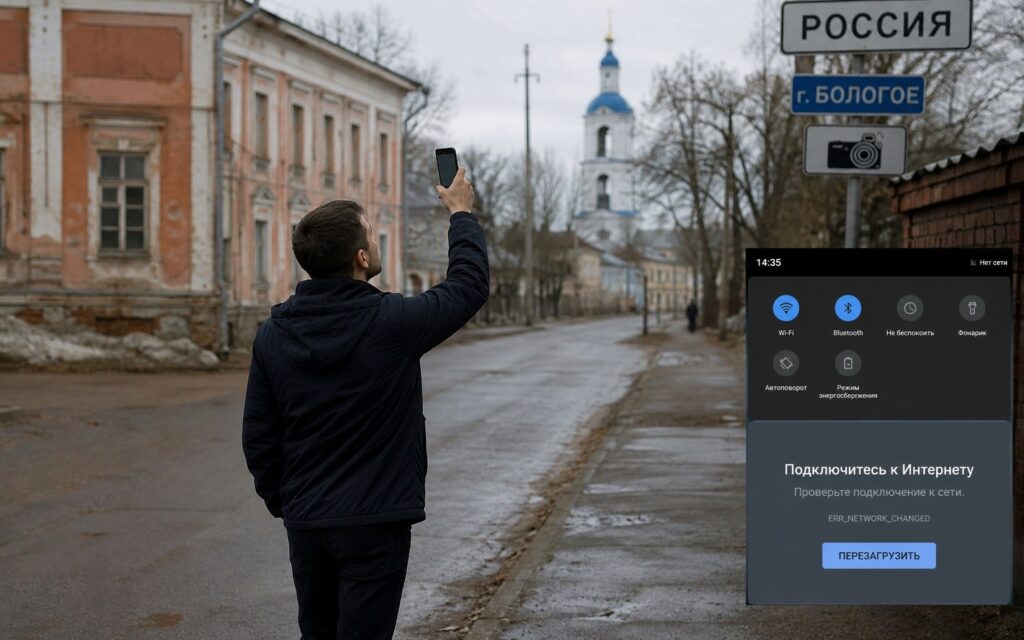
I tested the internet white lists on myself
Why They Shut Down the Internet in Russia
Let me start with the backstory, without which the rest won’t make sense. In Russia, there are so-called internet white lists — a tool for restricting network access that was originally introduced as a security measure during drone threat periods. The logic is simple: during danger, mobile internet is restricted to a minimal set of approved resources to disrupt potential drone control via the network.
Previously it worked like this: an SMS warning would arrive, then mobile internet would be shut off or switched to white list mode for several hours, then everything would return to normal. Unpleasant, but temporary. Now in the Sverdlovsk Region, where I live, the mobile internet white list operates on a permanent basis.

At least they used to warn about the restrictions being imposed
Not triggered by alerts, not by SMS — just always on. But this isn’t blocking in the traditional sense — it’s filtering at the carrier network level.
What Internet White Lists Are For
White lists in Russia are not the same as blocking individual websites. The fundamental difference: with regular blocking, the internet works but specific resources are unavailable. With white lists, it’s the opposite: the internet is effectively turned off, and only pre-approved services work.
On the evening of May 21st, the power went out across the entire neighborhood. I instinctively reached for my phone to tether mobile internet to my work laptop. And that’s where everything went wrong. Mobile internet was working. But literally only a few sites opened (some Yandex and VK services). AndroidInsider.ru — wouldn’t open. Work tools — didn’t work. Most familiar websites — unavailable. Wi-Fi wasn’t working either, since without electricity there was no way to power the router.

With white lists, the internet effectively doesn’t work
I had to message the editor-in-chief through MAX, saying I couldn’t work because of the white lists. In the process, I also found out whether the MAX messenger works without regular internet. The national messenger is included in the white list, so communication through it remained available. A peculiar advantage of a state-backed messenger.
The Official Website White List in 2026
What actually works under Russia’s internet white list through a mobile carrier:
- Yandex: search engine, email, maps, taxi, music, news;
- VK: the social network, Mail.ru email, Odnoklassniki;
- MAX messenger works fully;
- Gosuslugi (Government Services) and state services;
- Banking apps (partially);
- Mir Pay — works, SberPay and Yandex Pay — do not;
- RUTUBE (the video hosting platform is accessible).
Regarding banks on the white list, it’s worth elaborating separately. The apps work: you can check your balance and make transfers. But contactless payment through SberPay and Yandex Pay doesn’t function. Only Mir Pay made it onto the white lists. This means: you can pay at a store with a physical card, cash, or Mir Pay. The familiar way of paying by smartphone through other services is unavailable.

Essentially, only VK and Yandex services plus key banks are on the white list
And here’s what especially amused me about Yandex on the white list: the search engine works, results are displayed. But the actual websites from the results don’t open, because they’re not on the white list. So search turns into a showcase of the inaccessible: you see results but have nowhere to go. The search engine became a useless tool.
Can You Bypass Internet White Lists
This was the first question I asked myself upon realizing the situation. The short answer: no. And here’s why.
Regular website blocking is a ban on specific addresses. Such blocking isn’t a problem for a technically savvy person. Bypassing white lists requires solving a fundamentally different problem: individual sites aren’t blocked here — only specific traffic is allowed. Everything else, including VPN connections, is blocked at the carrier network level.

Bypassing white lists is impossible
You turn on a VPN — it won’t connect because the VPN server isn’t on the white list. You try a different protocol — same result. Disabling white lists at the user level is impossible, since it’s a setting on the carrier’s side, not on the phone.
White lists on Android cannot be managed from the smartphone’s settings. You can configure DNS, change protocols, install various apps — all of this operates above the level at which white lists are applied.