Xiaomi has released the REDMI Note 17 Pro Max, and its defining feature is a 10,000 mAh silicon-carbon battery with 100 W wired charging. According to the source, a global version is already on sale through AliExpress at a launch price it puts at under 30,000 rubles, depending on exchange rates and promotions. The headline capacity comes with clear trade-offs: a mid-range Snapdragon 6 Gen 5 chip, a two-camera setup without a telephoto lens, and a weight of 229.5 g. This overview lays out what the phone offers, where it cuts corners, and who is likely to benefit from it.
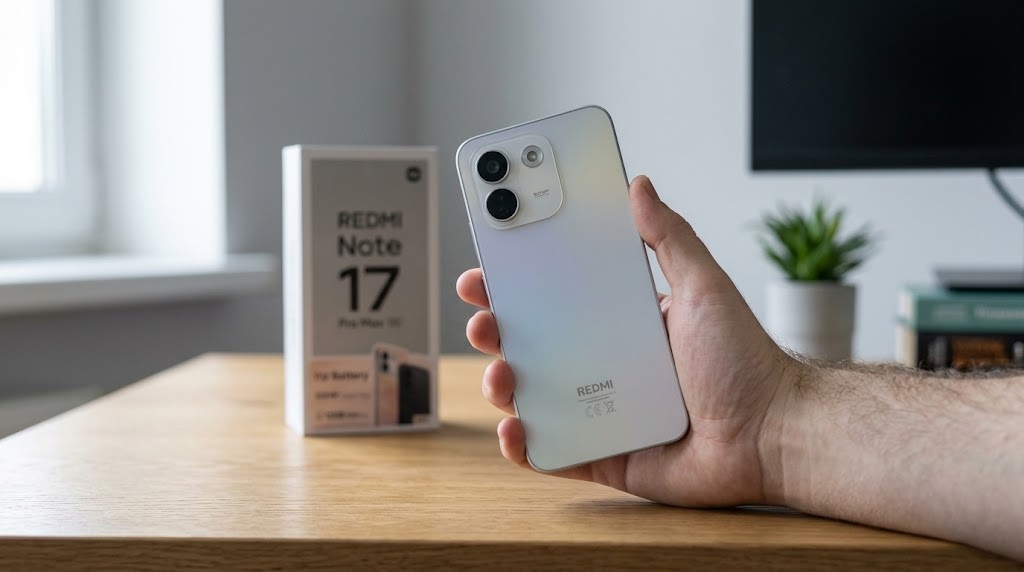
The REDMI Note 17 Pro Max in hand
What you need to know
- The phone carries a 10,000 mAh silicon-carbon battery, 100 W HyperCharge wired charging with a charger in the box, and 27 W reverse wired charging.
- Despite the capacity, the body is 8.65 mm thick and weighs 229.5 g.
- The 8/128 GB variant uses slower UFS 2.2 storage; the 256 GB and 512 GB variants use UFS 4.1.
- Trade-offs include a mid-range Snapdragon 6 Gen 5 processor and a 50 MP + 8 MP camera pair with no telephoto lens.
Available configurations and the storage caveat
The source lists four memory configurations for the global version: 8/128 GB, 8/256 GB, 8/512 GB and 12/256 GB. The notable detail is storage speed. The 8/128 GB model is equipped with UFS 2.2, which the source describes as noticeably slower, while versions with 256 GB and above use UFS 4.1 and handle large files considerably faster. The source author therefore recommends starting at 8/256 GB.
The global model supports Google services and, according to the source, comes with an official warranty. Its 5G band list is n1/n3/n7/n8/n20/n28/n77/n78; band n79 is not supported. Buyers should check these bands against their own carrier before purchasing, since 5G compatibility varies by country.
What 10,000 mAh means in practice
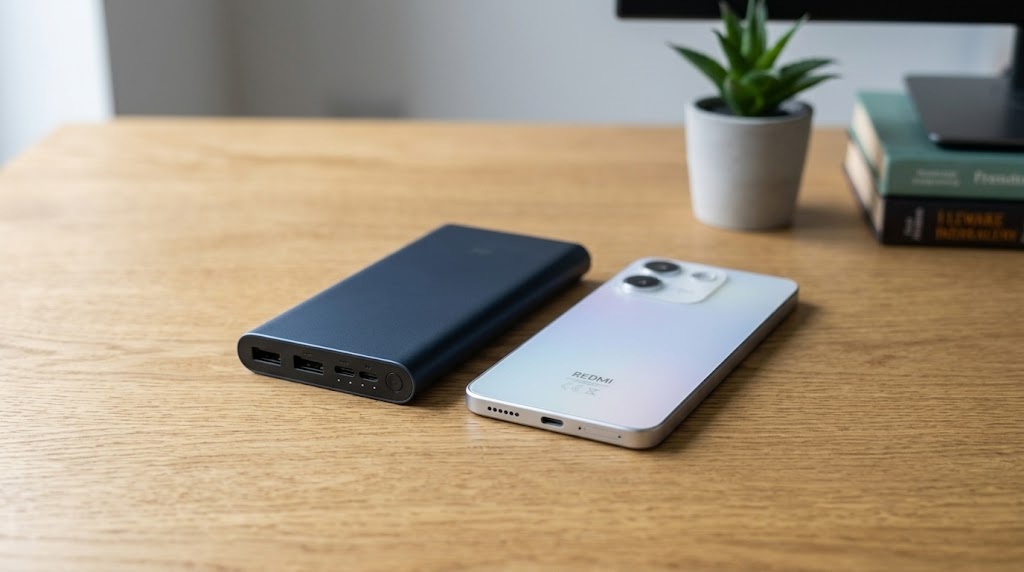
The REDMI Note 17 Pro Max beside a 10,000 mAh power bank
Record-setting phone batteries usually force one of two compromises: a thick body or slow charging. The source argues the REDMI Note 17 Pro Max tries to sidestep both:
- Thickness and weight. The phone measures 8.65 mm thick — slightly more than most flagships, but reasonable for this capacity. It weighs 229.5 g, which is heavy, but understandable given the cell size.
- Charging. 100 W HyperCharge with the power adapter included in the box. With a battery this large, slow charging would be a real problem. The phone also supports 27 W reverse wired charging, so it can top up earbuds or a second phone.
The source also points out that silicon-carbon chemistry matters beyond raw capacity: such batteries are said to degrade more slowly, which is relevant if the phone is meant to last three to four years. The source presents this as a general characteristic of the technology rather than a result of its own testing.
The source author estimates roughly three days of use between charges under moderate use and about two days under heavy use. These figures are the author’s estimates, not measured results, and real-world endurance will depend on usage, signal conditions and display settings.
Display, durability and connectivity
The display is a 6.83-inch AMOLED with 1.5K resolution, 120 Hz refresh rate, a claimed peak brightness of 3,500 nits, Gorilla Glass Victus 2, HDR10+, Dolby Vision and DC dimming. The source describes it as a bright, high-resolution panel with flagship-grade protective glass for the phone’s price class.
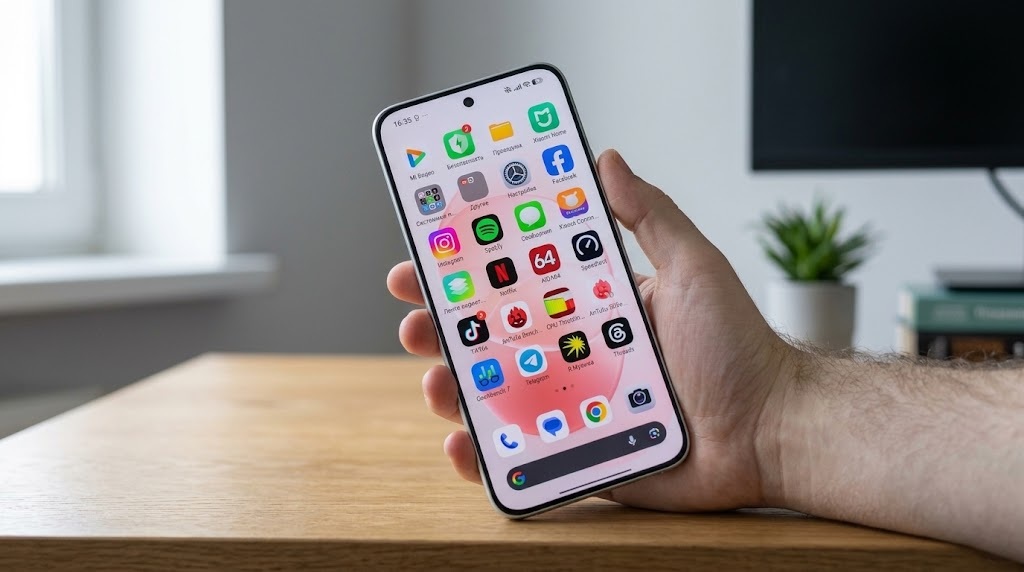
The large display of the REDMI Note 17 Pro Max

Dust and water resistance is rated IP66/68/69/69K, which the source calls unusually generous for a phone in this price bracket. Connectivity includes NFC, eSIM and 5G on the bands listed above.
The compromises: processor and cameras
The processor is the Snapdragon 6 Gen 5, which the source characterises as a middling chip suited to everyday tasks, undemanding games and media, but not to heavy 3D games at high settings.
The camera system consists of a 50 MP main sensor with optical image stabilisation (OIS) and an 8 MP ultrawide. There is no telephoto lens. OIS helps with night shots and video, but the source notes that a two-module setup without zoom looks modest for 2026, and the 8 MP ultrawide is basic.
REDMI Note 17 Pro Max vs POCO X8 Pro
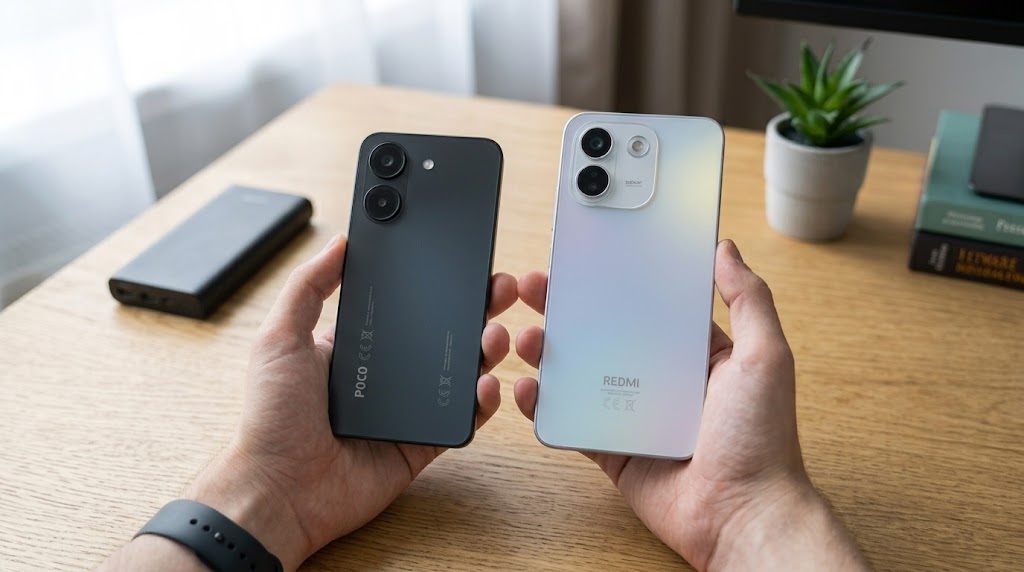
POCO X8 Pro and REDMI Note 17 Pro Max
The source compares the phone with the POCO X8 Pro, which it says sits at a similar price point (around 30,000 rubles in its market). Both offer 5G and good displays, but they are built for different priorities:
- POCO X8 Pro prioritises performance: a Dimensity 8500-Ultra chip with an AnTuTu score the source puts at around 2.1 million, a 3x periscope telephoto camera with OIS, and a 6,500 mAh battery with 100 W charging. For high-settings gaming and zoom photography, the source gives it the edge.
- REDMI Note 17 Pro Max prioritises endurance: the 10,000 mAh battery, IP69K rating, reverse charging and eSIM. Its processor is weaker and its cameras lack a telephoto lens.
The source’s rule of thumb is simple: for the longest possible time away from a charger, choose the REDMI; for gaming and zoom, choose the POCO.
Who the REDMI Note 17 Pro Max is for
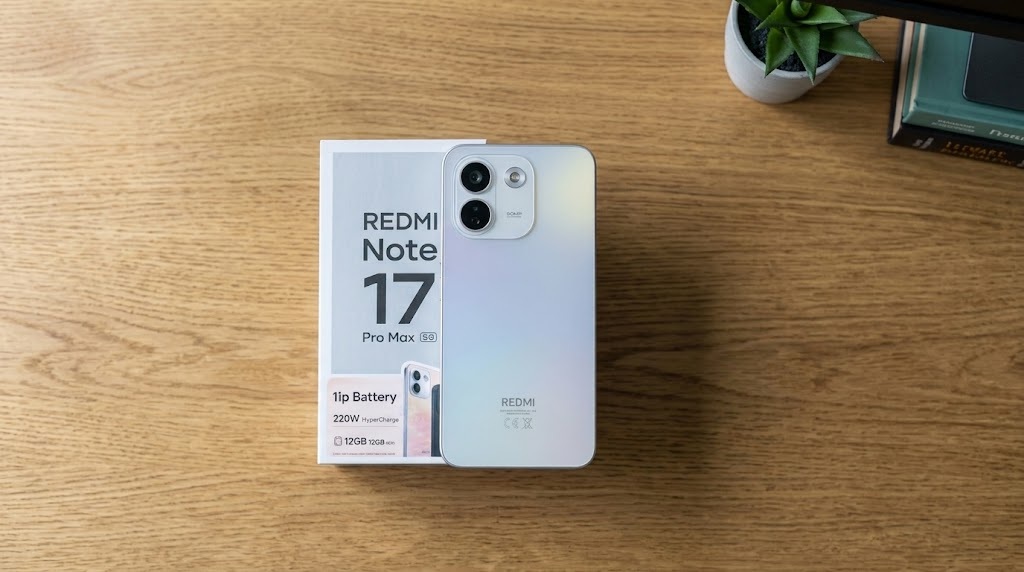
The REDMI Note 17 Pro Max with its box
The source describes the target audience as specific rather than broad, and frames that as honest positioning rather than a weakness.
According to the source, the phone makes sense if:
- battery life is the top priority and a weaker processor is an acceptable trade for multi-day endurance;
- you are frequently away from a power outlet — business trips, hiking, long journeys;
- you want reverse charging for earbuds or a second phone;
- you value the strongest water resistance (IP69K) available in this price class.
It is a poor fit for anyone who wants maximum gaming performance, a capable zoom camera or a compact device — at 229.5 g it is heavy in the literal sense. The source’s conclusion is that a 10,000 mAh battery at this price is a rare combination, but everything else in the phone is subordinate to that battery.