The POCO F9 Pro uses a quietly released variant of Qualcomm’s flagship chip — the Snapdragon 8 Elite Gen 5 V Series — which trims GPU resources to bring the price down while keeping CPU, AI, and modem capabilities identical to the full Snapdragon 8 Elite Gen 5. This makes the F9 Pro a deliberate compromise: the phone delivers near-flagship performance with meaningful savings compared to the POCO F9 Ultra, which carries the unrestricted chip. The trade-off is limited to graphics-intensive scenarios, and the source author reports that in everyday use and most games the difference is not noticeable.
What you need to know
- The Snapdragon 8 Elite Gen 5 V Series uses a two-section Adreno 840 GPU architecture instead of three sections, and 12 MB of dedicated graphics memory instead of 18 MB — all other silicon is identical to the standard chip.
- The POCO F9 Pro features a 6.59-inch display (2510 × 1156), a 200 MP main camera with 50 MP 2.5× optical telephoto, a 6,330 mAh battery with 100 W wired and 50 W wireless charging, IP68 dust/water resistance, and weighs 206 g.
- The F9 Pro lacks the rear subwoofer found on the F9 Ultra, using dual symmetric full-range stereo speakers with Bose tuning instead of a 2.1 system.
- Available in 12/256 GB and 12/512 GB configurations; the V Series chip is the key factor enabling a lower price than the F9 Ultra.
What the Snapdragon 8 Elite Gen 5 V Series changes — and what it doesn’t
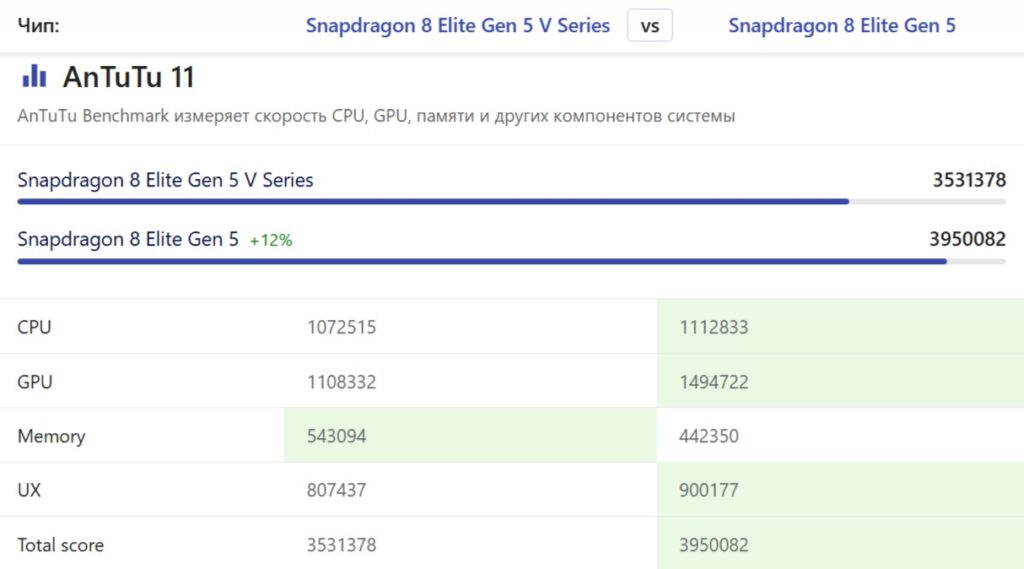
The V Series processor is slightly behind the standard Snapdragon 8 Elite Gen 5 in GPU performance
Qualcomm quietly introduced the Snapdragon 8 Elite Gen 5 V Series in early August 2026, according to the source. On the CPU side, it is identical to the standard chip: the same Qualcomm Oryon cores — two Prime cores at 4.6 GHz and six Performance cores at 3.62 GHz — plus the same Hexagon NPU for AI tasks, the same Sensing Hub, and the same Qualcomm X85 5G modem.
The differences are confined to the Adreno 840 GPU. Two specific changes are noted:
- Architecture: The standard Snapdragon 8 Elite Gen 5 uses a three-section GPU architecture; the V Series uses a two-section design.
- Dedicated graphics memory: The V Series has 12 MB versus 18 MB in the full chip.
Everything else appears identical between the two variants.

How the GPU trim affects gaming
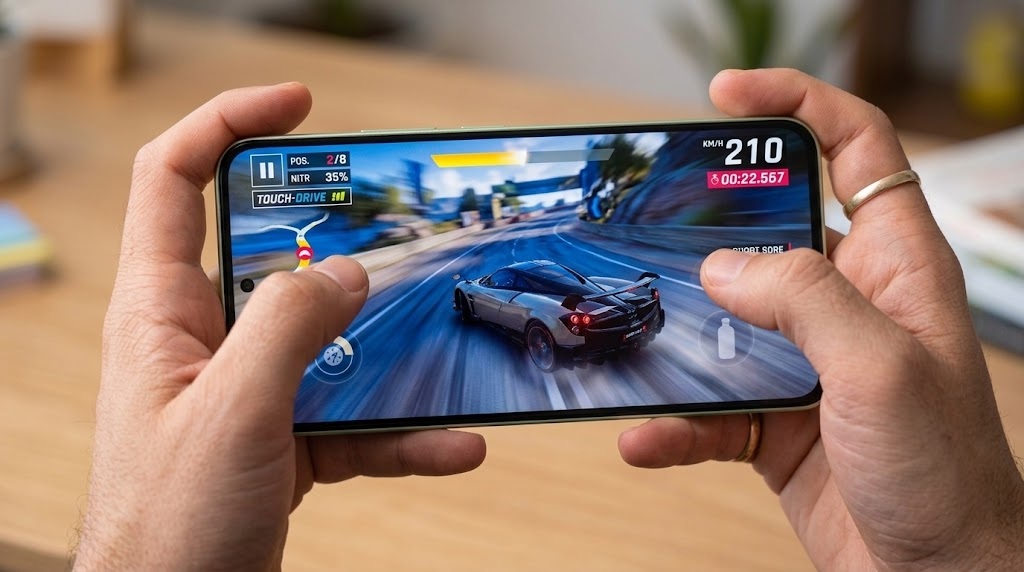
The source author reports the phone handles demanding games at maximum settings
The source author reports that in Asphalt 9: Legends there was no meaningful visible difference between the F9 Pro and the F9 Ultra (which uses the full Snapdragon 8 Elite Gen 5). The game ran smoothly and quickly on both devices.
However, the source cautions that the gap may emerge in extreme scenarios — specifically, prolonged sessions of graphically heavy games at maximum settings. In those cases, the F9 Pro may not sustain performance as well as the F9 Ultra or other phones with the unrestricted chip. For casual and moderately demanding mobile games, the source indicates performance should be indistinguishable.
Bose-tuned audio — without the subwoofer

The source author reports excellent sound quality, even without the subwoofer
The F9 Pro uses two symmetrical full-range stereo speakers with Bose tuning, but omits the dedicated rear subwoofer found on the F9 Ultra’s 2.1 speaker system. The source author reports that the F9 Pro still sounds excellent, with balanced vocals and slightly brighter midrange frequencies. In a direct comparison, however, the F9 Ultra’s subwoofer adds audible depth that the F9 Pro cannot match.
Display, cameras, and battery

The POCO F9 Pro offers flagship-level hardware at a lower price point

The rest of the hardware is firmly flagship-tier according to the source:
- Display: 6.59-inch panel, 2510 × 1156 resolution. The manufacturer claims a peak brightness of 10,000 nits at 1% screen area, but the source notes that the more practically relevant figure is the typical brightness of 850 nits.
- Rear cameras: 200 MP main sensor, 50 MP telephoto with 2.5× optical zoom, and 8 MP ultrawide.
- Front camera: 32 MP selfie shooter.
- Battery: 6,330 mAh with 100 W wired charging and 50 W wireless charging.
- Durability: IP68 dust and water resistance.
- Dimensions: 8.8 mm thick, 206 g — the same thickness as the F9 Ultra but 29 g lighter.
- Storage configurations: 12/256 GB and 12/512 GB.
POCO F9 Pro vs. F9 Ultra: choosing between them
The POCO F9 Pro is a deliberate trade-off that cuts costs in areas most users will not notice. The V Series chip keeps CPU, AI, and connectivity performance intact while trimming GPU resources that only matter during sustained, maximum-settings gaming sessions.
The source suggests the F9 Pro is better suited for users who:
- Want flagship-level performance without paying the Ultra premium
- Prefer a lighter, more compact handset (6.59-inch screen, 206 g)
- Prioritize a high-resolution camera system, large battery, and fast charging
The F9 Ultra may be the better choice for:
- Heavy gamers who play graphically demanding titles at maximum settings for extended periods
- Users who value speaker quality highly — the 2.1 system with a dedicated subwoofer provides noticeably deeper sound
Pricing and availability will vary by market. The key takeaway is that the Snapdragon 8 Elite Gen 5 V Series is a real, distinct chip variant — not just a marketing rebrand — and understanding its GPU limitations helps buyers make an informed choice between the two POCO models.