On paper, the OnePlus 16 looks like an easy upgrade over the OnePlus 15. It has a newer processor, a bigger battery and more megapixels. A point-by-point comparison by the source author, drawing on spec data and independent benchmark results, finds that the meaningful gains come down to two things: a 9,000 mAh battery and a main camera with a larger sensor. In several other areas the difference is small. In a few, including weight, thickness and wired charging speed, the older OnePlus 15 comes out ahead. The OnePlus 16 is also currently sold only as a China-market model, which matters for buyers elsewhere.
What you need to know
- The OnePlus 16 has a 9,000 mAh battery, compared with 7,300 mAh in the OnePlus 15. However, its wired charging is slower: 100 W instead of 120 W.
- The OnePlus 16 replaces the OnePlus 15’s 50MP 1/1.56-inch main sensor with a 200MP module that uses a larger 1/1.4-inch sensor.
- In AnTuTu 11, the OnePlus 16 averages about 15% higher. Most of the gain comes from memory (+61%) and graphics (+15%), while the CPU score rises only 5%.
- For now, the OnePlus 16 has launched only in China, while the OnePlus 15 is available in a global version.
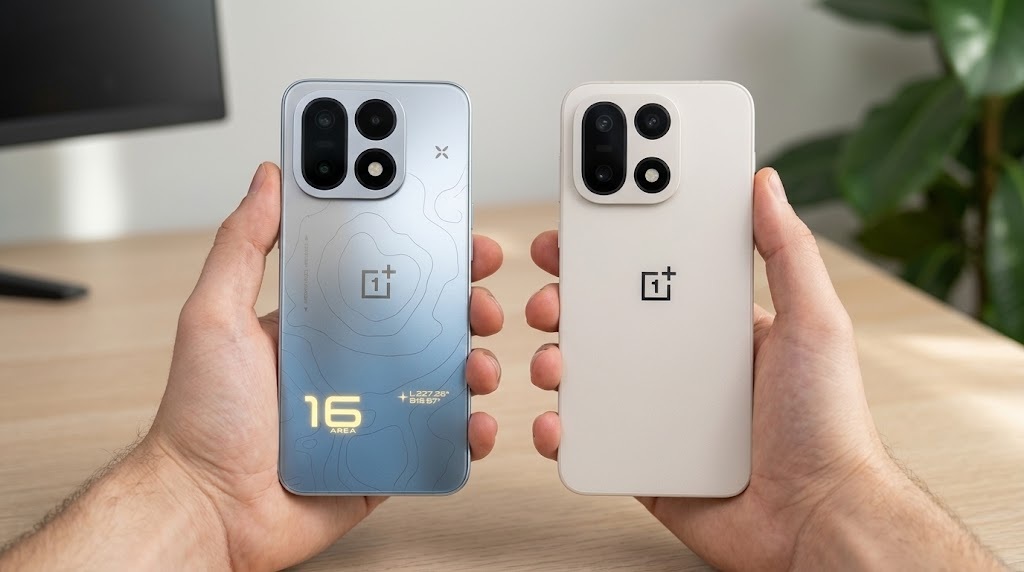
OnePlus 16 (left) and OnePlus 15 (right)
The price gap has narrowed
As recently as early October, the OnePlus 16 was priced in China at about one and a half times the cost of the OnePlus 15, according to the source. Since then, the picture has changed. In the import listings the source author tracked, the newer phone carried only a modest premium over the global OnePlus 15. Prices varied noticeably between sellers, and import duties could add to the cost.
The versions also differ. The OnePlus 15 being sold is the global model. The OnePlus 16 listings are for the Chinese version, since the phone has not yet been released elsewhere. With the price gap smaller, the source argues, the question is no longer whether the OnePlus 16 is affordable. It is what the extra money actually buys.
Design: heavier, slightly thicker, and able to glow
The two phones are close in size, but the OnePlus 16 is a little larger because of its bigger battery:
- OnePlus 15: 211 g, 8.1 mm thick
- OnePlus 16: 220 g, 8.5 mm thick
The source author notes that the extra nine grams are noticeable in a pocket or when reading for a long time while lying down. Both phones carry the same water and dust protection ratings: IP66, IP68, IP69 and IP69K.
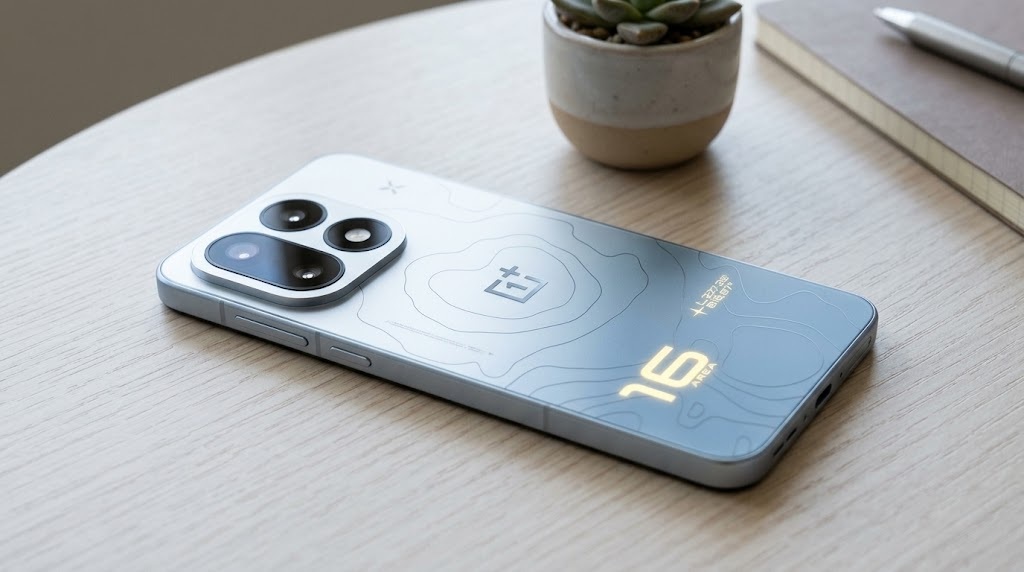
The OnePlus 16’s unique colorway

A backlit rear panel in one color
According to the source, the OnePlus 16 offers a colorway no previous OnePlus phone has had. It is a light finish called Tomorrow’s Starlight, with lighting built into the back panel. LEDs under the glass illuminate three elements in a warm orange: the number “16”, an “X” mark and a set of fictional star coordinates. The light does not change color like RGB lighting. The source describes it as noticeably more restrained than Nothing’s Glyph lighting.
The feature is more than decoration. It is switched on in settings and works as an indicator. It flashes for calls and notifications, shows charging status, and responds to music and to events in some games. It has four modes:
- steady glow
- pulsing
- flickering
- smooth flowing
The other two colors, black and red, have no LEDs. Buyers who want the lighting therefore need to choose Tomorrow’s Starlight.
Processor: faster in benchmarks, with a caveat
The two phones use different chips:
- OnePlus 15: Snapdragon 8 Elite Gen 5
- OnePlus 16: Snapdragon 8 Elite Extreme Gen 6
The newer chip is built on a 2 nm process, and its fastest cores run at up to 5 GHz. According to the source, other 2026 flagships will use the same processor.
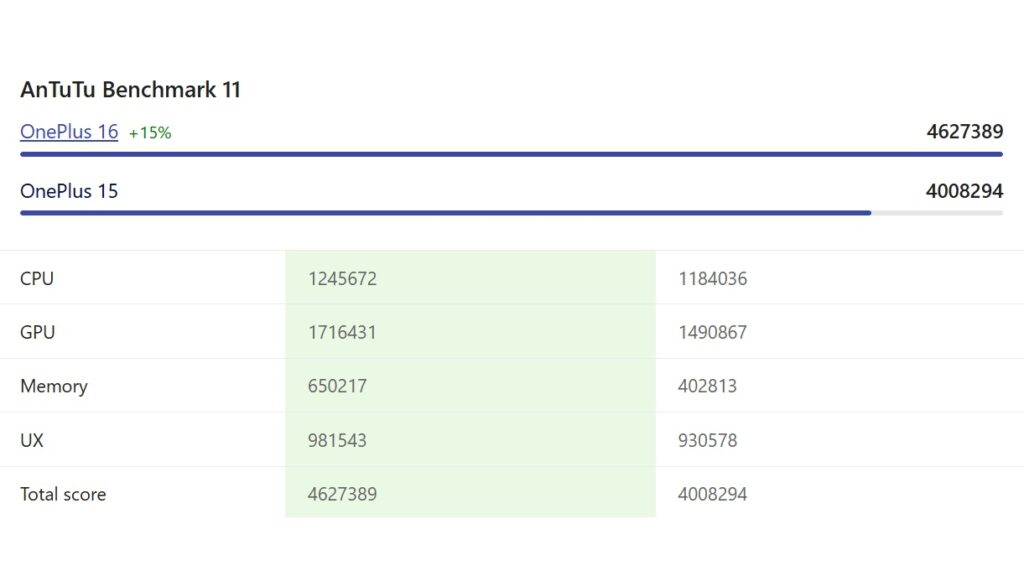
Performance comparison of the OnePlus 16 and OnePlus 15. Source: nanoreview.net
The source stresses that the phones can be compared directly only in the same version of a benchmark. In AnTuTu 11, the OnePlus 16 averages 4,627,389 points, compared with 4,008,294 for the OnePlus 15. That makes the newer phone about 15% faster overall. The gains, however, are very uneven:

| AnTuTu 11 component | OnePlus 16 | OnePlus 15 | Difference |
|---|---|---|---|
| CPU | 1,245,672 | 1,184,036 | +5% |
| GPU | 1,716,431 | 1,490,867 | +15% |
| Memory | 650,217 | 402,813 | +61% |
| UX (interface speed) | 981,543 | 930,578 | +5% |
In other words, the processor itself improved only slightly. Graphics and faster memory account for most of the overall gain. The source concludes that the OnePlus 16 has more headroom for demanding games. In social media apps, web browsing and app switching, however, a 5% difference is barely noticeable.
Battery: the strongest argument for the OnePlus 16
This is where the OnePlus 16 wins without qualification. Its 9,000 mAh battery is almost a quarter larger than the OnePlus 15’s 7,300 mAh cell. Independent battery-life measurements for the new phone are not yet available. Still, with the same screen and similar hardware, the source expects the larger capacity to deliver extra hours of use.
There is a trade-off. Wired charging on the OnePlus 16 is slower, at 100 W compared with 120 W on the OnePlus 15. Combined with the larger battery, that means a full charge will take noticeably longer. In return, the OnePlus 16 adds a bypass charging mode that powers the phone without going through the battery during long gaming sessions.
Camera: sensor size matters more than megapixels
According to the source, reviewers singled out the main camera as the OnePlus 15’s weak point. It uses a 50MP sensor measuring 1/1.56 inches, which is smaller than the sensor in the OnePlus 13. The OnePlus 16 uses a 200MP module with a 1/1.4-inch sensor. A larger sensor gathers more light. That matters most for evening and night photos, where the source says the OnePlus 15 fell behind its rivals.
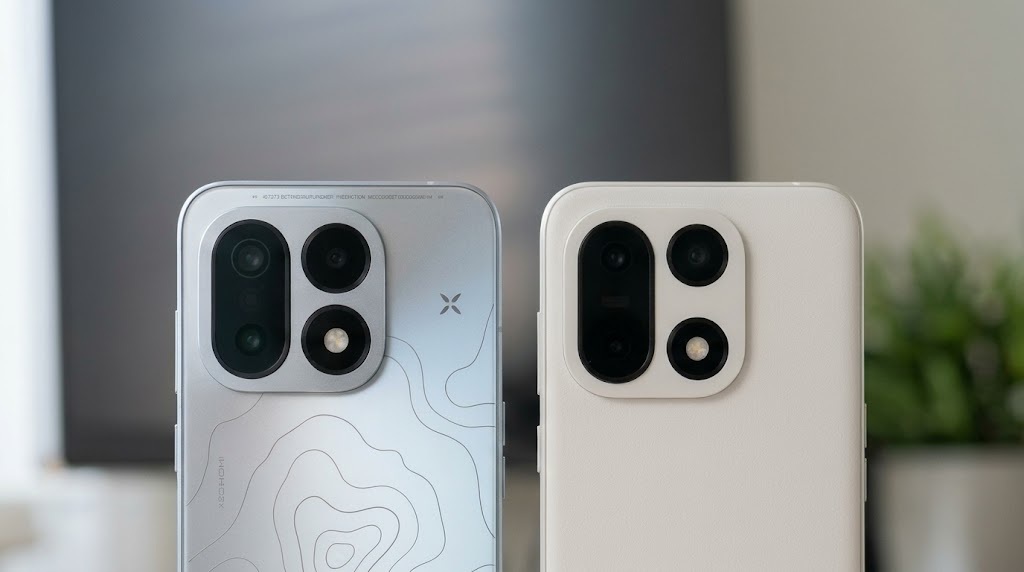
Camera module designs of the OnePlus 16 and OnePlus 15
Telephoto: less zoom, bigger sensor
The telephoto cameras involve a trade-off:

- OnePlus 15: 50MP, 1/2.76-inch sensor, 3.5x zoom
- OnePlus 16: 50MP, 1/1.95-inch sensor, 3x zoom
The OnePlus 16 zooms in slightly less, but its sensor is considerably larger. As a result, the source expects portraits and zoomed shots taken indoors or in the evening to come out cleaner. For distant subjects in good light, the OnePlus 15 offers a little more reach. Both phones have 50MP ultra-wide cameras and 50MP front cameras.
Display: 185 Hz only in games
Both phones have 6.78-inch screens with a resolution of 2772 × 1272. Across the system and in apps, both run at 165 Hz. The only difference is in gaming: in supported games, the OnePlus 16 can raise the refresh rate to 185 Hz.
According to the source, only players of high-frame-rate shooters will notice the difference, and only in games that support the mode. For social media, video and browsing, the screens are effectively the same. The source adds that the OnePlus 15’s display was already regarded as one of the best available.
Verdict: two reasons to pay more
Taken together, the source concludes that the real difference between the OnePlus 15 and OnePlus 16 comes down to two things: the 9,000 mAh battery and the larger main camera sensor. The OnePlus 16 is 15% faster in AnTuTu, but mostly because of graphics and memory, so everyday performance is close. The display differs only in games. The older model is better on charging speed, weight and thickness.
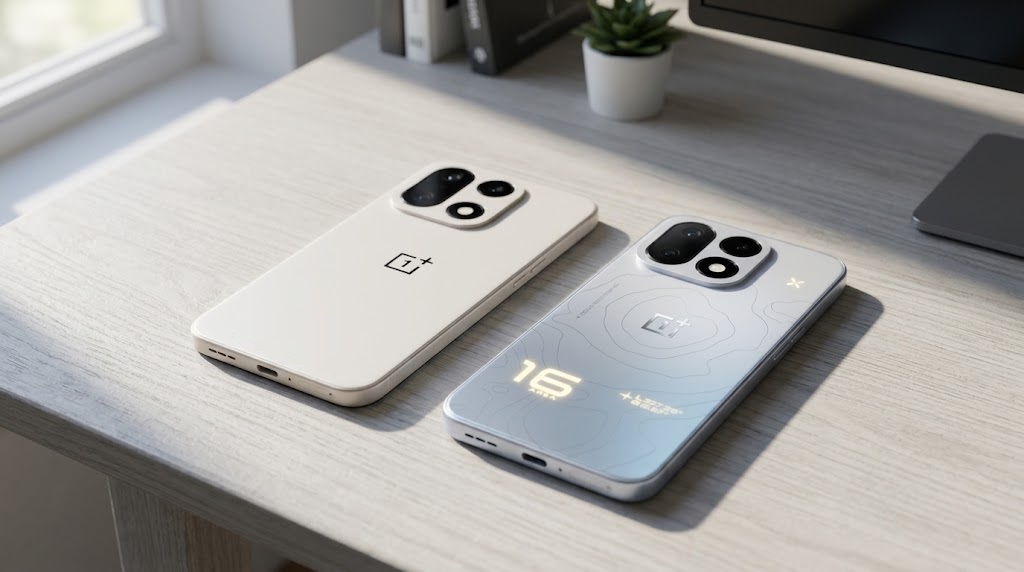
The OnePlus 15 and OnePlus 16 on a table
The source author’s recommendations are:
- Choose the China-market OnePlus 16 if you shoot a lot in the evening and want the maximum battery capacity, and if you live in a city and use a standard physical SIM card.
- Choose the global OnePlus 15 if you need eSIM, reliable connectivity outside cities, and global firmware without surprises. In the author’s view, it offers nearly the same experience for less money.
- Wait for the global OnePlus 16 if you are not in a hurry. Based on testing of the phone in India, the source believes a global release is being prepared. The source does not cite any official confirmation.