Apple’s foldable iPhone Duo, which tops out at $3,200, lists a main camera whose published specifications match the entry-level iPhone 17e rather than the standard iPhone 17 or the Pro models. According to MacRumors, Apple’s own spec pages describe both phones with the same 48-megapixel Fusion module, a 26 mm focal length, an f/1.6 aperture and identical autofocus wording. The Duo does gain sensor-shift stabilization and far stronger video capabilities, and Apple has not disclosed the sensor’s physical size, so whether the two phones share the same sensor remains unconfirmed.
What you need to know
- Apple lists the same main-camera figures for iPhone Duo and iPhone 17e: 48 MP Fusion, 26 mm, f/1.6, and “Hybrid Focus Pixels” autofocus, versus “100% Focus Pixels” on iPhone 17 and iPhone 18 Pro.
- The Duo has sensor-shift OIS, which the 17e lacks, and records 4K Dolby Vision video at up to 120 fps with dual-camera capture.
- Apple has not published the Duo’s sensor size or pixel density; Notebookcheck’s photo comparison suggests the Duo’s camera block is noticeably larger than the 17e’s.
- The top iPhone Duo configuration costs $3,200, while its A20 Pro chip, 12 GB of RAM, vapor chamber and Apple C2 modem are flagship-grade.
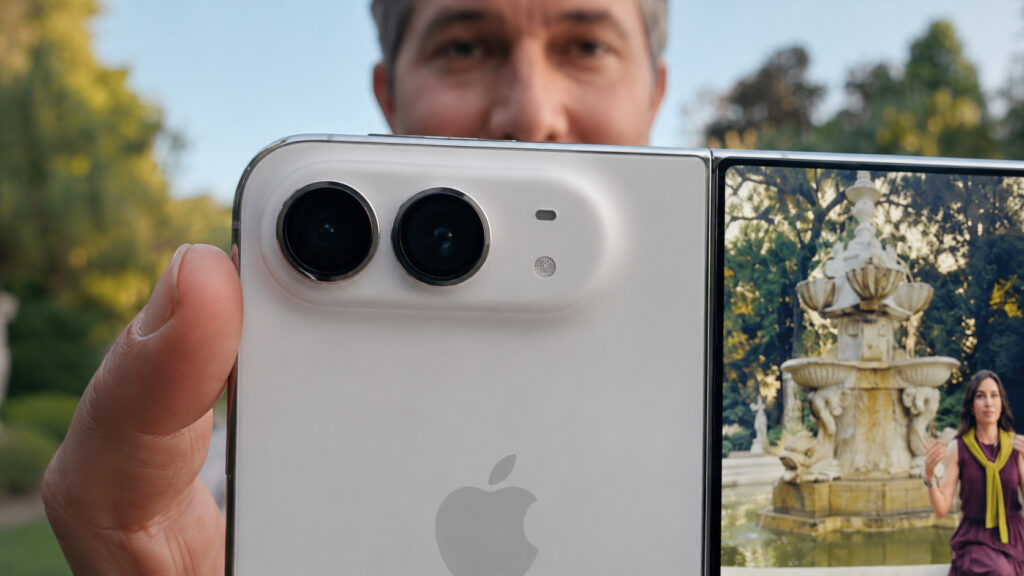
Close-up of the iPhone Duo camera
What the spec sheets show
The comparison rests on Apple’s published specifications. For the Duo’s main camera, Apple lists a 48-megapixel Fusion module with a 26 mm equivalent focal length and an f/1.6 aperture. Those are exactly the figures Apple gives for the iPhone 17e, right down to the autofocus terminology.
That wording matters because Apple describes autofocus differently across the lineup. The iPhone 17 and iPhone 18 Pro are listed with “100% Focus Pixels.” The Duo and the 17e are listed with the simpler “Hybrid Focus Pixels.” On paper, then, Apple’s most expensive iPhone carries the same autofocus designation as its cheapest current model.
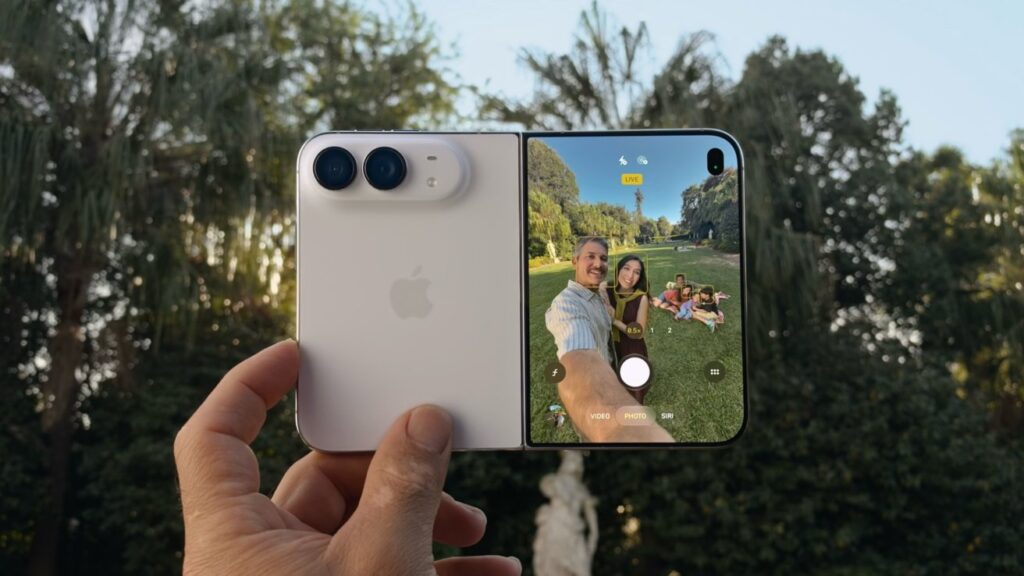
Using the iPhone Duo’s main camera as a front-facing camera
The rest of the camera system
The Duo also has a second rear camera: a 48-megapixel ultra-wide at 13 mm with an f/2.2 aperture. There is also a 2x digital zoom at 12 megapixels, cropped from the main sensor, which Apple presents as having no loss of quality. There is no dedicated telephoto lens, which is in line with most non-Pro iPhones.
Video is where the foldable clearly pulls away from the budget model. The Duo records 4K Dolby Vision at up to 120 frames per second, supports simultaneous recording from two cameras, and offers Action mode. The standard iPhone 17 has a lower ceiling, and the 17e is not positioned for that kind of video work. The source author’s take is that Apple did invest in the Duo’s camera pipeline, just not in the sensor most buyers care about.
The front cameras differ too: the outer display has a 12-megapixel f/2.2 camera, while the camera hidden beneath the inner folding screen has an f/1.8 aperture but is limited to 1080p.
Sensor-shift stabilization is the key difference
The match with the 17e is not complete, and the exception is significant. The Duo’s spec sheet lists sensor-shift optical image stabilization. The iPhone 17e lists only “optical image stabilization,” without the sensor-shift designation.
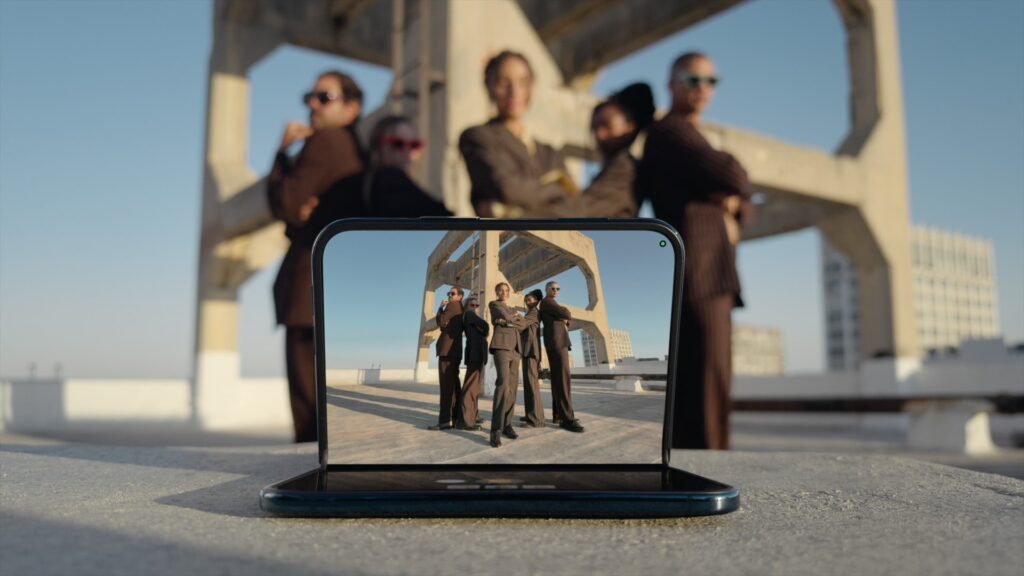
Shooting with the iPhone Duo unfolded
That detail aligns the Duo with the standard iPhone 17, which also has sensor-shift OIS. The result is a hybrid: a sensor and autofocus described like the budget model’s, paired with stabilization like the mainstream model’s. It is still well short of the Pro setup, which offers a variable aperture and second-generation sensor-shift stabilization.
In practical terms, sensor-shift stabilization helps with longer exposures and low light by countering hand shake. It does not compensate for a small sensor or slower optics; those remain physical limits regardless of stabilization.
Is it really the same sensor? The evidence is inconclusive
Here the story becomes less clear-cut. Apple has not published the physical sensor size or pixel density of the Duo’s main camera. Without those figures, there is no hard proof that the Duo uses the very same sensor as the 17e; only that Apple describes them with the same words.
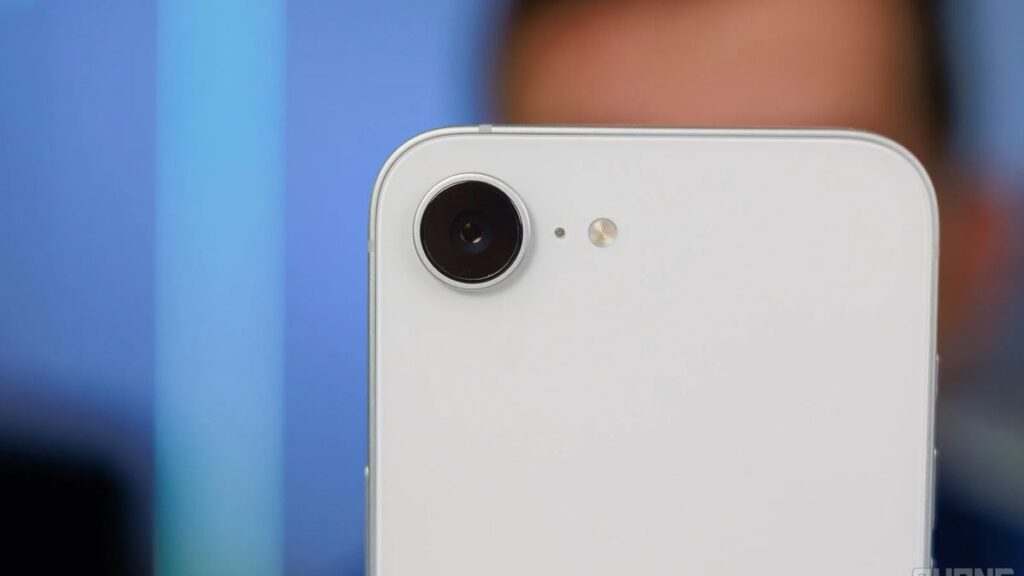
The camera on the iPhone 17e
According to Notebookcheck, overlaying Apple’s official product photos of the Duo onto those of the 17e shows the foldable’s camera module is noticeably larger. In size it appears closer to the standard iPhone 17 and even the 17 Pro than to the 17e’s compact module. A camera block’s size, however, reflects more than the sensor alone: it also houses the focus actuator and the stabilization carriage.
That leaves two possibilities. Either Apple used the 17e’s sensor and surrounded it with more capable mechanics, or the Duo has a different sensor that Apple simply describes with the same specification language. Until Apple publishes concrete figures, the question remains open.
How the camera fits the rest of the package
The top iPhone Duo configuration sells for $3,200. Everything else in the device is flagship-class: the new A20 Pro chip, 12 GB of RAM, a vapor chamber for cooling, and Apple’s own C2 modem. Against that hardware, the source author argues, the entry-level camera description stands out as the one place Apple appears to have economized.
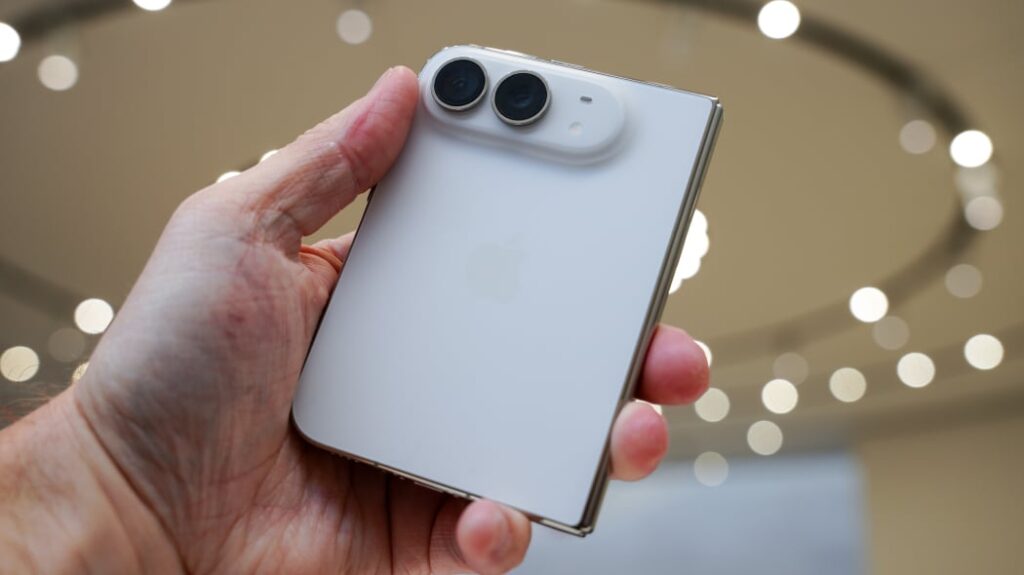
Rear panel of the iPhone Duo
To be fair, Apple is not marketing the Duo as a camera phone. Its central selling point is the flexible display and the foldable form factor, not night shots or zoom range. The company appears to be betting that buyers of a folding iPhone are paying for the experience of the device rather than for imaging specs.
The source author’s conclusion is that for a phone priced like two iPhone 18 Pro units, buyers might reasonably expect a camera that isn’t described in the same terms as the cheapest model. In the author’s view, anyone who prioritizes photography would be better served by an iPhone 18 Pro at a lower price, while the Duo is a purchase driven by the new form factor rather than by camera performance. Note that this is an assessment based on published specifications; no independent image-quality testing is cited.