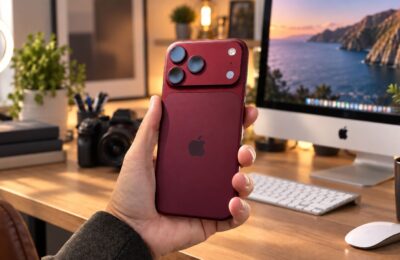
Apple has unveiled its first folding smartphone, the iPhone Duo, and within hours of the presentation dozens of journalists and bloggers had handled it. The question almost everyone asked was the same: can you see the crease on the large inner display, the flaw that has long frustrated owners of folding Android phones? According to the early hands-on reports collected in the source article, the answer is nuanced. Looking straight at the screen, many reviewers say the fold is nearly invisible thanks to a matte nano-texture coating; tilt the phone or catch side lighting, however, and the crease reappears. Apple, the source notes, has not eliminated the crease so much as skilfully disguised it.
What you need to know
- The iPhone Duo has a 7.6-inch inner display and a 5.4-inch outer display, both 120 Hz with roughly 3,000 nits peak brightness; it weighs 254 grams.
- Apple’s product page says the nano-texture surface minimizes the visibility of the crease, but does not claim there is no crease at all.
- US pricing starts at $1,999 for 256 GB and reaches $3,199 for 2 TB; pre-orders open October 16 with sales starting October 23.
- The phone is eSIM-only worldwide, with the space for a SIM tray given over to the battery.
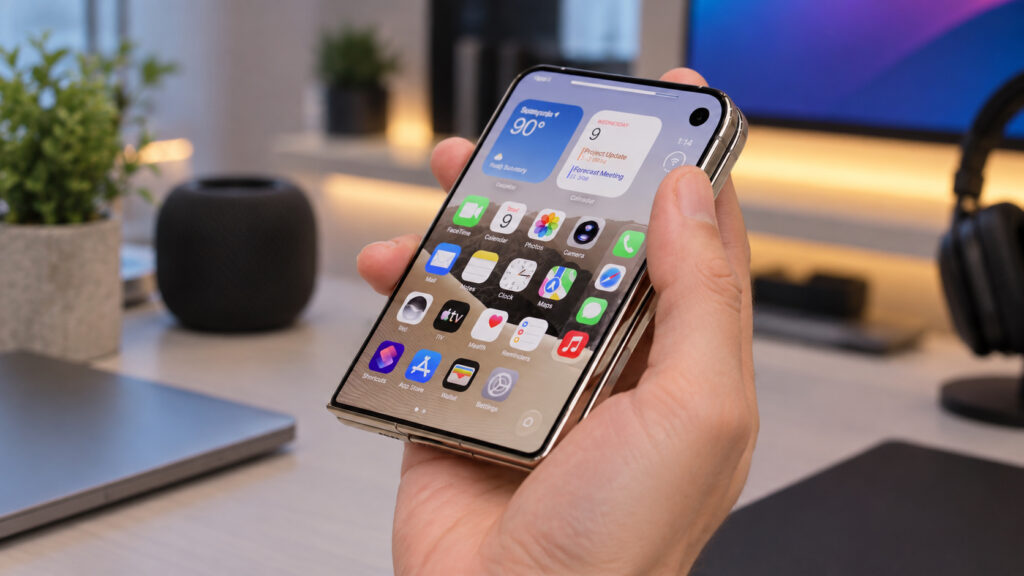
iPhone Duo in its folded state
How the folding iPhone looks in person
The first thing nearly everyone who handled the device mentions, according to the source, is that it looks even more striking in person than in the presentation footage, with the feel of a futuristic, almost engineering-grade object that invites touching.
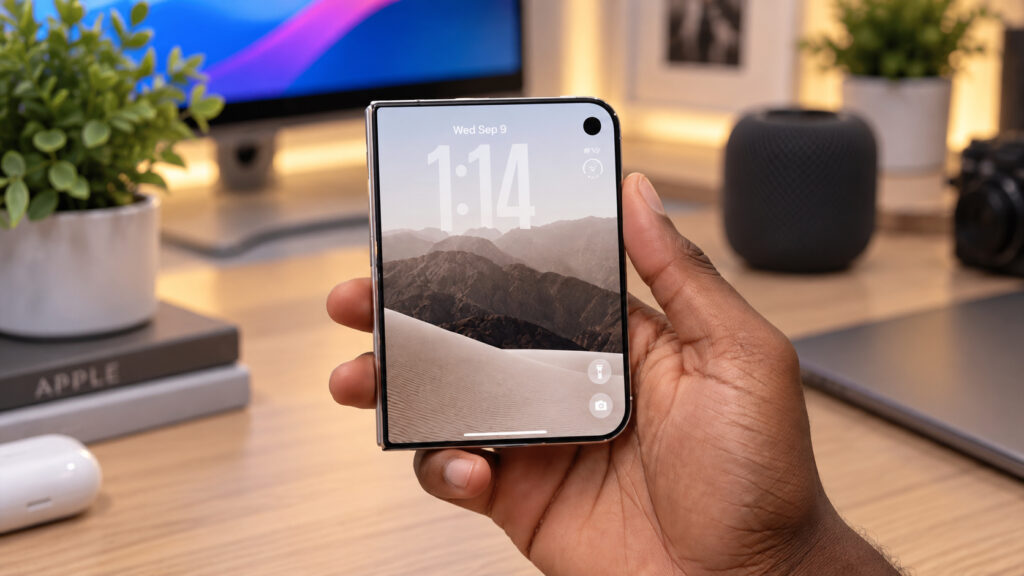
The outer display of the iPhone Duo
The Duo’s inner screen measures 7.6 inches and the outer screen 5.4 inches. Both run at 120 Hz with peak brightness of around 3,000 nits, so outdoor visibility should not be a problem. The inner display is covered with a matte nano-texture coating, which by all accounts does most of the work of hiding the fold. Closed, the phone is about 11 mm thick; open, it becomes a thin slab of roughly 5.2 mm. At 254 grams it is noticeably heavier than a conventional iPhone, and reviewers say that weight is felt in the hand.
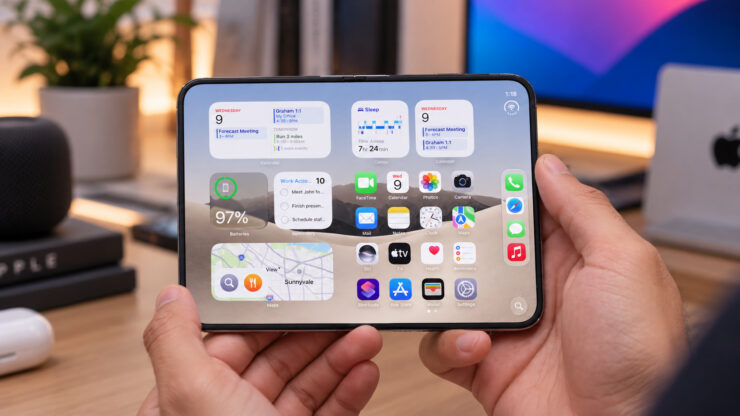
The inner display of the iPhone Duo
The hinge draws particular praise. It is assembled from more than a hundred parts, holds any opening angle and feels tight, with no play. Not everyone could open and close the Duo with one hand, but with two hands it is easy and gives a satisfying mechanical response. The biggest enthusiasm, though, is reserved for a software detail rather than hardware: when the phone is unfolded, the image flows smoothly from the outer screen to the inner one through a soft blur. The source says this animation has racked up millions of views on social media, and that even Android users concede such details are what set Apple products apart.
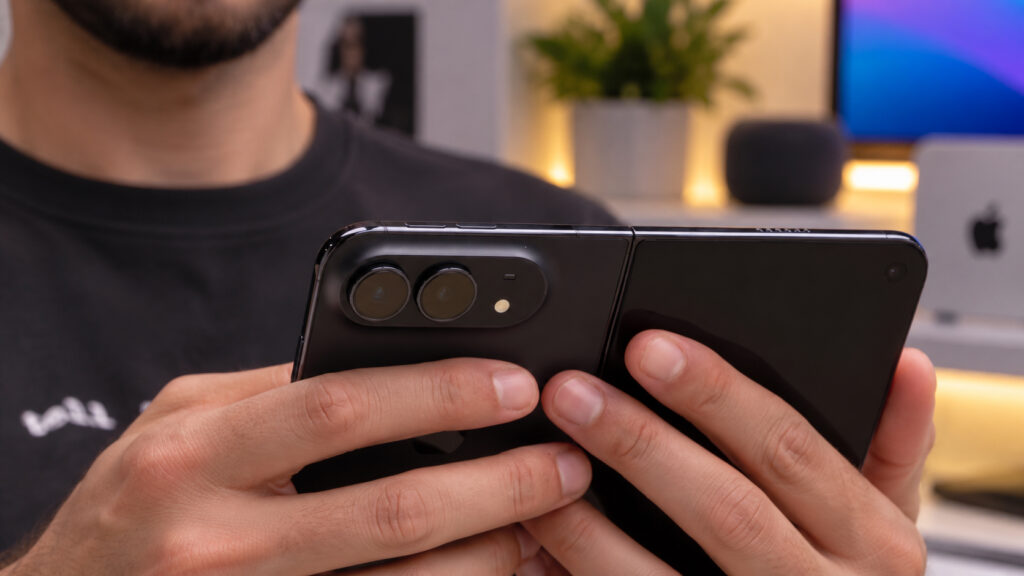
An unfolded iPhone Duo held in the hands
So what about the crease?
This is the most telling part of the story. In its marketing language, Apple carefully sidestepped the direct question. The device’s product page speaks of a perfectly smooth nano-texture surface that minimizes the visibility of the crease, but nowhere does it claim the crease is absent altogether. The source calls this honest, since no one has yet found a way around the physics of a folding panel.
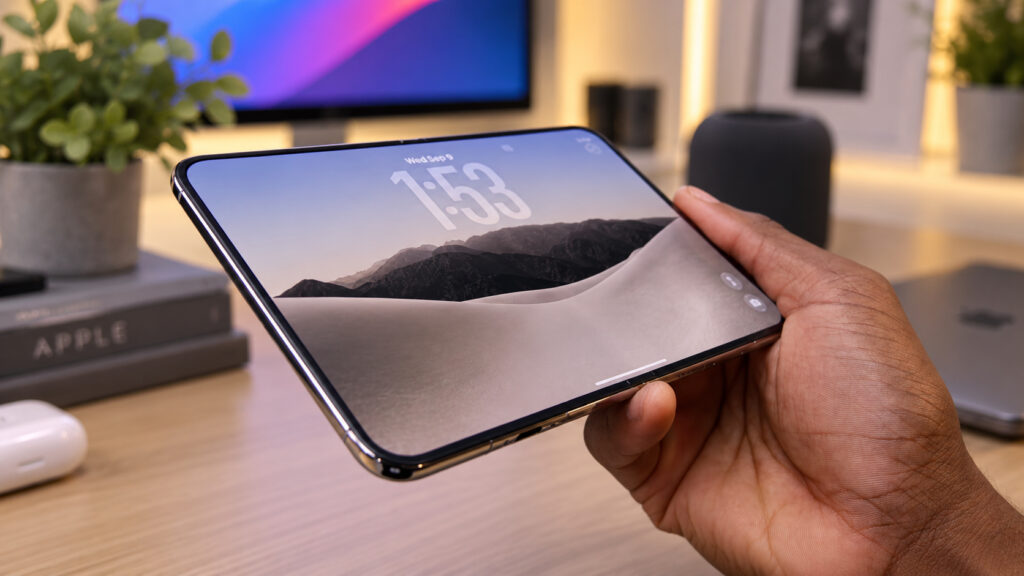
The barely visible crease on the iPhone Duo screen
In practice, reviewers’ impressions split. Some are delighted and say that when looking straight at the screen the fold is essentially impossible to make out: you can feel it with a finger but not see it with your eyes. The matte coating scatters light and hides the groove that is so conspicuous on glossy foldables. Others caution that tilting the device to a certain angle or catching side lighting brings the crease back into view. In other words, Apple has not removed it but has disguised it well.
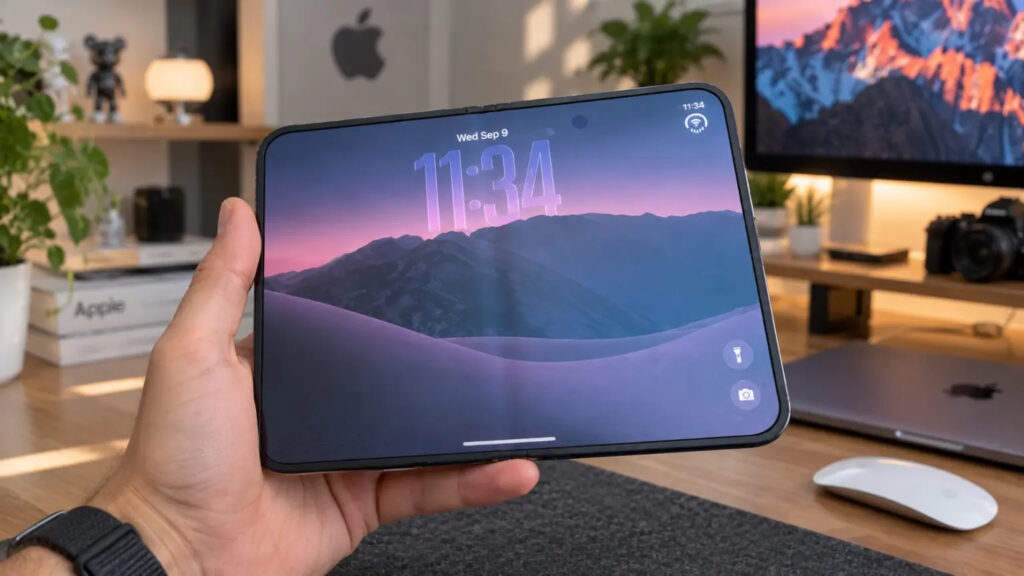
The angle and lighting at which the iPhone Duo crease becomes visible
Compared with rivals, the Duo appears to hold a small advantage over current Samsung and other Android foldables. Beneath the display sit a titanium plate and a couple of layers of flexible glass that reduce stress at the fold. There is a sobering caveat, however: on new Android foldables the crease is also nearly invisible in the first days, becoming more pronounced after a couple of weeks of daily use. The real test for the Duo, the source argues, will come not on a demo table but after a month or two in the pockets of actual owners.
Marques Brownlee’s assessment
The source gives separate attention to a video by Marques Brownlee, one of the world’s best-known tech reviewers. His overall verdict is described as warm: the folding iPhone comes across as a genuinely lively, fun device of the kind you want to keep turning over in your hands. In his view, the Duo beats Samsung’s foldables on build quality, finish and animations, and the crease really is almost unnoticeable. The price also surprised him: despite the daunting $1,999 figure, he said the phone came in cheaper than he expected. Unfolded, the inner display feels comparable to a small tablet, like holding an iPad mini.
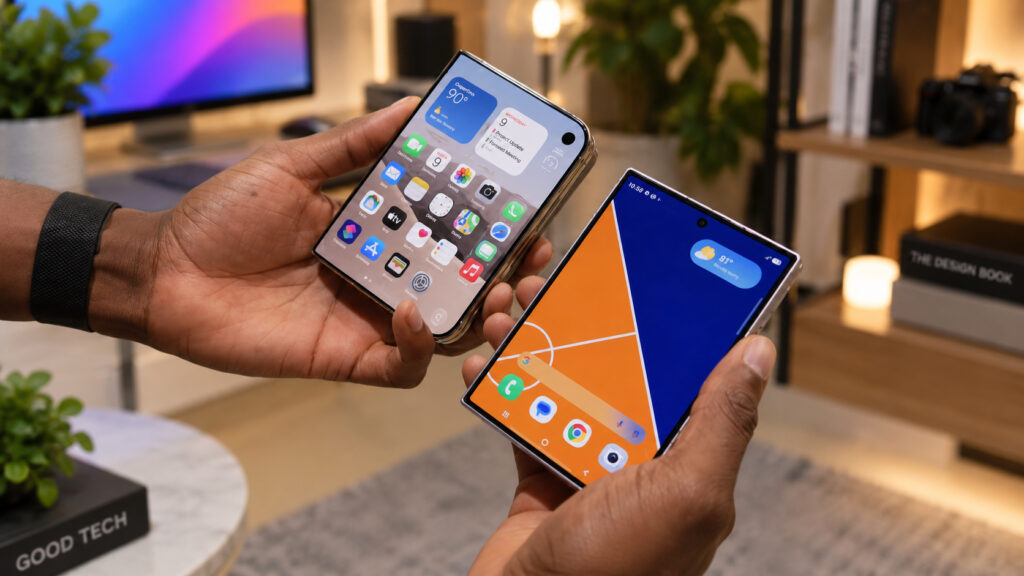
The iPhone Duo next to the Samsung Galaxy Z Fold 8
He did have criticisms, and the source considers them fair. The most noticeable is purely visual: the outer screen is rounded on one side but cut off by a straight edge on the other. It does not affect functionality, but the asymmetry will bother some people. On usability, the folding iPhone is noticeably less friendly to left-handed users, the dock holds only four icons, and the under-display front camera takes frankly mediocre photos. His closing thought: the device is not perfect, but its strengths far outweigh its flaws, making it a strong option for people who have long eyed folding phones but did not want to leave the iPhone.
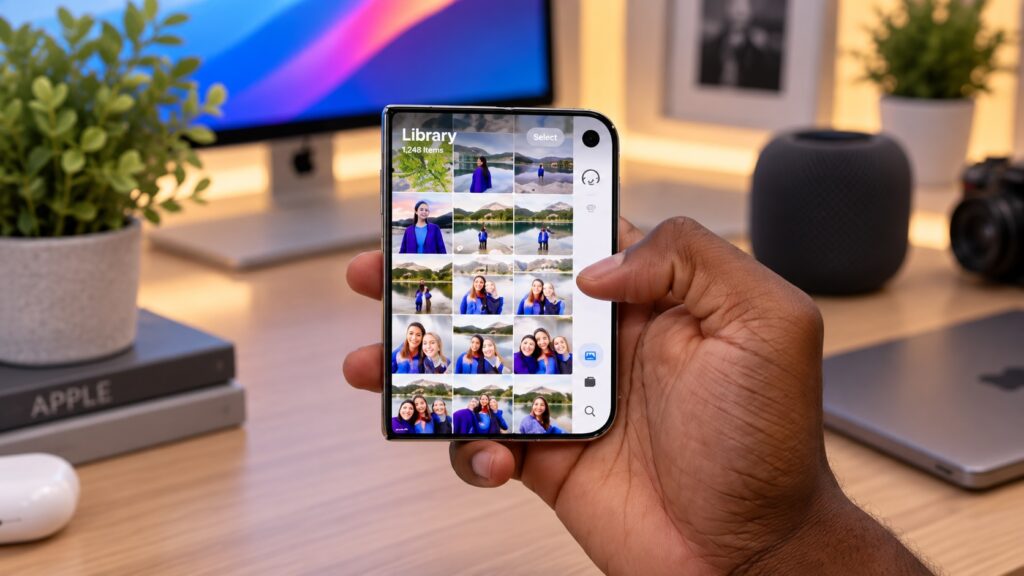
The corners are rounded on one side and straight on the other
What ordinary users are saying
Reactions from everyday users on social media, as summarized by the source, fit the same pattern. Opinion is split roughly down the middle over one old question: does anyone actually need a phone that folds? Supporters are enthusiastic that a foldable finally has coherent use cases rather than just a slightly larger screen for video, and many like the CarPlay-style dock that appears on the folded device. Skeptics dismiss the format as useless. The source suggests the truth lies somewhere in between and will only emerge through real-world use.
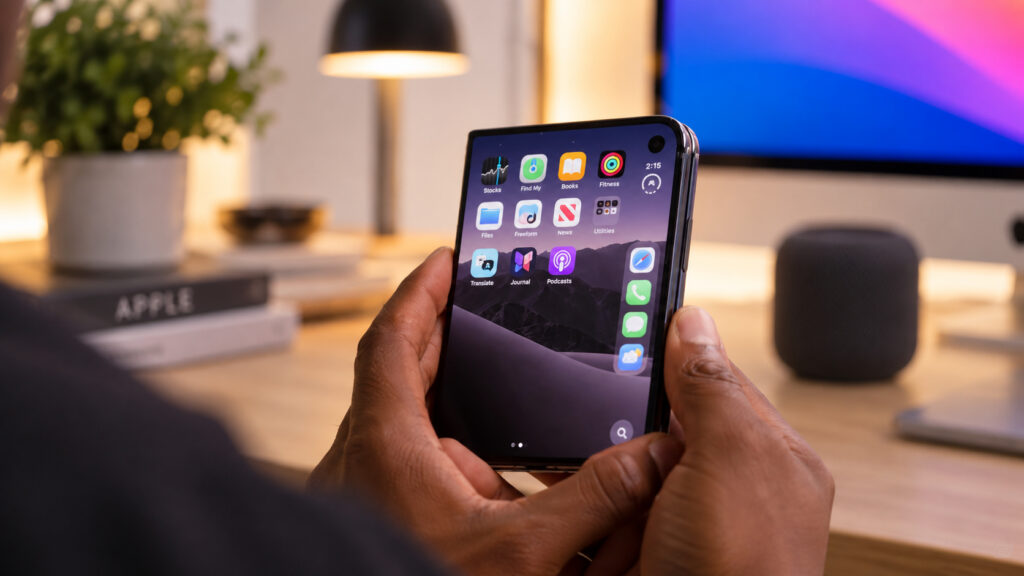
The dock sits on the right rather than at the bottom
Price, release dates and the eSIM-only design
In the United States, the iPhone Duo starts at $1,999 for the 256 GB version, rising to $3,199 for the top configuration with 2 TB of storage. Pre-orders open on October 16, with official sales beginning on October 23.
One detail matters for buyers everywhere: the Duo is eSIM-only worldwide, with no physical SIM tray. According to the source, the space that would have held a tray was given over to the battery, and battery life is described as respectable for this class of device.
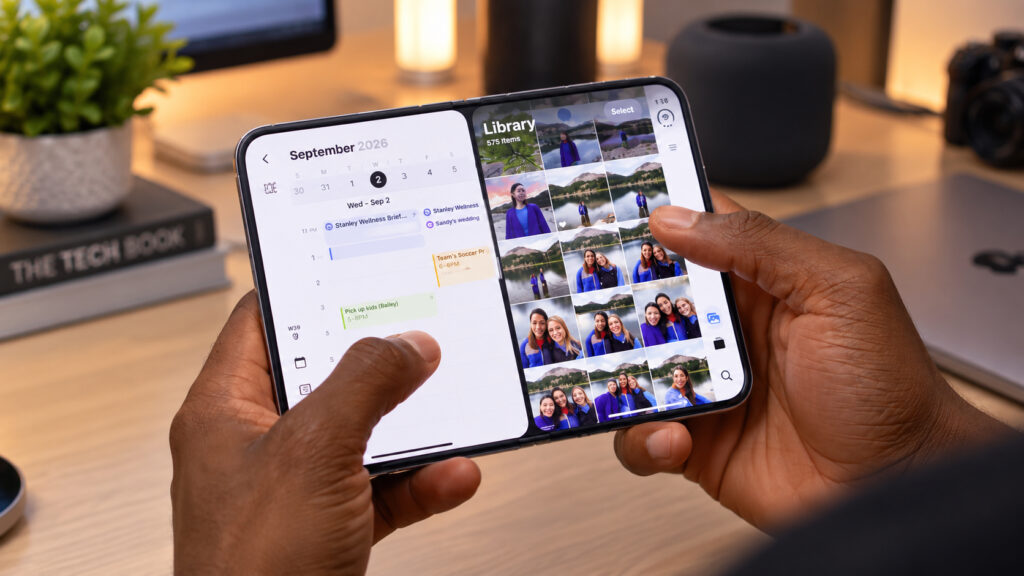
Two apps on one screen of the iPhone Duo
The source’s conclusion is that the iPhone Duo is not flawless, but it is the most interesting iPhone in years. Whether the crease stays hidden and the hinge holds up will only be known once the first owners have lived with it for a while.