Toilet stains look disgusting, but you can get rid of them
If you buy a special toilet gel for 500 rubles thinking it works effectively, you’ve been duped. Yellow stains on plumbing fixtures can be removed with products that cost ten times less and are sold in any grocery store. No, it’s not Coca-Cola, although it works too if you don’t mind spending the money. You simply never knew why this buildup appears in the first place. Once you understand the nature of it, you’ll immediately figure out how to wash it off.
Where Does Yellow Toilet Stain Come From
Under the general name “yellow stain” there are actually several different types of contamination. They differ in composition, color, and causes, but they often layer on top of each other, creating one unpleasant picture.
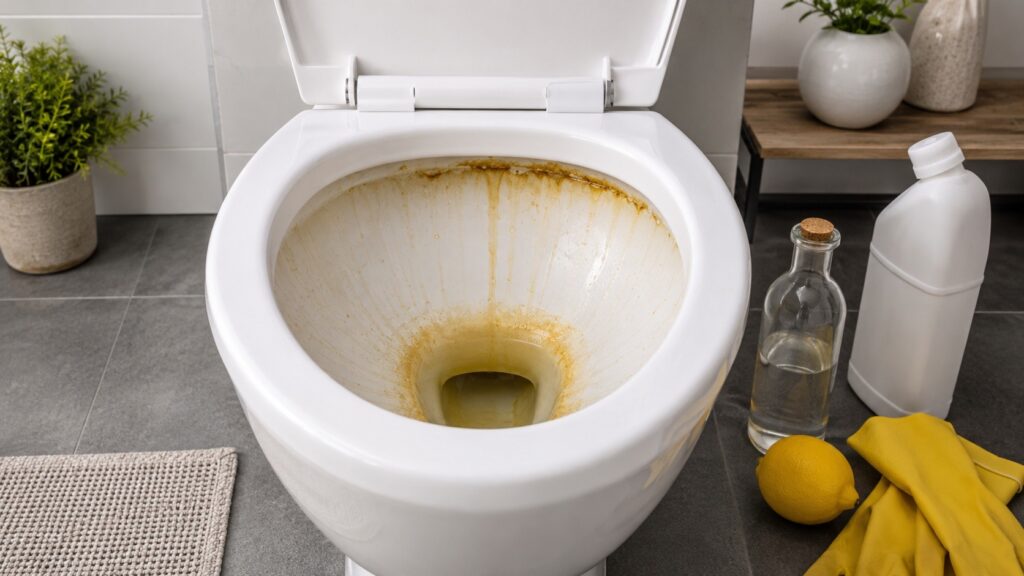
The first culprit is rust. These are orange or brown streaks that run from the tank’s drain hole down the bowl wall. The cause is high iron content in tap water. If the building has old metal pipes, micro-particles of corrosion get into the water and settle on the ceramic. Fresh rust is easy to remove, but old rust embeds itself firmly into the surface.
The second culprit is limescale. It looks like whitish or grayish rough deposits in areas of constant contact with water. The main cause is hard water with high calcium and magnesium salt content. Over time, the buildup grows in layers and becomes hard as stone. And no, kettle scale and limescale are not the same thing, although we sometimes use them interchangeably.
The third culprit is urine scale. This is what most often produces that unpleasant yellow-brown tint with a characteristic smell. It forms when mineral salts from water interact with urea. It usually appears under the rim and in the lower part of the bowl — areas that are hard to reach during cleaning.
All three types can be present simultaneously, and it’s their combination that creates the stubborn stain that regular soap can’t handle.
How Urine Scale Differs from Limescale
These two types of deposits are often confused, yet they require slightly different approaches. Limescale consists of calcium and magnesium salts from hard water. It forms wherever water contacts a surface and looks rather whitish or gray. Urine scale is a mixture of mineral salts and organic residues of human urine. That’s why it has a characteristic yellow-brown color and unpleasant odor.
Urine scale also has a porous structure and builds up faster with each passing day, since new deposits cling to the uneven surface of old ones. Limescale grows more slowly but over time becomes very dense and hard. Removing it mechanically without damaging the enamel is virtually impossible.
Both types of contamination are removed with acidic products because acid dissolves mineral salts. However, urine scale usually requires a longer exposure time and higher concentration.
Is Yellow Toilet Stain Dangerous
Limescale by itself is just ordinary mineral salts and poses no direct health threat. But urine scale is a different matter. Its porous structure becomes an ideal environment for bacteria and microorganisms to multiply. Combined with the humidity and warmth of the bathroom, urine scale deposits can become a constant source of unpleasant odor and bacterial contamination.
Additionally, neglected deposits damage the protective layer on the ceramic. When it becomes porous, mineral particles penetrate deeper, and dirt starts accumulating even faster. It becomes a vicious cycle — the longer you don’t clean, the harder it will be to clean later.
So it’s not so much about the danger of the stain to your health, but rather that it ruins plumbing fixtures and creates an unsanitary environment. The sooner you tackle the cleaning, the easier and cheaper the result will be.
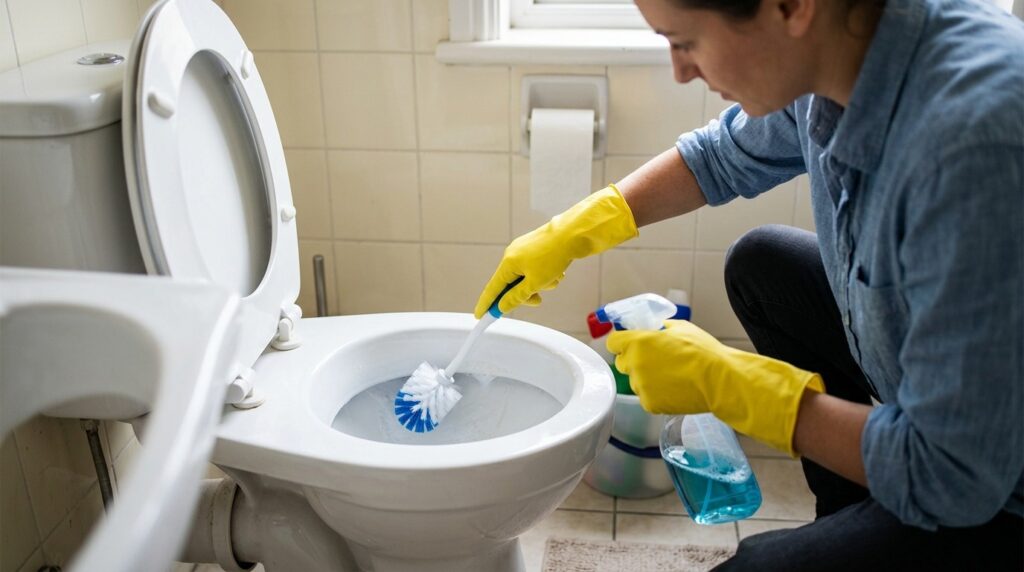
Regular cleaning is the best protection against stubborn deposits
How to Remove Yellow Stains from a Toilet with Home Remedies
Home remedies work well against fresh and moderate stains. Their main advantage is accessibility: everything you need is usually already in your kitchen.
White vinegar (9%) is a universal acidic agent. Generously soak a cloth or paper towels, press them against the stained areas, and leave for 3–4 hours. For zones under the rim, it’s convenient to firmly press vinegar-soaked towels in place. After cleaning, throw them in the trash — flushing them down the toilet will cause a clog. Also, make sure to ventilate the room after cleaning.
Citric acid works similarly but is more convenient to use. For the walls, dissolve 2–3 tablespoons of powder in a glass of warm water and apply with a spray bottle. You can also pour 3–4 tablespoons directly into the bowl water and leave overnight. In the morning, scrub with a toilet brush.
Oxalic acid is a stronger option. Apply it to a damp sponge, wipe the stained areas, leave for 10–15 minutes, and rinse. Be sure to wear gloves, as the acid irritates skin.
As for cola and other sodas containing phosphoric acid — they will help only with very light stains. The acid concentration in the drink is too low for serious buildup.
Which Products Best Dissolve Urine Scale
Urine scale is the most stubborn type of stain, and home remedies don’t always handle it. If vinegar and citric acid didn’t help, move on to professional household chemicals.
When choosing a product, pay attention to the composition:
- Formulas based on hydrochloric acid at 5–10% concentration are the most effective against urine scale;
- Products based on phosphoric or oxalic acid also work well;
- Toilet cleaning gels are more convenient for vertical walls — they don’t run off and stay in contact with the surface longer;
- Alkaline toilet cleaners are designed for grease and organic clogs.
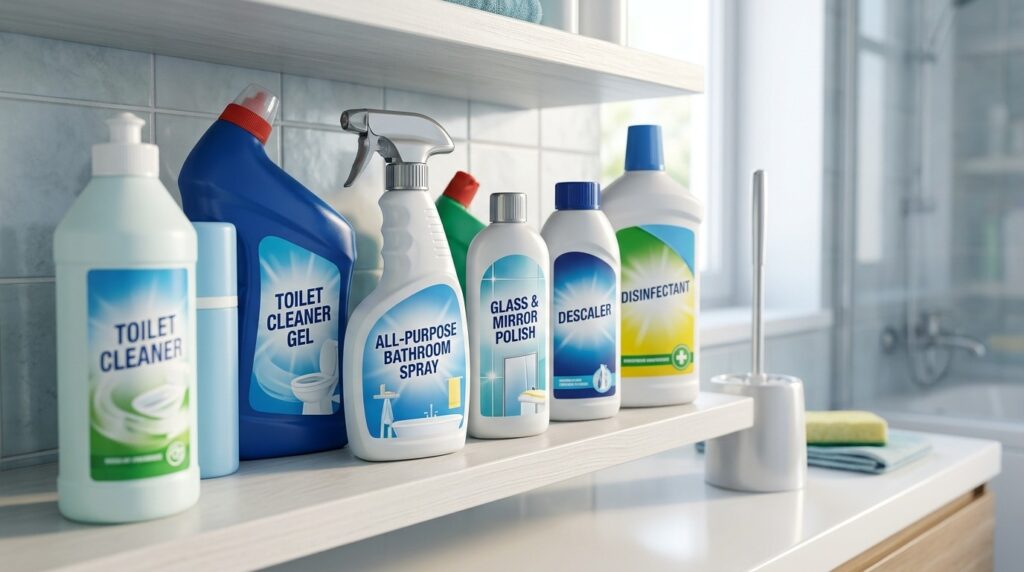
Acid-based toilet cleaning products are the most effective against mineral deposits
The procedure for working with professional chemicals is simple:
- Before applying, remove as much water from the bowl as possible so the product doesn’t get diluted;
- Apply the product to the stained areas, paying special attention to the area under the rim;
- Wait the time indicated on the packaging — usually 15–30 minutes. For urine scale, you can extend to 4–6 hours, but only if the manufacturer allows it;
- Scrub with a toilet brush and flush 1–2 times.
Important safety rules: wear rubber gloves, ventilate the room, and never mix acidic products with chlorine-based ones — this can cause the release of toxic gases.
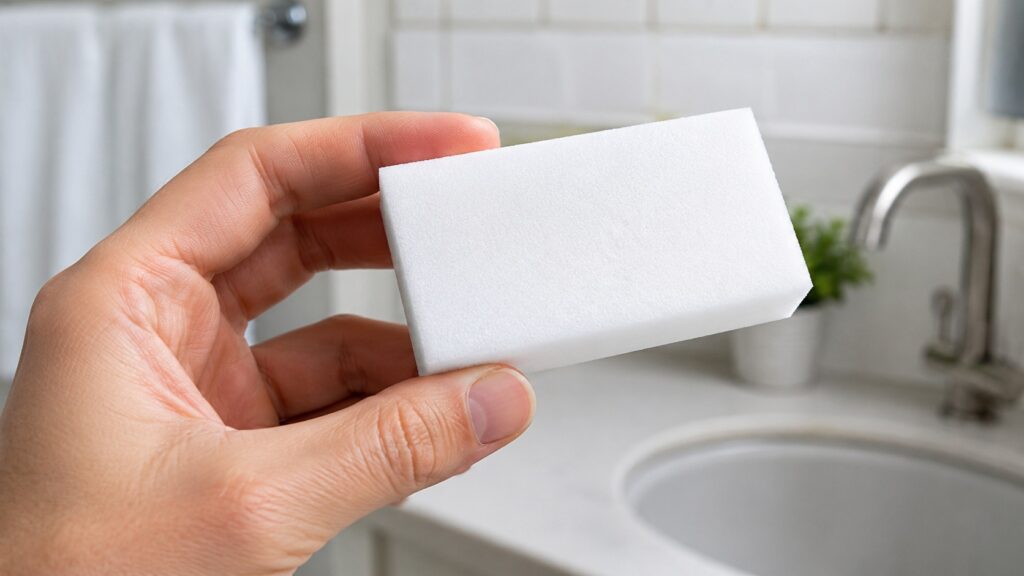
If the deposits are so dense that chemicals can’t handle them, there’s a last resort: mechanical cleaning with a pumice stone or melamine sponge. The area being cleaned should be generously moistened with water, and you shouldn’t press too hard. But keep in mind that such cleaning may strip the toilet surface of its shine and make it porous, which will only accelerate the appearance of new stains.