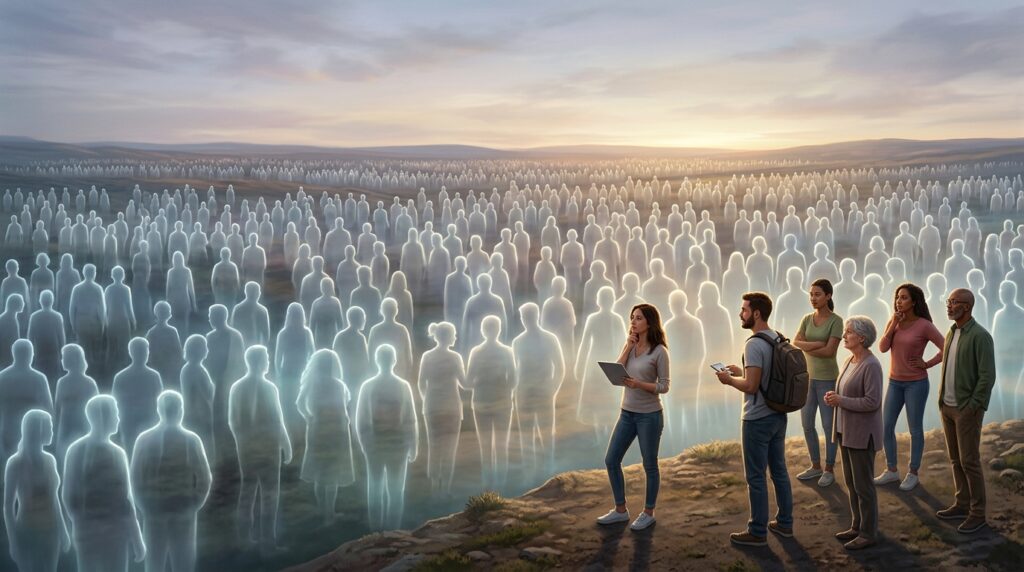
How many people actually lived and died on Earth? The numbers will shock you
About 117 billion people have been born on Earth — and the vast majority of them are long dead. The current population of the planet, just over 8.3 billion, makes up only 7% of that number. If anyone ever told you that there are more living people now than dead throughout all of history — that’s a myth, and a remarkably persistent one.
Is It True That There Are More Living People Than Dead?
The idea sounds appealing: humanity has multiplied so rapidly over the last two hundred years that the living now outnumber all the dead across millennia. The population did indeed grow from 1.6 billion in 1900 to over 8.3 billion today. It would seem that with such an explosive population growth, the living could well have overtaken the dead.
The claim that “the living outnumber the dead” appeared back in the 1970s — during the era of the population explosion and fears of overpopulation. Even Arthur C. Clarke in his novel “2001: A Space Odyssey” (1968) wrote that behind every living person stand 30 ghosts — and at the time, that was close to the truth. But the claim that the living outnumber the dead has never matched reality.
How Scientists Calculated the Number of All Dead People
Counting the number of people who have ever lived is, as demographers say, part science, part art. Demographic data doesn’t exist for more than 99% of the history of human existence. Nevertheless, with a set of assumptions about population size in different eras, it is possible to arrive at an approximate estimate: about 117 billion members of our species have ever been born on Earth.
This estimate was prepared by demographers Toshiko Kaneda and Carl Haub from the Population Reference Bureau (PRB) — a nonprofit research organization that has been collecting data on the world’s population for nearly a century. Their calculation relies on three key factors: how long humanity has existed on Earth, the average population size during different periods, and the number of births per thousand people in each era.
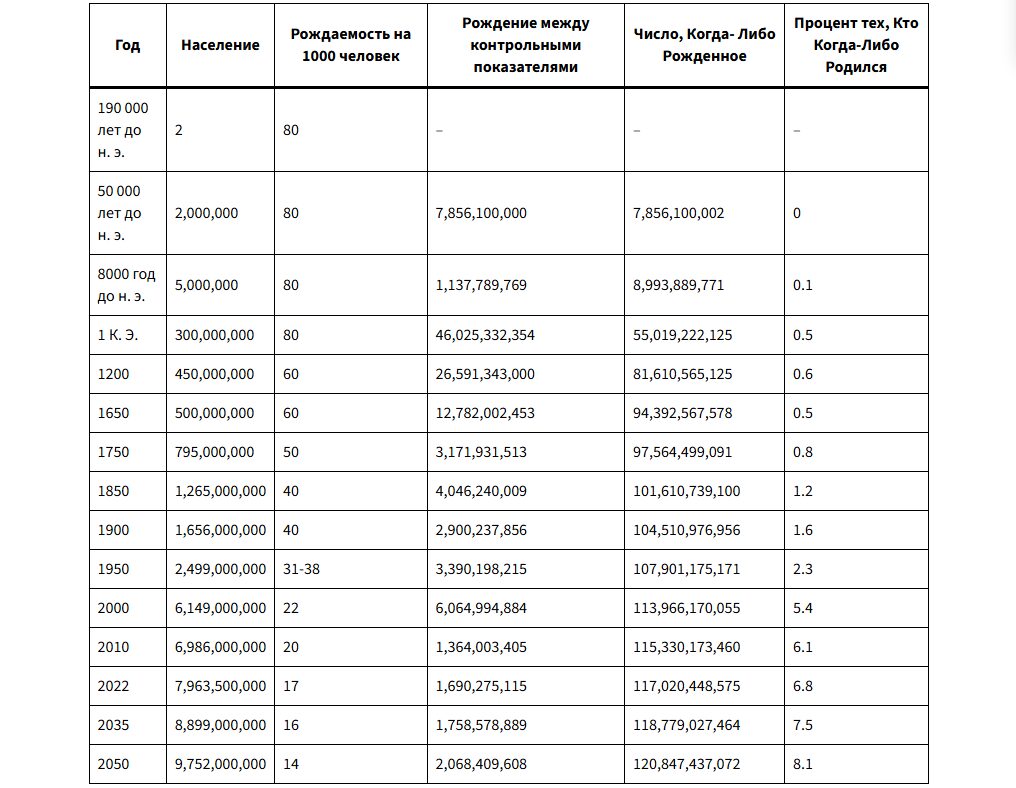
How many people have ever lived on Earth. Approximate data as of November 2022.
The method is simple in concept but complex in detail. The authors took population estimates at various historical points — from 190,000 BCE to the present day — and applied estimated birth rates that declined from era to era. The result: today’s 8.3 billion represent approximately 7% of all people ever born. Considering that we have existed on Earth for approximately 200,000 years, this is actually quite a large share.
Why Birth Rates Were So High in Ancient Times
To understand why 117 billion births accumulated over 200 millennia, you need to imagine how our ancestors lived and how long they survived. Life expectancy at birth for most of human history averaged only about 10 years. In Iron Age France (roughly 800 BCE to 100 CE), average life expectancy is estimated at just 10–12 years.
This doesn’t mean everyone died at age ten. The average was so dramatically low because of colossal infant mortality: a huge proportion of newborns didn’t survive to their first birthday. Those who did survive could well live to 40–50 years.

Ancient people lived in small groups, but birth rates were very high — otherwise the species simply wouldn’t have survived
Under such conditions, the birth rate had to be about 80 live births per thousand people — just to keep the species from going extinct. For comparison: a high birth rate today is 35–45 live births per thousand, and it is observed only in some sub-Saharan African countries. In other words, ancient birth rates were twice as high as the highest modern ones. And this lasted not for a single century but for tens of thousands of years — which is why such colossal numbers accumulated over all of history.
Why Scientists Cannot Precisely Count the Dead
The estimate of 117 billion is not an exact number but the most well-founded approximation. Even modern population estimates have a margin of error of 3–5%, and for more distant eras the range is far wider. Various sources cite figures from 80 to 150 billion.
One of the main problems is catastrophic population fluctuations (there were even periods in history when humanity nearly disappeared). One reason for the slowdown in growth during the Middle Ages was the bubonic plague. Moreover, the “Black Death” was not limited to 14th-century Europe: it may have begun in Western Asia as early as around 542 CE. Experts believe that in the 6th century, the plague wiped out half of the Byzantine Empire — about 100 million dead. Such massive population fluctuations over long periods seriously complicate the estimation of the total number of people who ever lived.
The study’s authors themselves acknowledge that their method most likely produces an underestimate of the number of births. The assumption of steady rather than fluctuating population growth in early periods may understate the average population size of that time.
When Did Accurate Counting of Earth’s Population Begin?
Reliable population data exists only for the last two to three centuries. Until the end of the 18th century, few governments conducted accurate censuses. Starting around 1800, written documents, censuses, and tax registers appeared that allowed people to be counted more or less accurately.
And before that? Thousands of years — almost complete darkness. Population size has to be reconstructed from indirect data: the area of cities, settlement density, archaeological finds. For example, one estimate of the Roman Empire’s population in 14 CE is 45 million. But other historians cite a figure twice as large, which shows how imprecise estimates of early historical periods are.
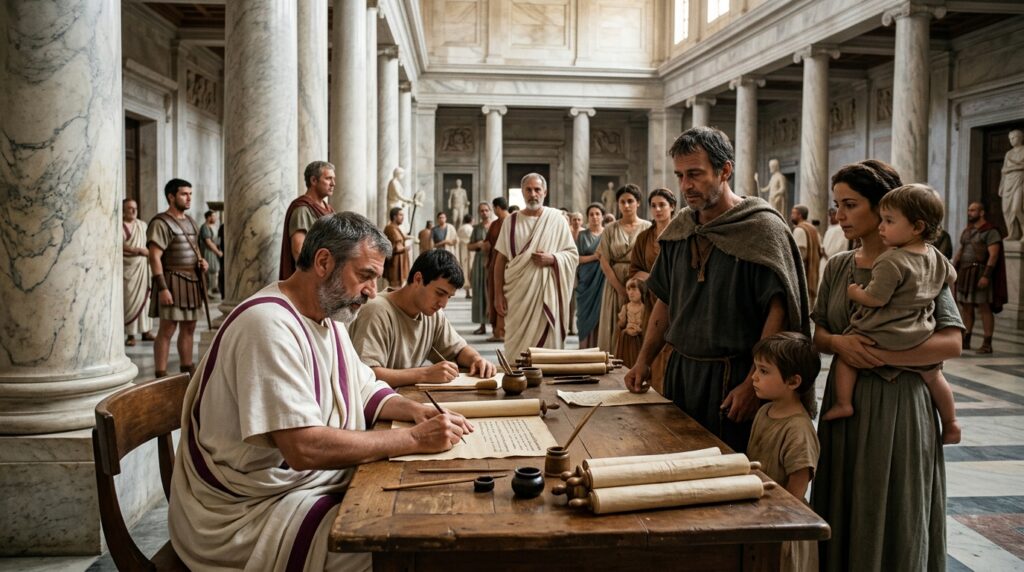
Even for the Roman Empire, population estimates differ by a factor of two
This doesn’t mean the figure of 117 billion is meaningless. The order of magnitude — a hundred billion — is confirmed by different methods and different researchers. Interestingly, scientists usually cite a single number rather than a range — and this in itself signals that we’re dealing with an approximation. The order of magnitude looks plausible, but an exact answer to this question is impossible.
How Many People Have Died Throughout All of Human History
You can look at these numbers another way: for every person alive today, there are approximately 14 people who are no longer living. All the languages we know, all the food we cook, all the tools we use — are the legacy of those 109 billion people who lived and died before us.
There is another astonishing fact. An article in The Economist from 2014 claimed that half of all people who ever lived to age 65 are alive right now. This is a consequence of the revolution in medicine and quality of life: previously, most people simply didn’t live to that age.
Modern medicine and agriculture have greatly influenced the number of people alive today and the proportion between young and old, between those who survived and those who perished in childhood. This is precisely why the share of the living — a full 7% of all people ever born — looks so impressive against the backdrop of 200,000 years of the species’ existence. But the main conclusion remains the same: the dead on this planet vastly outnumber the living — and this is not a grim fact but a reminder of whose shoulders our civilization stands upon.