A small but intriguing study published in Nature Human Behaviour found that paying close attention to bodily sensations during a mild inflammatory reaction physically reduced the size of that reaction — even though it felt more uncomfortable. The finding challenges the common advice to simply distract yourself from discomfort, suggesting that the body may regulate its immune response more precisely when the brain is tuned in to what is happening.
The research is preliminary, involving only 57 participants across two experiments, and the inflammation tested was tiny and temporary. It remains unknown whether the effect extends to infections, chronic inflammation, or autoimmune conditions. Still, the results offer a measurable, physical basis for the idea that mindful body awareness may do more than just shift mood.
What you need to know
- In two experiments totaling 57 healthy volunteers, focusing attention on a histamine skin-prick site reduced wheal size (3.5 mm vs. 5.0 mm) and redness (10.6 mm vs. 14.0 mm) compared with distraction.
- About 90% of participants showed a stronger inflammatory reaction when distracted than when paying attention to the affected skin.
- A follow-up experiment using identical visual stimuli but different attentional instructions replicated the result, with inflammation roughly 1.6 times smaller during body-focused attention.
- The study is small and used only a brief, harmless skin reaction — it has not been tested in clinical disease contexts.
A standard allergy test as a measuring tool
To capture the body’s immune response in measurable numbers, the researchers used a familiar clinical procedure: the histamine skin-prick test. A drop of histamine is applied to the skin and lightly pricked in, producing a small wheal (a raised bump) and surrounding redness — a localized, safe, and temporary inflammatory reaction. Both the wheal and the flare can be measured with a ruler over the roughly twenty minutes the reaction takes to develop.
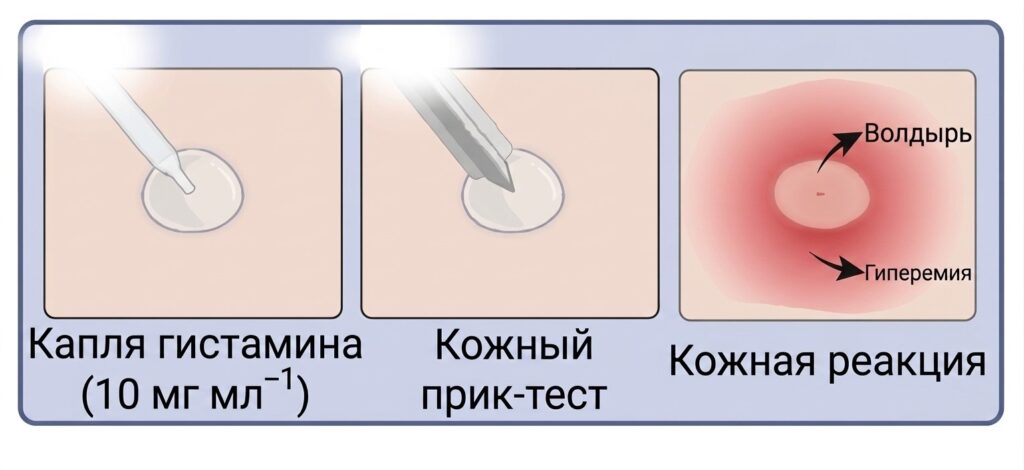
Diagram of the histamine skin-prick test procedure.
Attention vs. distraction: the first experiment
In the first experiment, 37 healthy volunteers each underwent the skin-prick test twice. In one session they were asked to focus carefully on the sensations at the irritated patch of skin. In the other, they watched engaging videos designed to pull their attention away from the itch.
Subjectively, the outcome was predictable: participants rated the inflammation as more unpleasant when they focused on it. Distraction genuinely reduced perceived discomfort.
Physically, however, the opposite happened. When participants focused on the sensation, the inflammatory reaction was measurably smaller. Average wheal diameter was 3.5 mm during focused attention versus 5.0 mm during distraction; redness measured 10.6 mm versus 14.0 mm. Roughly 90% of participants showed a stronger physical reaction when distracted.

How attention to your body changes the immune reaction: practicing mindfulness.
Ruling out the distraction material itself
A reasonable objection: perhaps the videos themselves, rather than the shift in attention, were responsible. So the researchers ran a second experiment with 20 participants and a cleverer design.
This time, participants viewed the same abstract shapes in both conditions. In one session the shapes served as reminders to return attention to the irritated skin — essentially a body-awareness cue. In the other, participants examined the shapes themselves, considering whether such forms could exist in the real world. The visual stimulus was identical; only the direction of attention changed.
The result held: inflammation was roughly 1.6 times smaller when attention was directed toward the body, and again about 90% of participants showed a stronger reaction when their focus was directed outward. The effect, the researchers concluded, was driven by the focus of attention itself, not by the specific material used for distraction.
How attention might regulate inflammation
The researchers proposed a straightforward explanation: when we attend to a sensation, we effectively signal the brain that something important is happening at that location. The brain receives richer information about the irritation and can calibrate the immune response more precisely.
To test this, they numbed the skin with lidocaine, removing the sensation. The attention effect weakened but, notably, did not disappear entirely. The wheal was larger than during attention with intact sensation, yet still smaller than during distraction. This suggests sensation is not the only mechanism at work.
A clue came from heart-rate data. The researchers found no differences in pulse rate, skin conductance, or skin temperature between conditions. They did, however, observe changes in heart-rate variability — an indirect marker of vagus nerve activity, which plays a role in dampening inflammation. Crucially, this change persisted even when the skin was numbed.
The implication is that attention may operate through at least two pathways: drawing the brain’s focus to the sensory signal, and engaging neural mechanisms — possibly vagal — that independently participate in regulating inflammation.

What we pay attention to may change not only our perception of the world but also the body’s physical response.
Important limitations and takeaways
This does not mean that attention can cure serious illness. Both experiments involved a total of only 57 people, and the inflammatory reaction studied was tiny and temporary. The researchers do not yet know whether the effect applies to infections, chronic inflammation, or autoimmune diseases — those questions require separate investigation.
That said, several points are worth noting:
- “Grit your teeth and distract yourself” is not a universal strategy. Distraction reduces perceived discomfort, but the body may sometimes benefit when you attend to the signal rather than ignore it.
- Body awareness produced measurable physical effects. In these experiments, focused attention was associated with smaller wheals and less redness — not just a change in how participants felt.
- Mindfulness practices may have a physical dimension. Techniques that involve tuning in to bodily sensations could potentially work beyond the level of mood, though much more research is needed to confirm this.
Where we direct our attention appears to change not only our subjective experience but, at least in this controlled setting, how the body responds to irritation. The science here is still in its early stages, but the direction is one worth watching.