A recent viral story claimed an iPhone 15 Pro Max caught fire because its storage was nearly full. The explanation sounds intuitive — but from a physics standpoint, it is nonsense. Flash memory, the chip responsible for storing photos and apps, contains no moving parts and no energy reserve capable of igniting anything. When your phone warns that storage is almost full, it is simply asking you to free up space so updates, cache, and the camera can function normally. It is not a heat warning, and it is certainly not a countdown to combustion.
The only component inside an iPhone that can actually catch fire is the lithium-ion battery. Here is what genuinely causes smartphone fires, how to spot the warning signs, and what habits keep the risk close to zero.
What you need to know
- Full storage has no connection to fire risk — flash memory chips cannot ignite or cause thermal events.
- The sole fire-capable component is the lithium-ion battery, which can undergo “thermal runaway” — a self-sustaining chain reaction that releases hot gases, smoke, and flame.
- Common triggers include mechanical damage, cheap or uncertified chargers, prolonged exposure to temperatures above 35 °C (95 °F), manufacturing defects, and aged or swollen batteries.
- A swelling battery — visible as a screen lifting away from the frame or a bulging back panel — is the most urgent warning sign and requires immediate professional service.
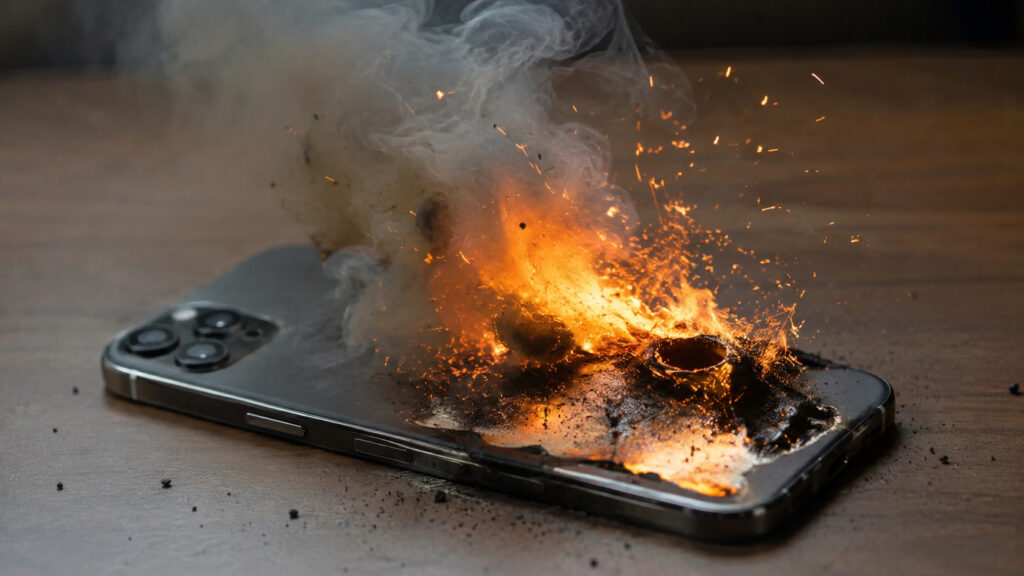
Debunking the myth that a full iPhone storage can cause an explosion
Full storage is not a fire hazard
Free space on a smartphone and the probability of combustion are two completely unrelated things. Flash memory is a passive storage chip — it holds data, nothing more. When the system warns that storage is nearly full, it is requesting room for updates, cache, and camera operation. It is not signaling overheating risk.
Scammers have long exploited this fear. Fake banners disguised as iOS system notifications warn users that their memory is about to “burst” and urge them to tap a “clean” button. Behind that button typically lies a dubious app or subscription — it has nothing to do with device safety.

What an iPhone looks like after a fire incident. Image: SHOT
The real culprit: the lithium-ion battery
The only component inside an iPhone physically capable of catching fire is the battery. Lithium-ion cells pack a large amount of energy into a very compact volume, and under certain conditions that energy can release all at once.
The mechanism is called thermal runaway. If the temperature inside a battery cell spikes for any reason, a chain reaction begins: heat triggers further chemical processes, which generate still more heat, escalating rapidly. Eventually the cell casing fails, releasing hot gases, smoke, and flames. Critically, this type of fire is self-sustaining — the reaction produces its own oxygen, which is why simply smothering a burning phone does not always work and why these fires are so difficult to extinguish with ordinary means.
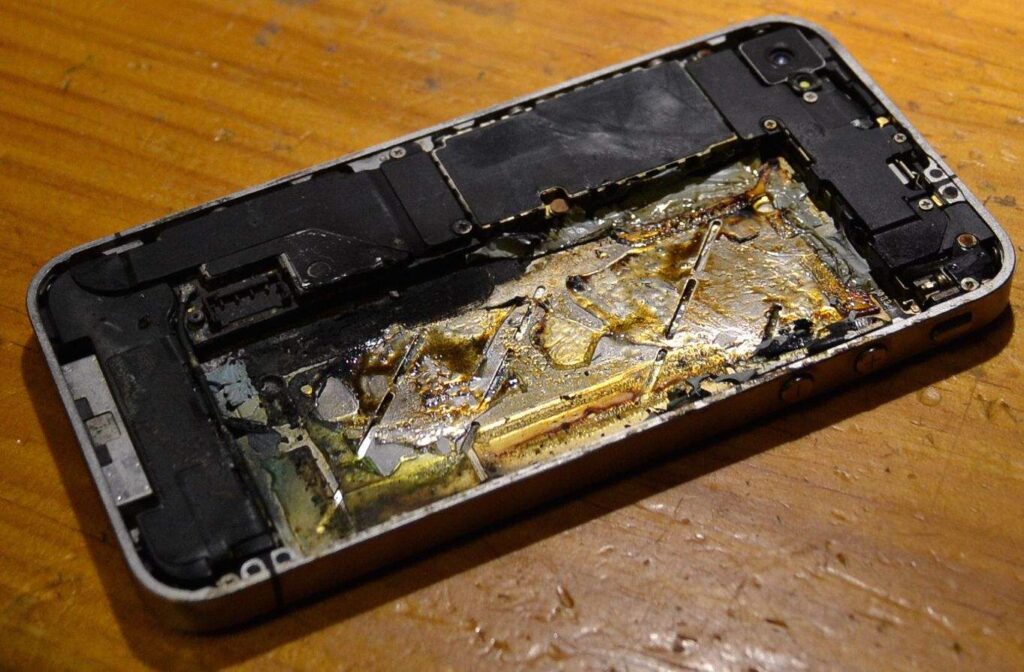
The problem is always the battery or the charging setup
What actually triggers a smartphone fire
Thermal runaway does not happen spontaneously — it always has a trigger. The most common causes include:
- Mechanical damage. A hard drop, an impact on a corner, or habitually sitting on a phone in a back pocket can puncture or compress the thin separator between electrodes inside the cell, causing an internal short circuit.
- Cheap or uncertified chargers and cables. Power adapters and cables without proper protection circuitry can deliver incorrect voltage or current, stressing the battery.
- External overheating. Leaving a phone on a sun-baked car dashboard, charging it in a hot vehicle in summer, or placing it near a heat source can push the battery past safe limits. Apple explicitly warns that operating above 35 °C (95 °F) can permanently damage the battery.
- Manufacturing defects. A microscopic metal particle that enters a cell during production can go unnoticed for years before eventually causing a short circuit.
- Moisture and aging. Water ingress and natural battery degradation over time — especially swelling — each raise the risk, and multiple factors together compound the danger.
How to spot a failing battery
Smartphones rarely ignite without warning. The battery usually gives advance signals:
- Swelling. The most obvious and dangerous sign. If the screen appears to lift away from the frame, the back panel separates, or the glass flexes slightly under finger pressure, the battery is almost certainly bloating with gas.
- Unusual heat in idle. The phone becomes noticeably hot even when not under load.
- Chemical smell or visible leakage.
- Erratic charge behavior. The phone loses charge rapidly or shuts down unexpectedly at 40 percent.
If you notice any of these signs: stop using the device, power it off, do not plug it in to charge, and take it to a qualified service center. Never puncture or pry open a swollen battery yourself — that is the fastest path to thermal runaway.

At the first signs of battery swelling, take the device to a service center. Using a smartphone with this defect is dangerous
Simple habits that reduce the risk
Bringing the probability of a battery fire close to zero is straightforward:
- Use original or certified accessories. A power adapter and cable from a reputable brand will include proper protection circuitry.
- Keep the phone in a comfortable temperature range. Apple recommends an operating range of 0–35 °C (32–95 °F). Avoid leaving the device in a hot car.
- Enable optimized charging. This setting reduces the time the battery sits at 100 percent, slowing long-term degradation.
- Replace aging batteries promptly. Every lithium-ion battery is a consumable. After two to three years of heavy use, capacity drops and the risk of swelling increases. If the battery is visibly swelling or the phone barely lasts a couple of hours, have it replaced at a qualified service center.
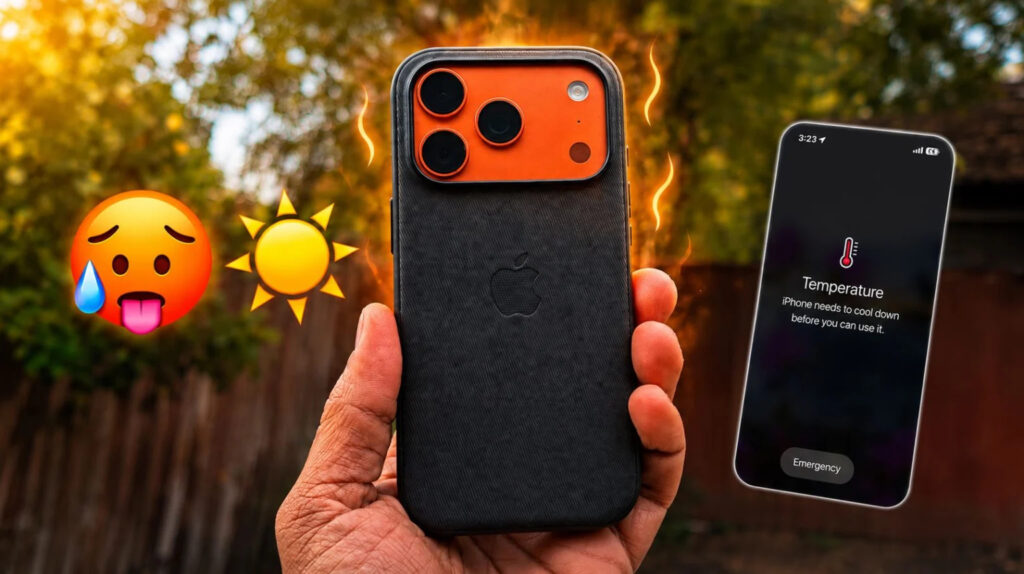
Do not overheat your device. In hot weather, you can even remove the case
Incidents like the one described in the viral story are rare, not routine. Millions of people use iPhones with nearly full storage for years without incident. A fire is almost always the result of physical damage, a manufacturing defect, or seriously improper use — not a full photo library.