People who live past 110 years — known as supercentenarians — carry a surprisingly high concentration of a rare type of immune cell in their blood, according to research from Osaka University in Japan. The study, led by Kosuke Hashimoto, found that these CD4 cytotoxic T-lymphocytes (CD4 CTLs) increase dramatically with extreme age and appear to target the same threats seen in cancer patients — even though the supercentenarians themselves had no cancer diagnoses. The findings suggest that extreme longevity may be linked to an immune system that actively adapts rather than simply declines.
What you need to know
- CD4 cytotoxic T-lymphocytes made up about 17.6% of T-cells in people aged 110+, compared with roughly 4% in those aged 70–99.
- In one centenarian participant, a single clone of these cells accounted for nearly 54% of the entire CD4 CTL population.
- Genetic receptor sequences of the dominant T-cells matched those found in patients diagnosed with lung, breast, and liver cancers — yet none of the supercentenarians had cancer.
- The study, published in Cell Reports, examined blood samples from 28 individuals across three age groups.

The blood of supercentenarians differs from that of ordinary people
The immune system doesn’t just weaken — it adapts
Hashimoto’s team collected blood samples from 28 people divided into three age brackets. They specifically looked for CD4 cytotoxic T-lymphocytes, a relatively rare class of immune cell. What they found was a clear, progressive increase:
- Ages 70–99: approximately 4% of total T-cells
- Ages 100–109: approximately 9.6%
- Ages 110 and above: approximately 17.6%
According to Hashimoto, this pattern suggests that immune aging is not simply a process of decline. Instead, the body appears to deliberately expand a specific army of defensive cells to cope with age-related threats.
Massive clonal armies of killer cells
When the body detects a threat, T-lymphocytes undergo clonal expansion — rapidly copying themselves to overwhelm the target. The researchers analyzed the receptors of these cells and found that in supercentenarians, this cloning process operates on an extraordinary scale.
On average, the largest single “squad” of identical cells made up about one-third of all CD4 CTLs in a participant’s blood. In one centenarian, a single clone occupied nearly 54% of the entire CD4 CTL population. Such dense concentration suggests that the immune systems of these individuals are engaged in a constant, hidden battle against some persistent threat.
A covert war against emerging tumors
To identify what these cellular armies might be fighting, the researchers compared the genetic receptor sequences of the dominant T-lymphocytes against open medical databases. They found roughly 30 matches with cells from patients who had been diagnosed with cancers — specifically lung, breast, and liver cancers. Crucially, none of the supercentenarians in the study had cancer.
The researchers hypothesize that the abundant CD4 CTLs represent a response to the earliest stages of potentially cancerous cell development. If this hypothesis holds, the immune systems of supercentenarians may be identifying and destroying threats before they develop into full tumors.
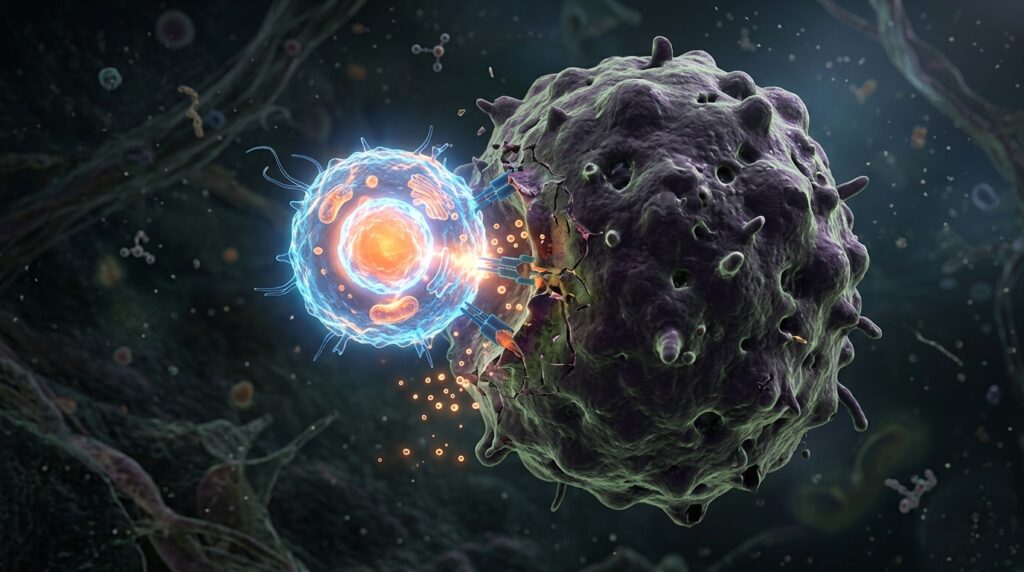
Cytotoxic lymphocytes are capable of recognizing and destroying abnormal cells in the body
Important limitations and what remains uncertain
Despite the promising results, the study — published in Cell Reports — has significant limitations that should temper any sweeping conclusions.
First, a high level of CD4 CTLs does not guarantee cancer protection and is not a direct “elixir of longevity.” The researchers found a strong association, but they cannot yet confirm a strict causal relationship. Notably, the highest percentage of CD4 CTLs in the study was recorded in a participant who had not yet reached 100 years of age, indicating that the process is triggered on an individual basis.
Second, the study examined only T-lymphocytes circulating in the blood. How these same cells behave within tissues and organs remains unknown — a question Hashimoto’s team has yet to investigate.
Nevertheless, the work challenges conventional assumptions about aging. Rather than simply surrendering to the accumulation of mutations and abnormal cells, the bodies of those destined to live beyond a century appear to keep adapting, finding new ways to sustain normal function.