Apple has updated the 24-inch iMac with its M6 chip, two years after the previous refresh in October 2024. The company announced the new model on October 27 in a press release, with no event or promotional video. The design, display and colors are unchanged. The main changes are inside: a 2-nanometer M6 chip in 10-core and 12-core versions, a faster Neural Engine, Wi-Fi 7 and Bluetooth 6. US pricing starts at $1,499, the same as the M4 iMac after Apple’s June price increase. According to the source, M4 owners have little reason to upgrade. Owners of M1 or Intel models will see a much larger difference.
What you need to know
- The iMac comes in two M6 versions: 10-core CPU and GPU for $1,499, or the full 12-core chip for $1,699 in the US.
- Pre-orders open October 28, and the first deliveries arrive November 6.
- Apple claims speedups over the M4 iMac of up to 1.5x in spreadsheet apps, up to 2x in Affinity and ray-traced games, and up to 5x for local AI models in LM Studio.
- The case, 4.5K display, camera, speakers and seven-color lineup are carried over unchanged.

The new 2026 iMac
A launch without a stage
Apple released the M6 iMac one day after it announced an iPad mini with an OLED display and IP67 protection. According to the source, the quiet launch makes sense. The M6 chip debuted on August 25 in the Mac mini, and Apple also released an M6 MacBook Pro without a presentation.

The iMac in green
Bloomberg’s Mark Gurman predicted in the summer that the update would not include a redesign, and that turned out to be correct. Gurman has also reported that Apple will show a touchscreen MacBook Pro with an OLED display in Los Angeles. The source expects that announcement on Wednesday, but this is based on Gurman’s reporting rather than an Apple announcement.
The iMac skipped the M5 generation entirely. It did the same with the M2, moving from M1 straight to M3. This time it went from M4 to M6.
Inside: a 2nm M6 in two configurations
According to the source, the M6 is Apple’s first processor manufactured by TSMC on a 2-nanometer process. The iMac uses it in two versions:
- Entry model: 10-core CPU and 10-core GPU.
- Higher-end model: the full M6, with 12 CPU cores and 12 GPU cores. That is two more cores than the previous iMac.
The full chip has three types of CPU cores:
- two “super cores” for single-threaded tasks;
- four performance cores;
- six efficiency cores.
Apple claims the iMac now has the world’s fastest CPU for single-threaded work. Earlier benchmark results cited by the source give some idea of the chip’s performance. In Geekbench 7, an M6 Mac mini scored 4,071 in the single-core test and 22,783 in the multi-core test. Those scores come from the Mac mini, not from the iMac itself.
Apple’s new 2nm M6 processor
Apple’s performance claims
Apple compares the new iMac with the M4 model as follows:
- up to 1.5x faster in Excel and similar apps;
- up to 2x faster in the Affinity photo editor;
- up to 2x faster in games with ray tracing;
- up to 5x faster at processing prompts with local AI models in LM Studio.
The source calls this an unexpectedly large step between neighboring Apple generations. These are Apple’s own “up to” figures, not independent test results.
For older machines, Apple promises bigger gains in the same tasks. M1 iMac owners would see improvements of 2.5x to 12x, and Intel iMac owners up to 18x. Apple also says the internal storage reads and writes data up to twice as fast as on the M4 model.
AI performance and the memory caveat
The biggest AI-related change is a dual 16-core Neural Engine. Apple says it processes AI tasks twice as fast as the previous generation. Each GPU core also now has its own neural accelerator. According to the source, people who run local models or use Apple Intelligence should notice the speedup in these areas.
The iMac ships with macOS 27. The new Siri AI is available in the macOS 27.2 beta, and the source notes that Russian is not yet among the supported languages. Local models run through LM Studio do not depend on the system language.
Apple says memory bandwidth has increased to up to 170 GB/s. The source highlights the words “up to.” On the M6 Mac mini, the base 16 GB configuration has 153 GB/s of bandwidth, and only the 24 GB and 32 GB versions reach 170 GB/s. The source believes the iMac likely uses the same arrangement, but Apple’s press release does not list bandwidth for each memory configuration, so this is unconfirmed. The difference should be unnoticeable for web browsing and documents. For video editing and AI workloads, the source advises against choosing the minimum memory configuration.
Same design, same display, same colors
The iMac’s 11.5 mm case, the “chin” below the screen and the stand are all unchanged. The display is also the same:
- 24-inch 4.5K Retina panel (23.5 inches of actual viewable diagonal);
- 4480 × 2520 resolution;
- 500 nits of brightness;
- wide P3 color gamut.
An anti-glare nano-texture coating is still offered, but only as an option on the higher-end model. There is no OLED version and no larger 32-inch iMac.

Design of the updated iMac
Gurman had predicted new colors, but the press release lists the same seven: blue, green, pink, yellow, purple, orange and silver.
Other hardware details:
- Camera: the same 12 MP camera, with Center Stage to keep users in frame during calls and Desk View to show a top-down view of the desk.
- Audio: unchanged, with six speakers supporting Dolby Atmos and three studio-quality microphones. The source describes the sound as very good for an all-in-one.
- Accessories: a color-matched keyboard and mouse that charge over USB-C.
- Touch ID: included in the keyboard on the higher-end model; a paid option on the entry model.
Connectivity: the most practical upgrade
According to the source, the most welcome changes are in connectivity. Like the M6 Mac mini, the iMac now has Wi-Fi 7 and Bluetooth 6. The higher-end model includes 2.5 Gb/s Ethernet, which is 2.5 times faster than before and should speed up large network file transfers.
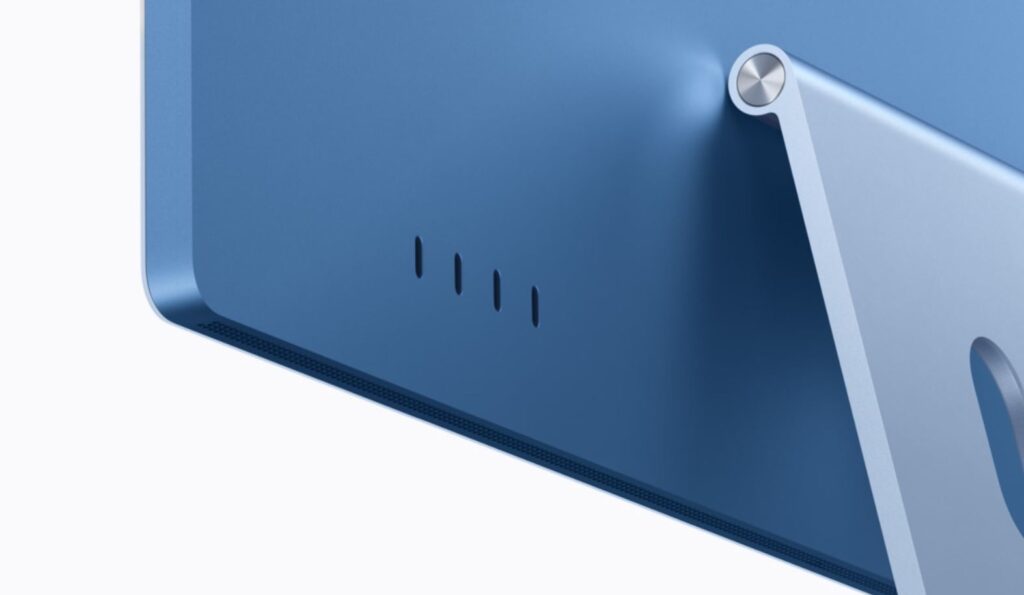
Ports on the 2026 iMac
The port arrangement follows the previous pattern. Only the higher-end model has four Thunderbolt 4 ports; on the entry model, not every port supports Thunderbolt. The new iMac can drive two external 6K displays. The source argues that for a computer that stays on the same desk for years, this matters more than a new design.
Pricing: no cheaper, but no more expensive
On June 25, Apple raised prices on almost its entire lineup, and Macs went up by roughly 15–20%. The starting price of the M4 iMac rose from $1,299 to $1,499 at that time.
The M6 model keeps the same pricing in the US:
- $1,499 for the 10-core CPU and GPU version;
- $1,699 for the 12-core version.
The previous base model had an 8-core chip, so buyers now get more cores for the same price.
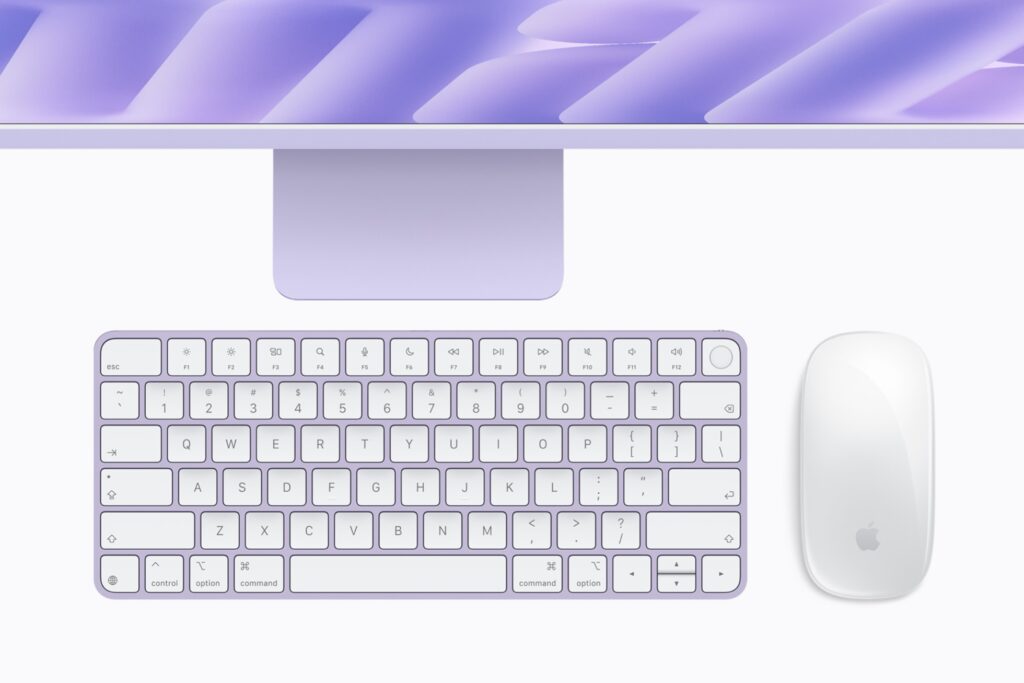
iMac with Apple accessories
Most of what you need comes in the box, but the source notes that some buyers will still need extras. Examples include an adapter for older USB-A flash drives and an external SSD for Time Machine backups.
Who should upgrade
M4 iMac owners: according to the source, there is little reason to upgrade. The display, camera and case are the same, and the speedup is unlikely to be noticeable in browsing, email or photo apps. The one exception is heavy use of local AI models, where Apple’s claimed fivefold improvement could make a real difference.
M1 (2021) and Intel iMac owners: the source expects the difference to be obvious right away. It points to gains in speed, AI performance and support for future macOS versions.
Which configuration the source author plans to buy
The source author reports mostly working at a desk and finding the 13-inch screen of an M2 MacBook Air too cramped. After reading the press release, the author settled on a configuration.
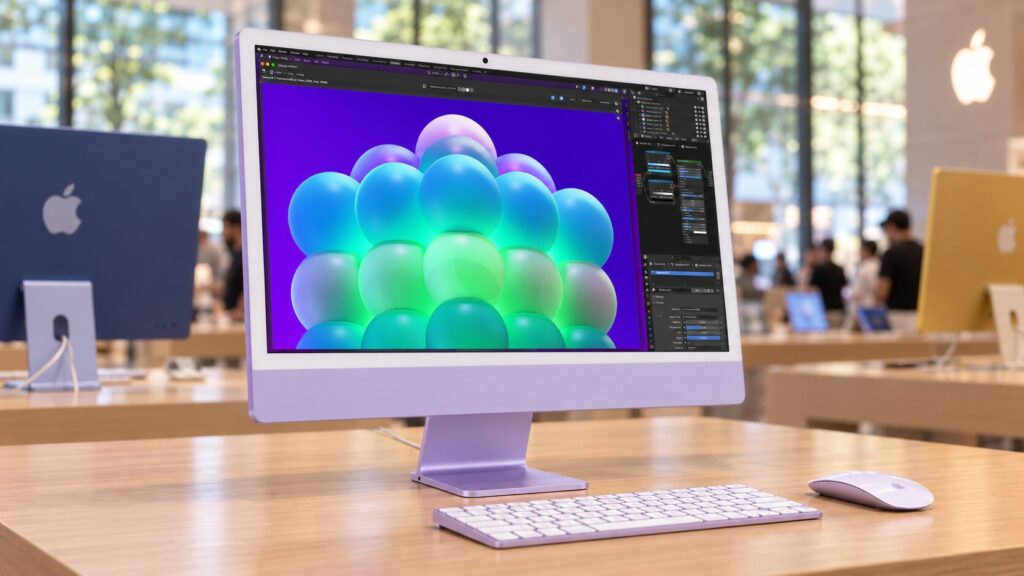
A purple iMac
The author considers the $1,499 entry model sufficient for their workload:
- writing;
- keeping dozens of browser tabs open;
- editing photos;
- occasionally running a local AI model.
The author does not need four Thunderbolt ports or faster Ethernet, because their router is in another room and Wi-Fi 7 is fast enough. The author also notes that a browser version of Need for Speed: Most Wanted ran well even on their M2 MacBook Air, so they expect the entry M6 iMac to handle it easily.
The author plans to pay extra for two things:
- 24 GB of memory, for more headroom and the higher memory bandwidth. The author’s view is that paying once now is better than running into the limits of 16 GB in a couple of years.
- Touch ID, to avoid typing a password many times a day.
The author will choose a color after seeing the iMac in person, noting that colors in Apple’s renders often look different on a real desk.
iMac M6 specifications
| iMac M6, 10-core | iMac M6, 12-core | |
|---|---|---|
| CPU | 10 cores | 12 cores: 2 super cores, 4 performance, 6 efficiency |
| GPU | 10 cores, neural accelerator in each core | 12 cores, neural accelerator in each core |
| Neural Engine | Dual 16-core Neural Engine | |
| Memory | From 16 GB, bandwidth up to 170 GB/s | |
| Display | 24-inch (23.5-inch viewable), 4.5K Retina, 4480 × 2520, 500 nits, P3 | Same, plus nano-texture option |
| Camera | 12 MP, Center Stage, Desk View | |
| Audio | 6 speakers, Dolby Atmos, 3 microphones | |
| Ports | USB-C, some with Thunderbolt 4 | 4 × Thunderbolt 4 |
| 2.5 Gb/s Ethernet | No | Yes |
| Wireless | Wi-Fi 7, Bluetooth 6 | |
| External displays | Up to two at 6K | |
| Touch ID | Optional (extra cost) | Included |
| Colors | Blue, green, pink, yellow, purple, orange, silver | |
| Operating system | macOS 27 | |
| US price | $1,499 | $1,699 |
| Availability | Pre-orders from October 28, deliveries from November 6 | |