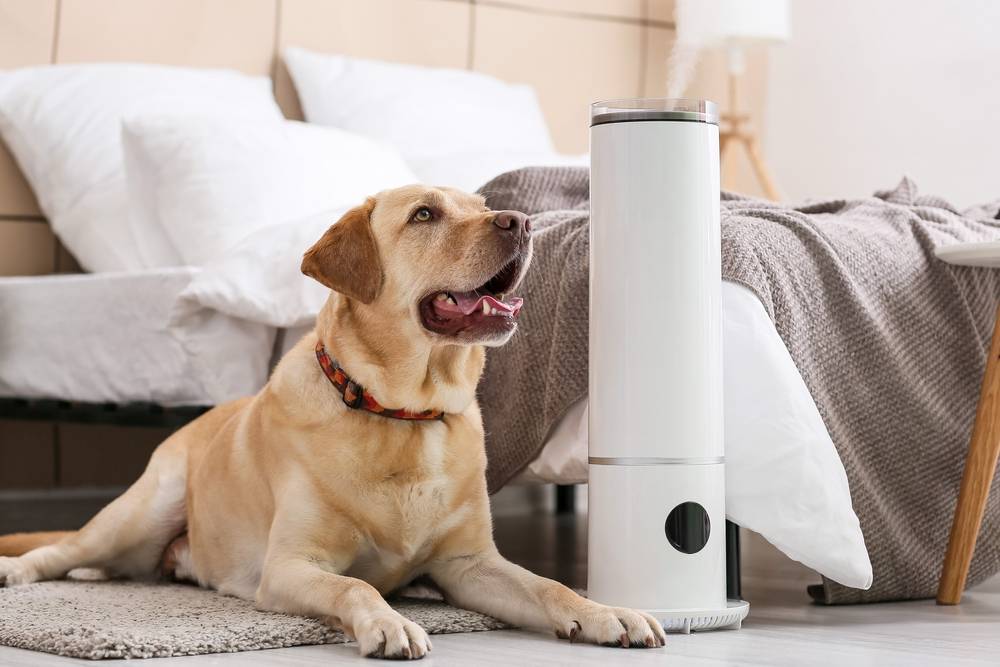
How to choose an air purifier for pet allergies? Image source: petstory.ru
Pet allergies are one of the most common causes of year-round runny nose, congestion, sneezing, and watery eyes. But giving away a beloved cat, parrot, or dog is an incredibly difficult decision that few people are ready for. Scientists are working on this issue and want to create cats that don’t cause allergies, but in the meantime, we need to find ways to cope. Fortunately, modern air purifiers can truly reduce the concentration of allergens in your home to a comfortable level. The key is understanding exactly what you’re protecting yourself from and what to look for when buying one.
What actually causes cat and dog allergies
Many people think that fur causes allergies, but that’s not entirely true. The main culprit is microscopic proteins produced by the animal’s body. In cats, the primary allergen is the protein Fel d 1, found in saliva, sebaceous glands, and skin. When a cat grooms itself, the protein gets on the fur, dries out, and spreads through the air. In dogs, a similar role is played by the protein Can f 1.
The insidious thing about these allergens is that they are incredibly airborne and “sticky”: they settle on furniture, clothing, carpets, and together with household dust can persist in an apartment for months — even if the animal no longer lives there. That’s exactly why simple ventilation doesn’t fully solve the problem.
In addition to allergenic proteins, reactions can be triggered by parasites carried by animals, as well as skin and feather particles. That’s why fighting allergies should always be approached comprehensively, not with a single magic pill.
How to reduce pet allergies at home: simple rules for living with a pet
Before choosing an air purifier, it’s worth establishing a basic “hygiene minimum.” Here’s what actually helps reduce contact with allergens:
- Restrict your pet’s access to the bedroom — you spend a third of the day there, and clean air for sleeping is critically important.
- Vacuum more often than usual, ideally with a vacuum cleaner equipped with a HEPA filter that doesn’t blow fine particles back out.
- Do wet cleaning: allergens settle on surfaces, and a dry cloth just lifts them back into the air.
- Regularly ventilate rooms.
- If your cat has a litter box, use quality litter and clean the box daily.
All of this reduces the overall “allergen load” but does not completely eliminate the problem. And this is where the air purifier takes the stage.
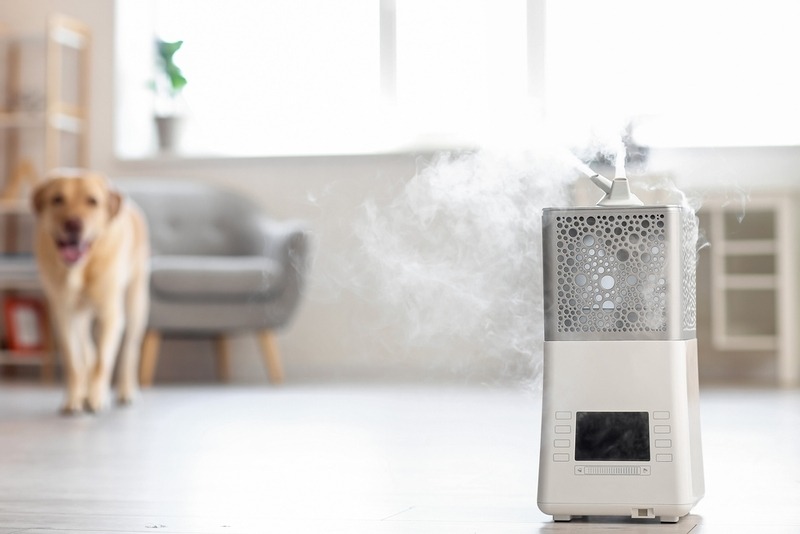
Don’t confuse an air purifier with a humidifier! Image source: petstory.ru
Does an air purifier help with pet allergies
The device works on the principle of recirculation: a built-in fan draws air into the housing, pushes it through a filter system, and blows it back out already cleaned. All contaminants — from large fur to microscopic protein particles — remain on the filters.
It’s important not to confuse an air purifier with a humidifier. A humidifier helps when the air in the apartment is dry, but it doesn’t filter allergens at all. Meanwhile, an air purifier with the right filter removes up to 99.97% of particles as small as 0.3 microns (thousands of times smaller than a human hair).
With pet allergies, the principle is the same as with pollen allergies — but there are nuances in choosing filters.
Which air purifier to choose for cat and dog allergies
What to pay attention to when buying:
- Filter type and class — the main criterion. For allergy sufferers, HEPA filters of class H12 or H13 are optimal. An H12 filter captures 99.5% of particles larger than 0.3 microns, while H13 captures 99.95%. Animal allergens (skin particles, dried saliva) range in size from a few to tens of microns, so HEPA handles them excellently. Advanced models may feature multiple filtration stages: a pre-filter collects large fur and dust, the HEPA catches fine allergens, and an activated carbon filter neutralizes odors.
- Coverage area. Each model is designed for a specific room volume. If you have a multi-room apartment or a house, one unit may not be enough. Look at the CADR (Clean Air Delivery Rate) — for an allergy sufferer’s bedroom, 4–6 air changes per hour are recommended.
- Noise level. A purifier that runs 24/7 shouldn’t disturb sleep — yours or your pet’s. A comfortable night mode is 25–38 dB, which is quieter than a whispered conversation.
What else to consider when buying an air purifier:
- Cost of replacement filters: a HEPA filter needs to be replaced every 6–12 months, and this is a recurring expense.
- Size and design: the unit will be in plain sight, and modern models can fit nicely into your interior.
- App control: convenient if you want to turn the purifier on remotely or monitor filter condition.
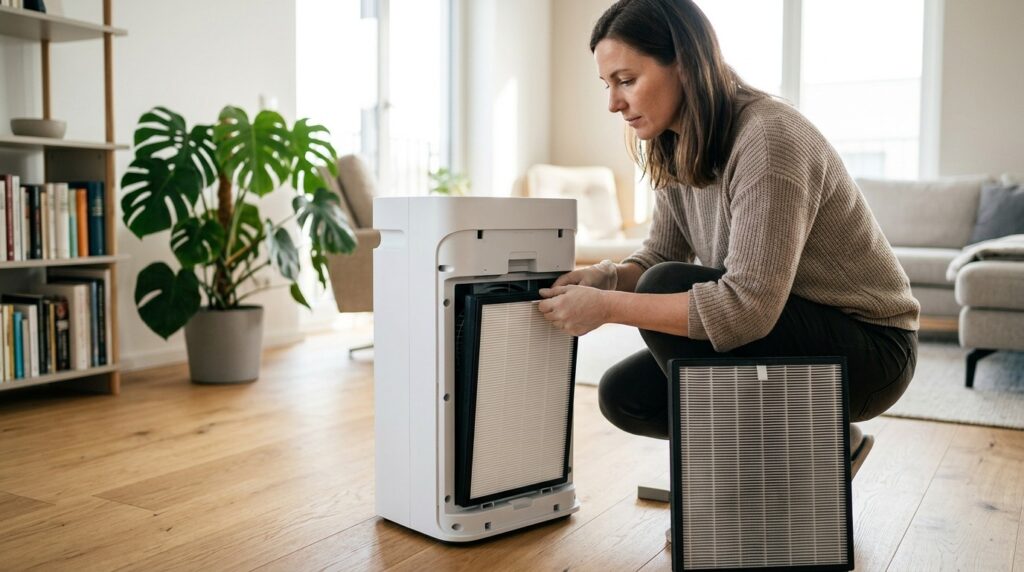
Timely filter replacement is the key to an effective air purifier
Limitations of air purifiers for pet allergies
An air purifier is a powerful helper but not a cure-all. It does not replace ventilation: the device doesn’t remove carbon dioxide, so you still need to air out rooms. It won’t cure your allergy — but it will help keep symptoms under control by reducing the concentration of allergens in the air.
It’s also worth remembering that a HEPA filter doesn’t destroy allergens — it accumulates them. A clogged filter loses its effectiveness, so it needs to be replaced strictly on schedule, not “when you remember.” Also: don’t try to vacuum a HEPA filter — this damages its delicate fibers.
The optimal usage mode is continuous operation at low speed. Constant filtration is more effective than occasional bursts at maximum power. This way, an air purifier becomes a practical tool that lets you live with your beloved pet without constant sneezing.