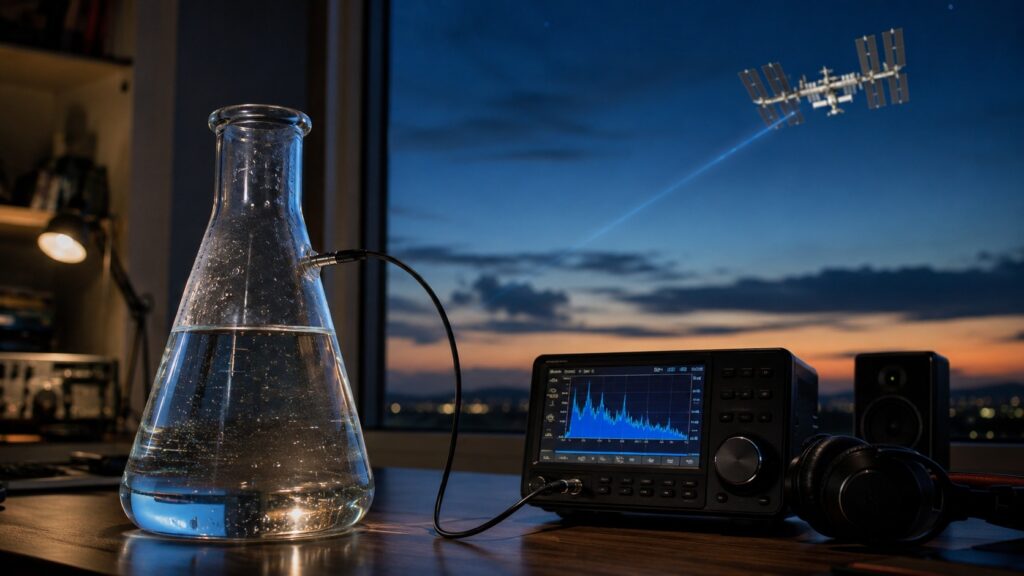
A Japanese enthusiast proved that you can pick up a signal from the International Space Station using just a glass of water
Picking up a signal from the International Space Station using a glass of water? You might think this is nonsense, but a ham radio enthusiast from Japan recently pulled off exactly this trick. He didn’t need kilometers of copper wire, satellite dishes, or expensive receivers. He poured water into a 14-centimeter-tall flask and simply received the signal.
How to Pick Up an ISS Signal with Improvised Means
The author of the experiment is an enthusiast from Japan’s Mie Prefecture. According to a post on the social network X, he tuned to a frequency of 51 MHz — one of the frequencies the ISS broadcasts on. Instead of a regular antenna, he connected a flask filled with tap water to about 14 centimeters to his receiver.
He not only picked up the signal but also demodulated it, meaning he extracted audio from it. Astronaut conversations were audible on the recording. And this despite the fact that the station orbits at an altitude of about 400 kilometers!
One clarification that is fundamentally important here: this was reception only. The enthusiast didn’t transmit anything back — he only listened.
Why Water Can Work as an Antenna
An antenna is essentially a conductor in which radio waves induce an electric current. Metal is typically used for this: copper, aluminum, steel. But water also conducts electricity, albeit much worse than metal. Tap water contains dissolved salts and minerals that make it a weak but still functional conductor.
However, the main trick isn’t about conductivity. Water has a very high dielectric permittivity, roughly 80 times greater than that of air. In everyday terms, a radio wave inside water gets “compressed” and behaves as if the antenna is much longer than it appears from the outside.
Let’s do the math. For 51 MHz, a quarter wavelength is about 1.5 meters. That’s how long a classic quarter-wave antenna should be to work properly. But the flask is only 14 centimeters — almost ten times shorter. However, due to water’s dielectric properties, it “looks” larger to radio waves than it physically is. That’s the entire effect.
How a Water Antenna from a Glass Differs from a Metal One
A metal antenna is a conductor with very low resistance. It efficiently converts radio wave energy into an electrical signal and vice versa. A water antenna works on a different principle: water acts more as a dielectric resonator rather than a classical conductor.
In practice, the difference is enormous:
- A metal antenna works for both reception and transmission with high efficiency;
- A water antenna loses a significant portion of signal energy, but for receiving a powerful source like the ISS, it’s sufficient;
- A metal antenna is easy to calculate and tune to a specific frequency; with water, everything is more complicated.
The experiment’s author himself suggested that saltwater would likely produce a similar result. And this makes sense, because while seawater has higher conductivity, the underlying mechanism — dielectric “shortening” of the wavelength — remains the same.
Why Receiving an ISS Signal with Water Is Easier Than Transmitting One Back
This is precisely the detail that makes the whole trick work. Receiving and transmitting a radio signal are tasks of entirely different complexity levels.
When we receive a signal, the antenna simply collects the energy of waves that are already flying in its direction. The ISS radiates several watts in all directions. Even a mediocre antenna will pick up something, and then it’s up to the receiver to amplify that weak signal to an audible level.
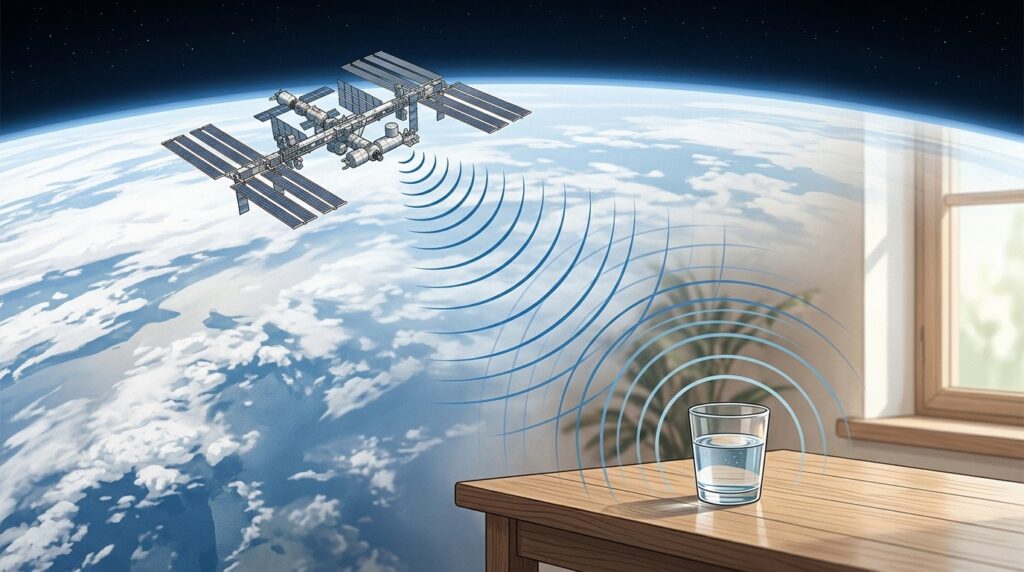
Radio waves from the ISS reach Earth’s surface and can be picked up even by a non-standard antenna
With transmission, everything is the exact opposite: the antenna must efficiently convert an electrical signal into radio waves and direct them in the right direction. Any losses in the antenna mean the signal simply won’t reach the recipient. A water antenna loses too much energy to function as a transmitter.
This is exactly why the experiment’s author specifically emphasized that to attempt transmitting through a water antenna, you would need serious measurement equipment — in particular, a vector network analyzer, a device for precise antenna tuning. And even then, no one guarantees success.
Can You Pick Up an ISS Signal Yourself?
The ISS regularly passes over most populated areas on Earth and transmits signals on open frequencies. Ham radio operators around the world pick them up, and it’s a fairly popular hobby. Most commonly, people use a simple directional antenna and an inexpensive SDR receiver. This is software-defined radio — a device that turns a computer into a radio receiver.
The Japanese experiment merely demonstrates that under the right circumstances, an ordinary glass of water can work instead of an antenna. However, you shouldn’t count on stable reception with such an antenna — it’s a demonstration of a principle, not a practical way to listen to orbit.
If you still want to try, here’s the minimum setup:
- SDR receiver (costs from a few thousand rubles);
- A simple antenna for the required frequency;
- Software for tracking ISS passes;
- A bit of patience, since the communication window lasts only a few minutes per pass;
What the Glass of Water Experiment Reveals About the Properties of Liquids
At first glance, this is just a fun trick. But behind it lies an important physical principle: an antenna doesn’t have to be a metal rod. Any material with suitable electromagnetic properties can interact with radio waves.
Water antennas aren’t exactly a new idea. Military researchers have been studying them for several decades. The main advantage of water antennas is that such an antenna can be quickly “turned on” and “turned off” simply by filling or emptying the container. This is impossible with a metal antenna.

A flask of water connected to a radio receiver
The value of the Japanese experiment lies in the simplicity of the conditions: tap water, no special equipment, and a real signal from hundreds of kilometers away. This simple example shows that the physics of radio waves is richer and more flexible than the familiar picture of metal antennas on rooftops.
Of course, no one is going to replace traditional antennas with glasses of water in the foreseeable future. But when a 14-centimeter column of water picks up voices of people from orbit, you can’t help but start looking differently at familiar things — both at water and at the radio waves that surround us.