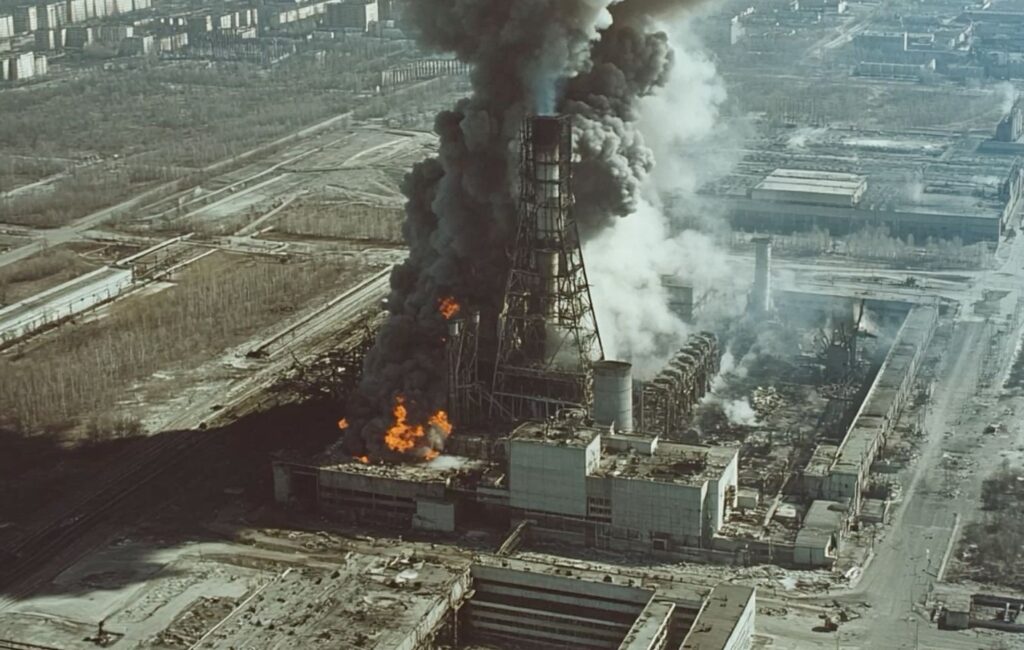
Fire and the destroyed 4th power unit of the Chernobyl NPP. Image source: vetkagolos.by
On the night of April 26, 1986, the largest nuclear disaster in history occurred at the Chernobyl Nuclear Power Plant. Two steam explosions destroyed the fourth reactor unit, releasing radioactive materials high into the atmosphere. The cloud covered vast territories of Europe, but the rest of the world learned about what happened only days later. Decades later, experts reconstructed the chain of events and found that the catastrophe was caused not by a single error, but by an entire cascade of decisions compounded by a fatal design flaw in the reactor.
What Happened at the Chernobyl Nuclear Power Plant on April 26, 1986
It all began with a routine test. Engineers wanted to check whether the turbine of the fourth power unit could, in the event of an emergency power outage, generate enough energy to power the emergency pumps. To do this, the reactor’s power had to be gradually reduced.
Around one o’clock in the morning on April 25, operators began reducing power. However, the dispatcher of the Kyiv power grid prohibited a complete shutdown because the grid needed the energy. As a result, the reactor operated at half power from 14:00 until approximately 23:00. This grossly violated the test protocol and led to the accumulation of xenon-135 — a substance that “poisons” the reactor and makes it unstable.
When the test finally resumed, the night shift took over — a less experienced crew. Instead of raising power and stabilizing the reactor, operators accidentally dropped it even lower. By 00:30 on April 26, it became clear that power had fallen too quickly. Trying to correct the situation, they extracted nearly all control rods — the very elements that slow down the nuclear chain reaction by absorbing neutrons.
Explosion of the Fourth Reactor Unit at the Chernobyl Nuclear Power Plant
The reactor’s power began fluctuating wildly. Operators tried to maintain control, including by temporarily reducing the supply of cooling water. But at 01:23, a power surge occurred that exceeded the norm by approximately 100 times. It was an uncontrollable runaway.
Personnel pressed the emergency shutdown button to lower all 211 control rods into the active zone. But the rods jammed. Two steam explosions, one after another, blew off the roof of the reactor building and hurled radioactive debris outside. The debris caused a massive fire. The active zone partially melted.
Radioactive materials rose high into the atmosphere and began spreading across Ukraine, Belarus, and then throughout all of Europe. Meanwhile, Soviet authorities did not immediately report the scale of the disaster. Swedish scientists were the first to raise the alarm, having detected an anomalous increase in radiation levels on their territory — several days after the explosion.
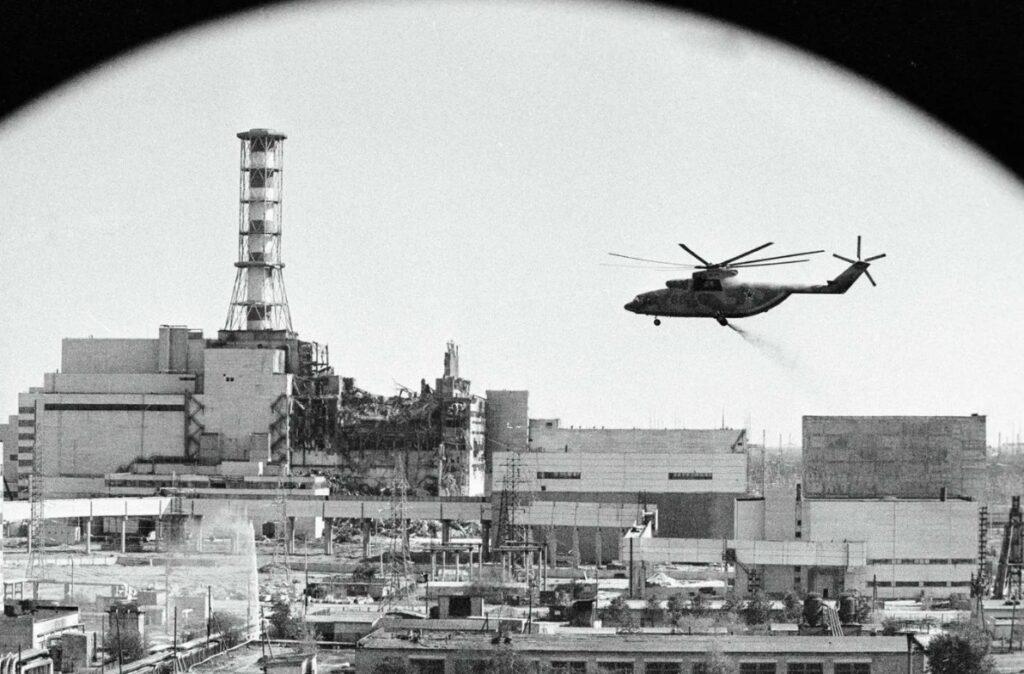
Helicopters decontaminate buildings of the Chernobyl Nuclear Power Plant after the explosion. Image source: gazetametro.ru
Why the Reactor Was Fatally Dangerous
Operator errors and protocol violations were only part of the cause. At the core of the catastrophe lay a fundamental design flaw of RBMK-type reactors (High-Power Channel Reactor), which were used at the Chernobyl NPP and other power plants in the Soviet Union.
To understand the essence of the flaw, you need to know how a nuclear reactor works. It sustains a chain reaction of uranium fission: neutrons split nuclei, which release energy and new neutrons. For the reaction to proceed stably, neutrons need to be slowed down, and for this a so-called moderator is used. And to prevent the reactor from overheating, it is cooled with water.
In Western reactors, ordinary water serves both functions — as moderator and coolant. This creates a natural safety mechanism: if the reaction speeds up, the water boils and turns to steam, the moderator disappears, and the reaction automatically dies down. This is called negative feedback.
In RBMK reactors, graphite served as the moderator, while water was only the coolant. When the water boiled, the moderator (graphite) remained in place, but the neutron absorber (water) disappeared. The reaction didn’t slow down — on the contrary, it accelerated. This is positive feedback: the hotter it gets, the faster the runaway. Imagine a car where pressing the brake engages the accelerator — that was roughly how the RBMK design worked in certain operating modes.
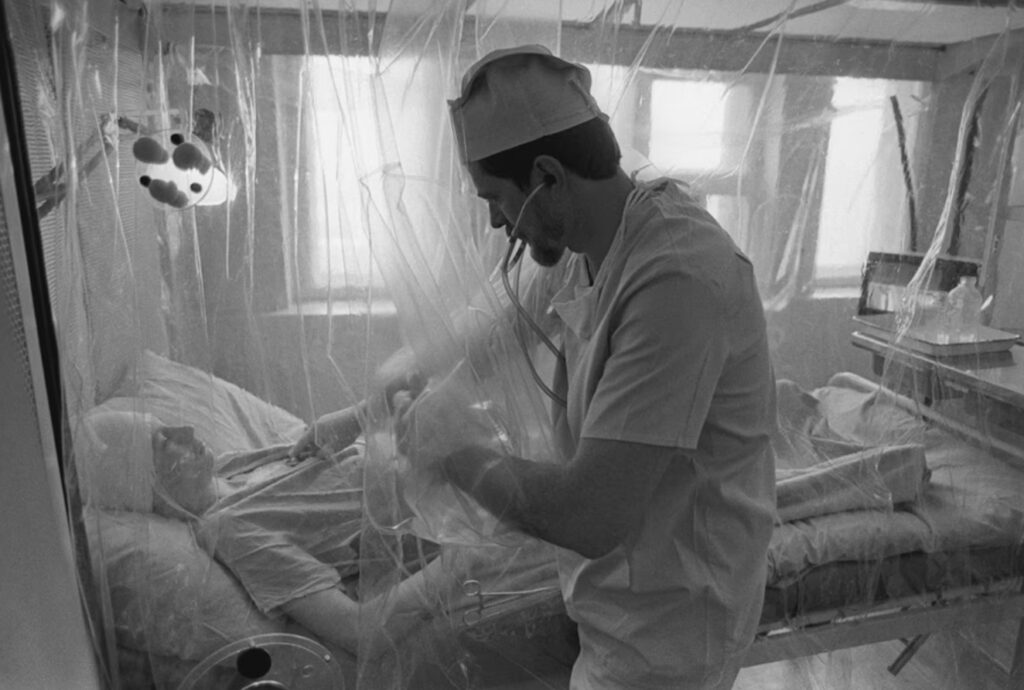
Examination of a patient with radiation sickness. Image source: theatlantic.com
Chain of Errors: From Plan to Catastrophe
Decades of investigations showed that the accident was caused not by a single reason, but by several overlapping factors:
- Operators did not have sufficient training to conduct the complex test;
- The test protocol was violated: the reactor operated at half power for about nine hours, leading to xenon poisoning;
- The night shift was less experienced and allowed a critical power drop;
- To compensate, operators extracted nearly all control rods, stripping the reactor of its last means of protection;
- The RBMK design with positive feedback turned errors into an uncontrollable runaway.
Each step individually might not have led to catastrophe. But together they created a situation from which there was no escape. When reactor power surged a hundredfold in mere seconds, there was no longer any chance of stopping the process.
The Chernobyl Exclusion Zone Today
Today, an exclusion zone of approximately 2,700 square kilometers surrounds the Chernobyl NPP, making it one of the most radioactively contaminated places on the planet. At the same time, it is a nature reserve where scientists observe how animals and plants adapt to elevated radiation levels. In 2025, it became known that a black fungus is growing on the walls of the Chernobyl NPP.
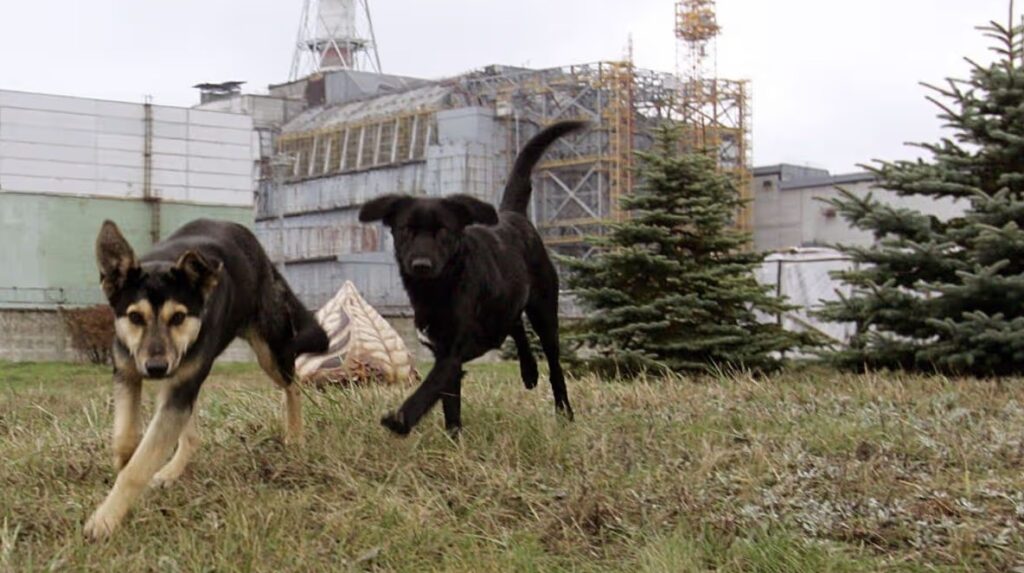
Chernobyl dogs. Image source: mirror.co.uk
Researchers have discovered that some species, such as frogs, have changed their coloring — they have darkened, which may be related to protection from radiation. The exclusion zone is called an example of “evolution in action”: nature is forced to adapt to conditions that did not exist before April 26, 1986.
The Chernobyl catastrophe became a turning point for the world’s nuclear energy industry. It forced a reassessment of reactor safety standards, changed society’s attitude toward nuclear energy, and demonstrated how a chain of “small” mistakes and compromises can lead to consequences of planetary scale. RBMK-type reactors were modernized after the accident, and new power plants around the world are built with the lessons of that night in mind. But Chernobyl’s main lesson is not an engineering one — it is a human one: even the most powerful technology becomes fatally dangerous when decisions are made in haste, with insufficient knowledge, and under the pressure of external circumstances.