
Exercise allergy can cause many problems, especially for those who enjoy an active lifestyle
Exercise allergy sounds like a lazy person’s excuse, but scientists say this condition truly exists. For some people, even a light jog or dancing can trigger a severe allergic reaction that includes itching all over the body and breathing difficulties. You might think this is something unbelievable, but doctors have been describing such cases for several decades.
What Is Exercise-Induced Anaphylaxis
This condition has an official name — exercise-induced anaphylaxis, or EIA. It is a rare but serious allergic reaction to physical exertion. It can cause intense itching all over the body, quickly followed by severe breathing difficulties.
According to Refractor.io, from 2.3% to 5% of all anaphylaxis cases worldwide are triggered specifically by physical exertion. This means that for most people, exercise is completely safe and helps strengthen the body and improve sleep quality, but a small group faces a real threat.
It’s important to understand that this is not made up and not an excuse for laziness. Allergies come in many forms, and sometimes people can even be allergic to other people.
How Exercise Allergy Was First Discovered
The condition was first described in the 1970s by doctors from Colorado. The case involved a 30-year-old long-distance runner who was hospitalized several times within a few days apart, right during his runs.
Tests showed that his blood had all the characteristic signs of anaphylaxis. Intrigued, the doctors dug deeper and quickly discovered a curious detail. It turned out that symptoms only appeared when he ran after eating seafood. Once seafood was eliminated before training, there was no reaction.
This case launched an entire field of research. It turned out that food and exercise together can trigger what passes without a trace when they occur separately.
Exercise Allergy and Food
Today it is well known that not all cases of exercise allergy are related to food. But one of the most common subtypes is called exactly that — food-dependent exercise-induced anaphylaxis. It is most often provoked by specific foods.
The most common causes of food-dependent anaphylaxis are:
- seafood and shellfish;
- nuts;
- eggs;
- milk;
- wheat.
Symptoms can also occur when exercise follows medication use, infections, hormonal changes, alcohol, and even inhaling pollen. In some cases, the reaction is triggered by physical exertion alone, without any additional trigger.

Seafood, nuts, and wheat are common food triggers
The symptoms themselves are similar to other allergic reactions: itchy rash, swollen lips, tingling in the mouth, and even vomiting after exercise. In severe cases, breathing and circulation problems are added. Most often, the reaction is provoked by jogging, soccer, dancing, and even gardening.
Why the Exact Cause of Exercise Allergy Remains Unclear
Despite decades of research, the exact cause of exercise allergy remains unknown. Scientists initially thought it was simply a variant of food allergy, but subsequent studies showed it was more complex.
The closest to an answer came through oral immunotherapy trials. This is a method where people with peanut or wheat allergies are given tiny doses of the product every day to train the immune system to tolerate it. It turned out that this trained tolerance stops working if the person exercises after consuming that same small dose. According to scientists’ calculations, after exercise, a reaction can be triggered by roughly half the amount of food that would normally be needed.
Medical literature describes cases where people with no known allergies experienced repeated episodes of anaphylaxis after moderate or intense aerobic exercise. Conversely, participants in the same studies did not always have a reaction from exercise, even if they had eaten potentially allergenic food beforehand. This suggests that some unidentified factors are involved in the development of symptoms.
The Role of Mast Cells and Histamine in Allergy
Although complete clarity is lacking, most scientists now believe that a special type of immune cell plays a central role — mast cells. These are the cells that release chemical substances into the blood, including histamine.
Under normal circumstances, histamine is useful because it helps regulate blood flow, mucus production, and airway opening, protecting us from infections and injuries. But during an allergic reaction, the same histamine causes itching, redness, and narrowing of the airways. In exercise allergy, mast cells become activated at the wrong time, and a sudden release of histamine constricts both the airways and blood vessels. And that is anaphylaxis.
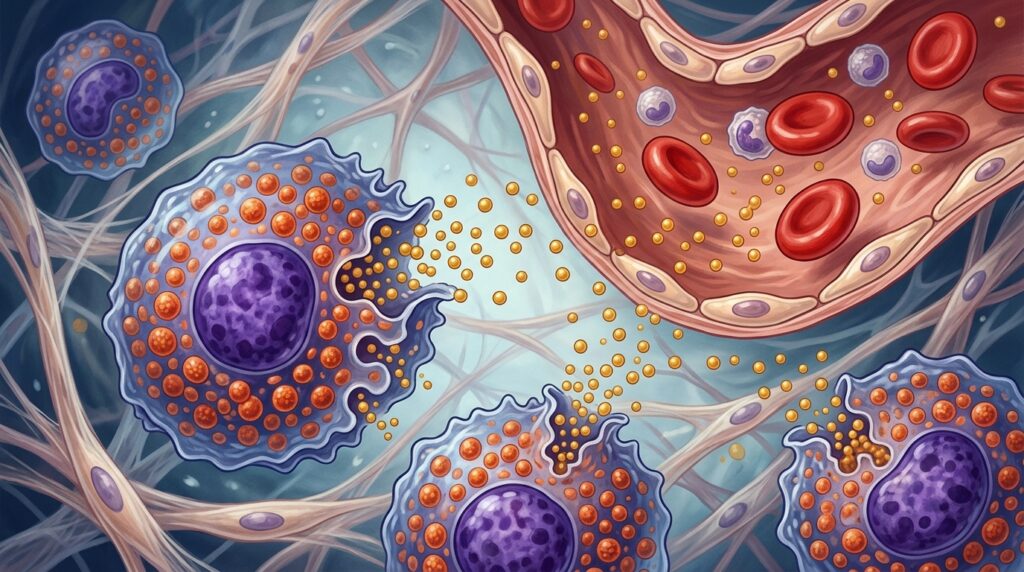
Mast cells release histamine into the blood
How People with Exercise Allergy Live
For people with exercise allergy, doctors try to reduce both the severity and frequency of reactions. This is usually achieved through behavioral changes. For example, starting with light activity and gradually increasing the intensity to find personal limits.
If a specific food trigger is identified, specialists advise not exercising for at least four hours after contact with the allergen. The main precautions for those already diagnosed are as follows:
- always carry an epinephrine auto-injector;
- exercise with a partner who can notice symptoms and help;
- immediately stop exercising at the first signs of a reaction.
The good news is that most people with this diagnosis live normal, active lives. This is possible thanks to knowledge of their diagnosis, behavioral changes, and medication. But if something like this has ever happened to you, it’s worth staying prepared. It’s important that a healthy habit doesn’t turn into something serious.