
Applause has a very long history, and ovations even have their own rules
Clapping your hands out of joy or during a concert seems so natural that few people wonder where this habit came from. Applause is so deeply wired into us that a crowd always claps in unison. Behind the ovations we take for granted lie both the evolutionary past of our species and several thousand years of cultural history. The history of applause stretches from Ancient Rome to modern concert halls, where clapping “at the wrong time” is now considered bad form.
When Did People Learn to Clap Their Hands
If clapping your hands together to make the loudest possible sound seems like a rather primitive activity, that’s not far from the truth. The origins of applause go deep into human evolutionary history, and most likely appeared even before our ancestors mastered complex language.
When people couldn’t really speak yet, a loud clap was a convenient universal signal. With a sharp clap, our ancestors could attract attention, place themselves at the center of the group, express excitement or anxiety, and sometimes even intimidate a rival or potential predator, driving it away.
Why Clapping Is a Human Universal
The habit of clapping has such a long history that it is literally built into our lives. This is why researchers consider applause a human universal — a trait found in all people without exception.
According to the authors of the website Mental Floss, there is not a single culture on the planet that doesn’t use clapping in some form as a way to communicate with one another. This puts applause in the same category as things like smiling or gestures — behavior that doesn’t need to be specially reinvented in each society.
Interestingly, this doesn’t make clapping absolutely identical everywhere. Psychologists note that in different cultures, the same claps can mean slightly different things.
Four Types of Applause and What They’re For
Although clapping looks uniform from the outside, psychologists identify different types of applause that serve different purposes. Understanding these types helps explain why we sometimes clap for rhythm, sometimes out of politeness, and sometimes from genuine delight.
- Motivational applause — the kind used to encourage a person and push them toward achieving a goal;
- Playful applause — rhythmic, coordinated claps that accompany a game or pick up a musical beat;
- Protocol applause — clapping at formal events like speeches and political addresses, which a speaker can deliberately elicit and an audience can use to show agreement;
- Appreciative applause — the most familiar form, in which an audience expresses gratitude, admiration, and pleasure at a successful performance.
The last type is the most common today. But our ancestors were unlikely to have put on lavish shows for each other, so where did the habit of applauding a performance come from?
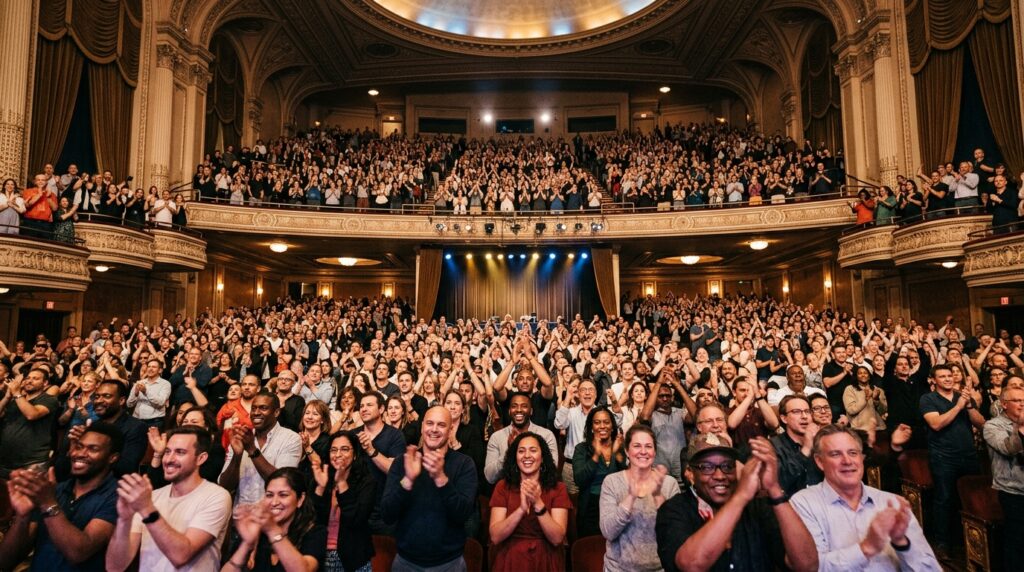
Appreciative applause is the most familiar type of ovation
Where Did the Tradition of Clapping at the End of a Performance Come From
There is no direct evidence, but appreciative applause may well have ancient roots. Applause and ovations may have appeared alongside the first social groups, when people developed collective creative activities like music and storytelling.
Clapping in this case falls in line with other bodily ways of making noise: whooping, shouting, stomping feet. After a particularly moving story or rousing music, a collective burst of applause could easily have followed. This is a plausible hypothesis, but we have no solid evidence of such ancient origins.
Applause in Ancient Rome and Greece
The earliest evidence of applause comes from an unexpected source — the Bible. Clapping is described as a celebration at the coronation of King Joash in the Second Book of Kings, and this text was recorded more than 2,500 years ago, in the 6th century BCE.
The Greeks, according to available data, preferred to stomp their feet after performances. But their audiences could be remarkably rowdy, and clapping hands is the easiest thing to do, so it’s quite possible they used applause as well. The Romans, however, undoubtedly used applause to express appreciation, though not always in the way we’re accustomed to.
Roman audiences might merely snap their fingers as a sign of moderate approval. But if a performance truly impressed them, spectators would wave the hems of their togas (their garments) or flutter white handkerchiefs in the air. So the Romans were among the first cultures to adopt the ovation as a way to acknowledge a brilliant performance.
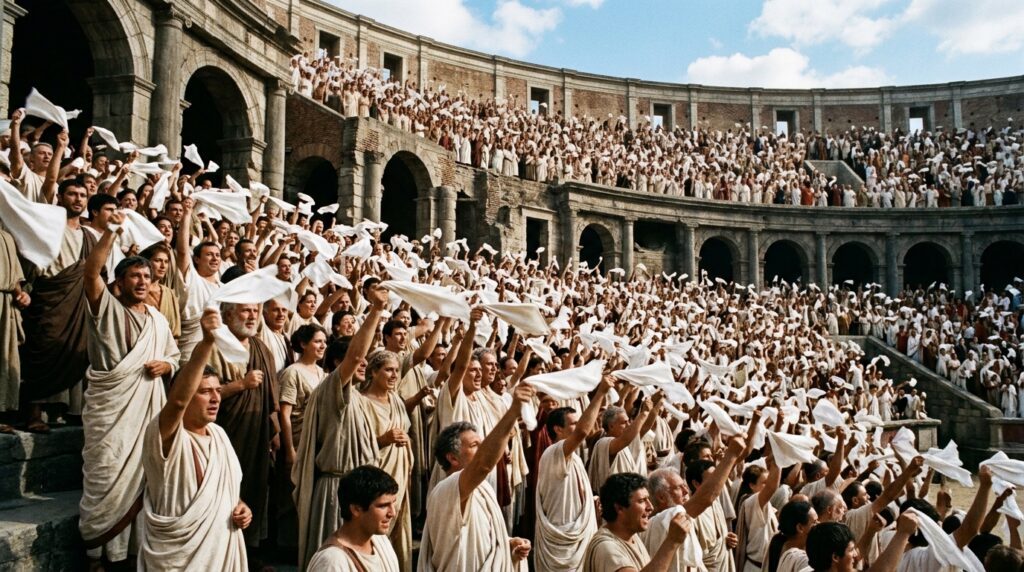
Romans expressed their delight not only with clapping, but also by waving togas and handkerchiefs
When You Shouldn’t Applaud at a Concert
Since antiquity, the habit of clapping has changed considerably. As recently as the 18th and 19th centuries, audiences often applauded right in the middle of a performance if they were particularly captivated by what was happening, and this was considered perfectly normal.
Mozart himself, who died under mysterious circumstances, welcomed such reactions. In a letter to his father after a concert in 1778, he described how right in the middle of the first allegro movement the audience became ecstatic and broke into thunderous applause. Moreover, the composer said he had known in advance that this particular passage would produce such an effect.
Today the rules have been turned upside down. Try clapping in the middle of a piano concert in a modern hall, and you’ll most likely be asked to leave. The very same gesture that was once the highest praise during a piece is now perceived as a gross breach of etiquette.
So applause is an ancient, almost instinctive signal. But how and when we clap depends entirely on culture and era. And the next time a hall erupts in an ovation, it’s worth remembering that this simple gesture may be millions of years old.