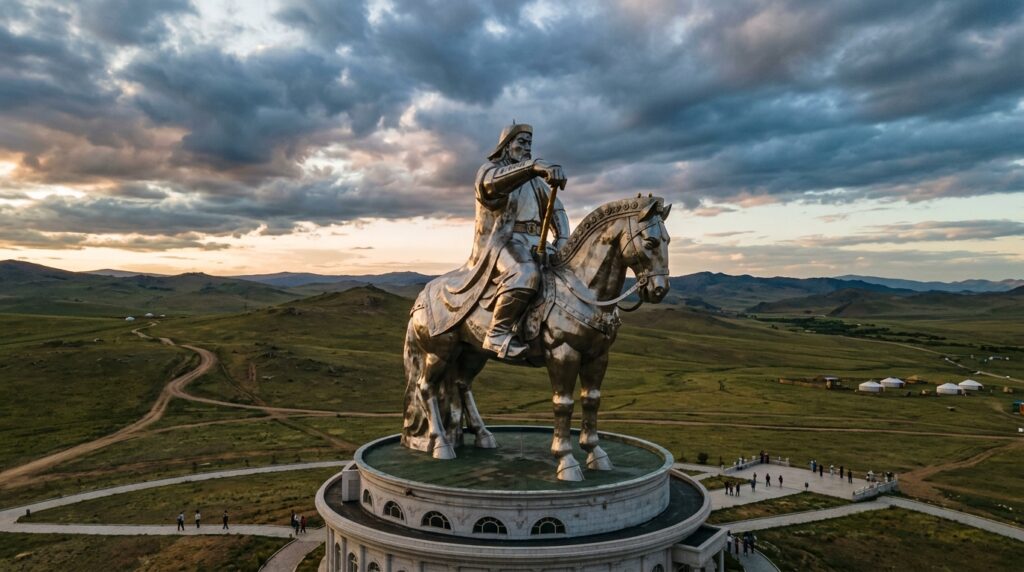
Genghis Khan’s tomb is so well hidden that it will likely never be found
Genghis Khan was one of the most influential people in history because he created the largest land empire of all time and was known for his extraordinary cruelty. But despite all this, the burial site of Genghis Khan has still not been found, even though nearly eight centuries have passed since his death. And there are people who sincerely believe that searching for it is unnecessary.
How Genghis Khan Died and Why It Remains a Mystery
Genghis Khan died in 1227, leaving behind an empire stretching across all of Eurasia. Yet surprisingly little is known about the man himself — even the exact circumstances of Genghis Khan’s death remain a mystery.
There is no shortage of theories, ranging from infectious disease and battle wounds to a fall from a horse and a fatal lightning strike. There is even a rather exotic legend that the khan died from blood loss after being mutilated by a Tangut princess. It sounds wild, but stories like these show just how little reliable information has reached us about his final days.
Where Genghis Khan’s Tomb Might Be Located
The most well-known theory points to a sacred mountain in Mongolia. According to legend, Genghis Khan’s body was returned to his homeland, to the summit of Burkhan Khaldun in the northeast of the country. It is believed that the khan once hid on this mountain from his enemies and swore to return there after death.
But even this version raises doubts. Some scholars question it, and not without reason: historically, the name Burkhan Khaldun was given to at least five different mountains, so it is unclear which peak is actually being referred to. In other words, even if the legend is true, it doesn’t give us a specific point on the map.
Why Genghis Khan’s Burial Site Was Kept Secret
According to the most widely circulated legend, the secrecy was absolute and bloody. Warriors building the tomb killed everyone they encountered along the path of the funeral procession, and then took their own lives so that no living soul could reveal the location.
Whether this is true is impossible to verify. This is folklore passed down from generation to generation, not a documented fact. Interestingly, one of the main Mongolian sources makes no mention of a tomb at all and simply states that in 1227 Genghis Khan “ascended to heaven.”
Does the Curse of Genghis Khan’s Tomb Exist
According to one legend, Genghis Khan’s tomb was sealed with a curse. If the khan’s remains are ever found, it would supposedly trigger the end of the world.
It is important to note here that there is no evidence for this story — it is a belief, not a scientific fact. But it is precisely this belief that explains why there is so much superstitious fear surrounding the topic, and why some people prefer that the tomb not be disturbed at all. This was discussed by the authors of the IFL Science website.
Why Mongolian Authorities Won’t Allow the Search for Genghis Khan’s Tomb
Even if you set aside all the folklore, reaching the possible tomb is extremely difficult — and for entirely earthly reasons.
First, Burkhan Khaldun mountain is a sacred site, listed as a UNESCO World Heritage Site, and is strictly controlled by Mongolian authorities. Archaeologists with shovels would hardly be welcome there.
Second, searching elsewhere won’t make things any easier. The Mongolian steppe is a vast open space, largely undeveloped and poorly connected by roads. Moving through such terrain requires serious preparation, knowledge of the area, and decent horseback riding skills. This is not a casual weekend trip out of town.
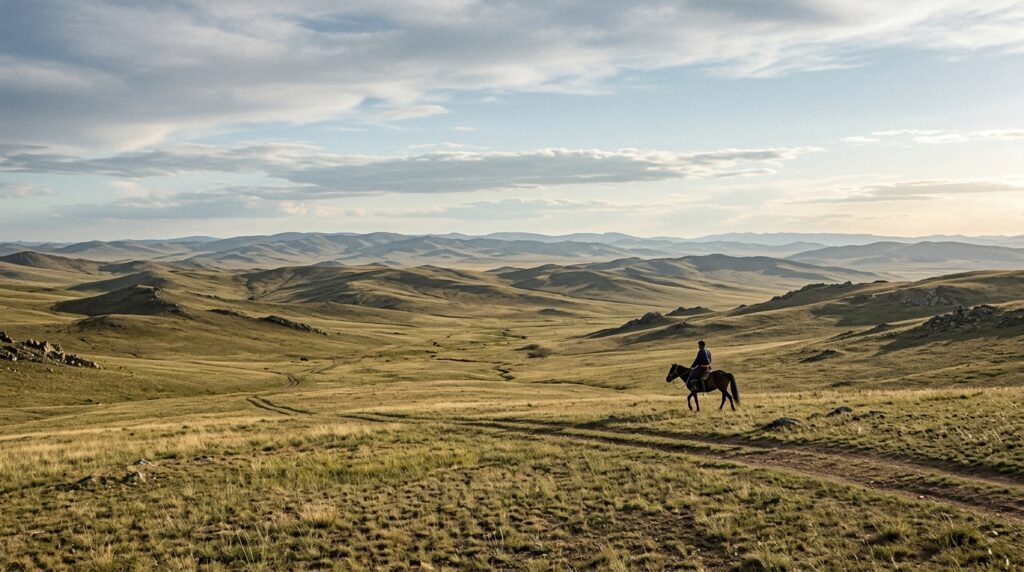
The Mongolian steppe is a vast and nearly uninhabited space that is difficult to traverse
Which Locations Archaeologists Have Already Checked
Claims about finding Genghis Khan’s tomb appear regularly, and almost always fail to hold up under scrutiny. As early as 1927, it was reported that a Russian archaeologist discovered Genghis Khan’s tomb near the ruins of the dead city of Khara-Khoto in the Gobi Desert. Over the past century there have been numerous such claims, and historians have met most of them with skepticism.
Later, modern technology entered the picture. An engineer from the University of California, San Diego, Albert Yu-Min Lin, came up with an unusual approach to the search back in the late 2000s.
Searching for Genghis Khan’s Tomb via Satellites
Lin’s idea was simple yet brilliant. He proposed enlisting volunteers from around the world to help with the search. In a 2014 study published in the journal PLOS ONE, researchers invited thousands of internet users to examine satellite images of Mongolia and mark anything that looked unusual.
The scale is impressive. More than 10,000 volunteers spent approximately 30,000 hours, examined 6,000 square kilometers, and made 2.3 million annotations. The trick was that no one knew what the tomb was supposed to look like, so scientists relied on the collective intuition of the crowd to identify anomalies across a vast territory.
This approach is also beneficial because it is non-invasive — satellites, drones, and scanning allow researchers to examine the Burkhan Khaldun area without digging into the ground. This was largely what helped obtain permission to approach the sacred mountain. The search identified 55 potentially significant archaeological sites, and the team found thousands of artifacts from that era, but the tomb itself or the remains of Genghis Khan were not among the discoveries.
Why Genghis Khan’s Tomb May Never Be Found
Put it all together, and it becomes clear why the mystery of Genghis Khan’s tomb has persisted for so long. We have no clear description of what the tomb looks like. The sacred mountain is closed to excavation. The steppe is vast and difficult to traverse. And the topic is shrouded in so many legends and fears that separating fact from fiction is difficult even for specialists.
It is entirely possible that this is how it should be. If the legend is to be believed, Genghis Khan deliberately wanted his final resting place to remain a secret. Technologies like satellite-based searches have shown that such mysteries can be studied without disturbing the peace of sacred sites.