
They say you should make a wish at 11:11, but this only makes us fall into a trap
If you’ve ever caught yourself thinking that the clock suspiciously often shows exactly 11:11, you’re not alone and you’re definitely not losing your mind. Behind this lies not magic, but a feature of how the brain works — the so-called frequency illusion, or the Baader-Meinhof phenomenon. This effect makes us notice the same thing everywhere once it has entered our field of attention.
What Is the Baader-Meinhof Phenomenon in Simple Terms
You’ve probably experienced this: you learned a new word, bought a car of a certain model, or heard a rare name. And suddenly that word, that car, and that name start appearing literally at every turn. It feels like the world is conspiring. In reality, nothing around you has changed — only your attention has.
The name of the effect is unusual and has no relation to science. According to IFL Science, the phenomenon was named after the German terrorist Baader-Meinhof group. In 1994, a man named Terry Mullen wrote a letter to a Minnesota newspaper: he had been talking about the gang with a friend, despite not having heard about it in years, and the next day his friend stumbled upon an article about the same group and began encountering mentions of it constantly.
Since then, this name has been used to describe exactly that situation when something new to you suddenly seems to be everywhere. Scientists more often use the more precise term, frequency illusion.
How the Frequency Illusion Works
The mechanism here is extremely simple and consists of two parts. First, your brain essentially receives a tag that the information it encountered is important. For example, someone told you that 11:11 appears frequently. After that, the brain begins to selectively notice exactly those moments and ignore everything else.
Then the second part kicks in — confirmation of your own belief. Every time you see 11:11, the brain happily notes: “There it is again!” But the dozens of times when the clock showed 14:37 or 09:02, you simply don’t remember, because they seem insignificant. As a result, you get the feeling that the special time appears more often, when in reality you’ve just stopped counting all the other glances at the clock.
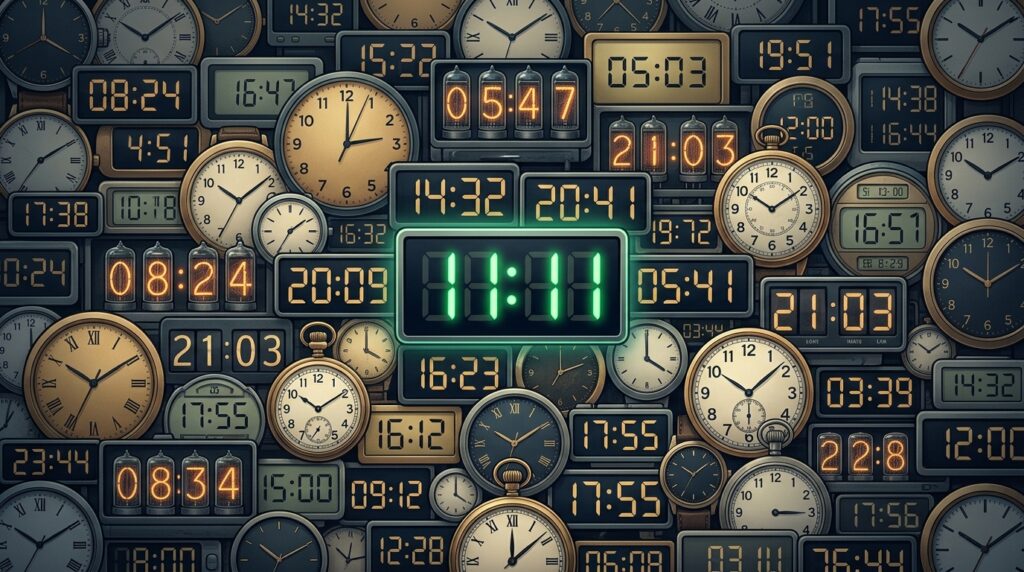
We remember rare coincidences and skip hundreds of ordinary moments
Interestingly, even scientists are not immune to this trap. Linguist Thomas Grano described in 2005 how his research group was convinced that young people used a certain speech expression constantly. But when conversations were recorded, transcribed, and counted, it turned out that it actually appeared very rarely. The researchers themselves had fallen into the very same frequency illusion.
Does 11:11 Really Appear More Often Than Other Numbers?
No. And this is easy to verify with logic. There are exactly two moments in a day when the clock shows precisely 11:11 — in the morning and in the evening — exactly the same number of times as 03:33, 21:15, or any other specific time. There is simply no statistical advantage for this combination.
So why does it catch our attention more? The thing is that the brain perceives identical repeating digits as a pattern, and our brain loves patterns. A neat row of four ones looks special next to random digits like 16:48. That’s why we pay attention to it, and attention then turns into a sense of frequency.
Why 11:11 Seems Like a Sign of Destiny
Here, culture adds to how the brain works. On the internet, 11:11 has long been turned into an “angel number” and supposedly a sign of luck on which you should quickly make a wish. Once this idea takes root in your mind, the frequency illusion triggers with double force. You’re already inclined to notice neat digits, and now you also have an emotional reason to look for them.
Social media plays a separate role. Posts about coincidences and signs go viral because they evoke emotion and the desire to share. The more people around you talk about 11:11, the higher the chance that you too will start noticing this time. It turns out that belief in a sign strengthens attention, and attention reinforces belief in the sign.
When Searching for Signs Becomes a Problem for Mental Health
The 11:11 coincidence itself is completely harmless — it’s a normal and even amusing feature of perception. You should only worry when a person starts building important decisions around random coincidences. For example, they begin waiting for the right sign to act, or see hidden meaning where there is none.
It’s useful to remember that a coincidence remains a coincidence, even if it’s a beautiful one. Understanding how the frequency effect works helps you take a calmer attitude toward such signs and not attribute power to them that they don’t have.
Next time the clock shows 11:11, you can simply smile. Now you know that it’s not a message from the Universe, but a clear demonstration of how your brain chooses what to notice and what to skip. And most likely, in the coming days you’ll see this time especially often — because you’ve just hung that very same tag on it again.