If you’re currently choosing an Apple Watch, you’re probably itching to grab the latest model — Series 11. The logic is clear: newer means better. But what if I told you that these watches have the exact same processor as the Series 10 from two years ago? And that the price difference between them can reach 5,000 rubles? Let’s figure out which Apple Watch is actually worth buying in 2026 and where you can save money without sacrificing quality.

Found the ideal Apple Watch model for the best price-to-features ratio
Processor in Apple Watch Series 10 and Series 11
Let’s start with the most important thing. Series 11 runs on the S10 SiP chip — the exact same one found in Series 10. A quad-core neural engine, 64-bit architecture, 64 GB of built-in storage. Everything is identical. Apple didn’t develop a new processor for the eleventh generation. Instead, the company focused on software optimization in watchOS 26. Apps on Series 11 launch a fraction of a second faster, animations are slightly smoother — but noticing this without a stopwatch is virtually impossible.
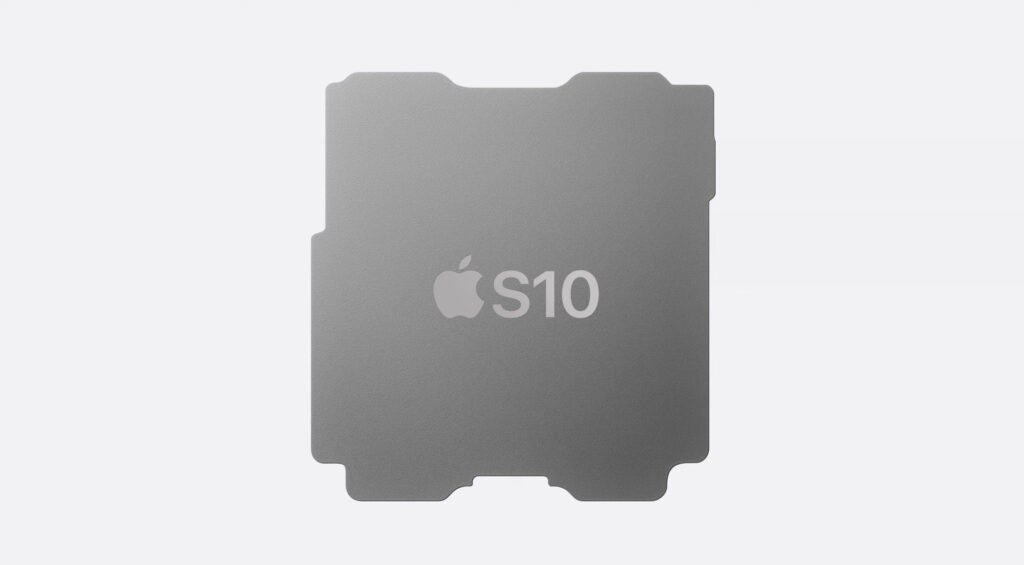
Both watches have the same processor, meaning the same performance speed
For the average user, this means one simple thing: both generations perform at the same speed. The interface is responsive, apps fly, Siri works without delays. You won’t feel any difference in everyday scenarios. And this isn’t just my speculation — it’s confirmed by all reviewers who’ve had both generations in hand.
Differences Between Apple Watch Series 11 and Series 10
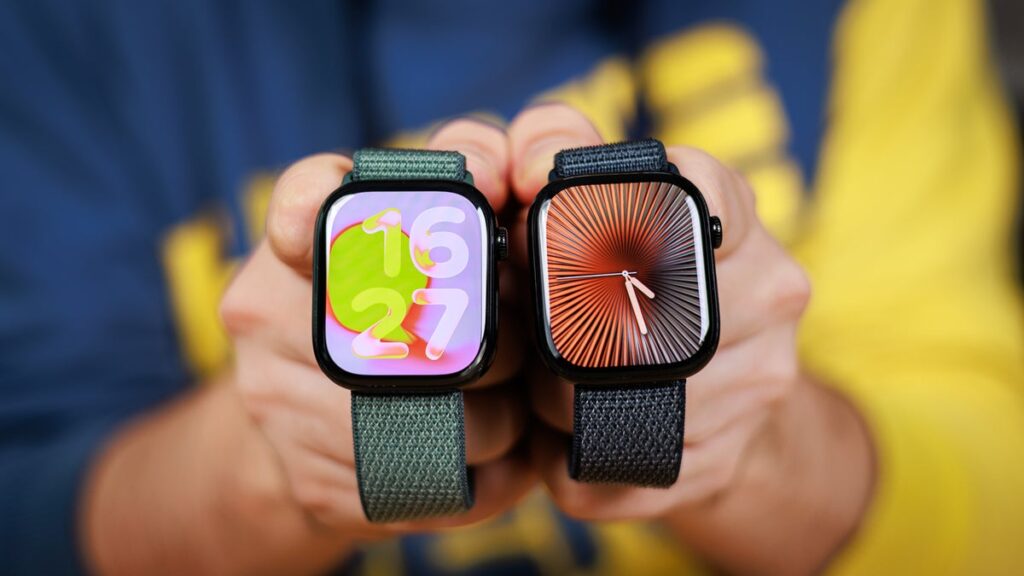
You definitely won’t find any design differences either
To be fair, there are some differences between the generations. But you can count them on one hand.
- Battery life. Apple claims up to 24 hours of use for Series 11 versus 18 hours for Series 10. In power-saving mode — 38 versus 36 hours. Battery capacity increased by roughly 8-10%. On paper it sounds impressive — an extra six hours is significant.
But there’s a catch. Apple changed its battery life calculation methodology. The 24 hours for Series 11 includes 6 hours of sleep tracking, when the watch consumes minimal energy. In reality, with the same daytime usage scenario, the difference between the Series 10 and 11 isn’t as dramatic as you’d hope. Both models still need charging every evening.
- Cellular module. The Cellular version of Series 11 added 5G support instead of LTE. For Russia, this is completely irrelevant — 5G networks aren’t deployed there, and eSIM technology on Apple Watch doesn’t work in the country due to legislative restrictions. So for Russian buyers, this difference can be safely crossed off the list.
- Glass protection. Apple updated the Ion-X glass on aluminum versions. According to reviews, it does resist scratches better. A nice but not critical improvement.
- Hypertension detection. Series 11 can analyze data from the optical sensor and warn about signs of high blood pressure. But the watch doesn’t measure blood pressure directly — it only tracks trends and sends notifications. A useful but not revolutionary feature.
Just as a reminder, 5G support and hypertension detection are completely irrelevant for Russia. Neither function works in the country, which means there are even fewer differences.
What Apple Watch Series 10 and Series 11 Have in Common
And this is where it gets really interesting. Series 10 and Series 11 are absolutely identical in key specifications.
Both models come in 42 and 46 mm sizes. Case thickness is 9.7 mm. LTPO3 OLED display with brightness up to 2000 nits and Always-On Display. Screen resolution on the 46 mm version is 416×496 pixels.
The sensor suite is also identical: heart rate monitor, blood oxygen sensor, ECG, thermometer, barometer, compass, accelerometer, gyroscope. WR50 water resistance — you can swim at depths up to 50 meters. The depth gauge works up to 6 meters.
Case materials are the same — aluminum for base versions, titanium for premium ones. All bands from Series 10 fit Series 11 and vice versa. Even visually, it’s impossible to tell one watch from the other on your wrist.
Apple Watch Series 10 Price
Now let’s look at prices. And here Series 10 wins by a huge margin. At the time of writing, Series 10 in the 46 mm version can be found on Ozon starting from 24-25 thousand rubles plus customs duty. These are watches with the same processor, the same screen, and the same set of sensors.
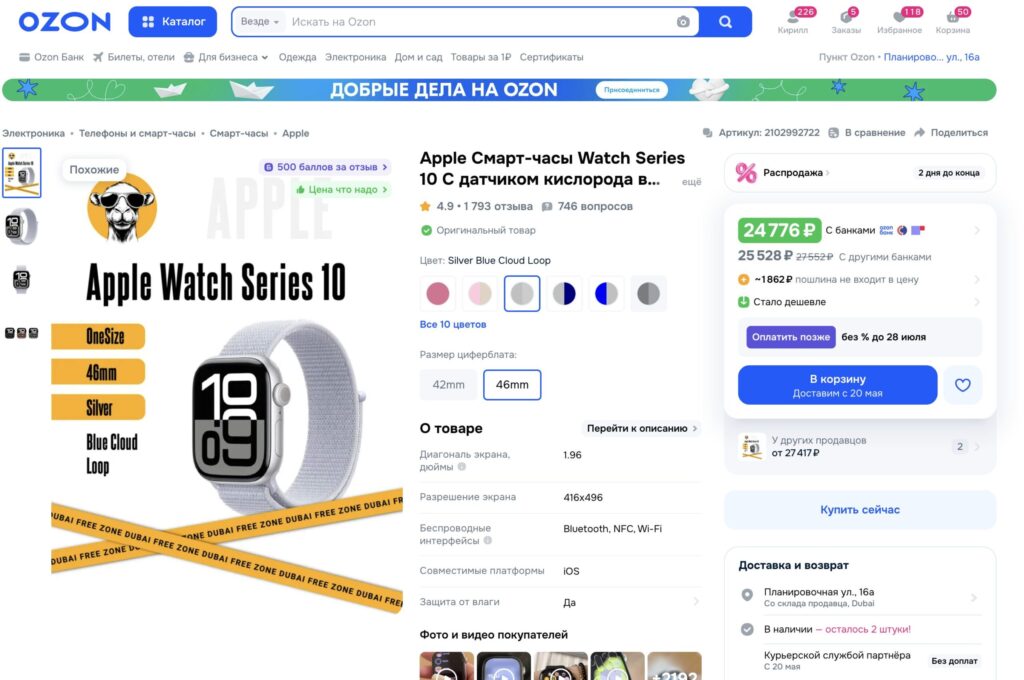
You can get a great deal on Series 10 on Ozon
Series 11 in a similar configuration starts from 29 thousand rubles in the best deals, and the customs duty is even higher when purchasing them, while major retail chains like re:Store or DNS price them at 45-55 thousand. The difference is significant — especially if you’re not willing to overpay for a marketing claim of six extra hours of battery life.
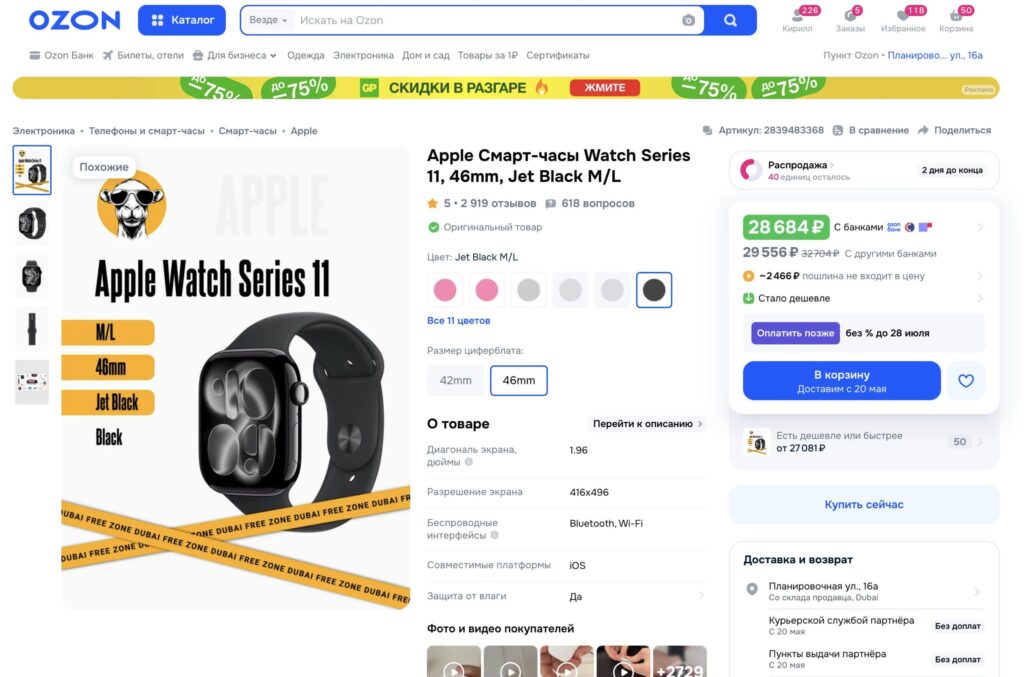
Series 11 is also available on Ozon, but more expensive. If there’s no difference, why pay more
The situation with the Series 10 is especially favorable right now because after the new generation launched, sellers are actively clearing out remaining stock. Discounts, promotions, sales — you can catch Series 10 at a very attractive price. And in six months, there will be even fewer such offers.
Who Should Buy Apple Watch Series 11
It would be unfair not to mention the cases where the Series 11 justifies its price. If battery life is critically important to you — for example, you wear your watch around the clock and want to track sleep without the daily hassle of charging — Series 11 will give you extra capacity. Even though the real difference is less than the claimed six hours, it does exist. Fast charging has also improved slightly: 15 minutes on the charger gives you 8 hours of use.
If you’re buying your first Apple Watch and the price difference between Series 10 and 11 at a particular store is minimal — of course, go with the newer generation. Why save a thousand rubles when you can get a newer device?