We recently covered when 5G will launch in Russia, and now some rather disappointing details have emerged. Soon you may notice the coveted 5G icon on your smartphone — but there will likely be nothing to celebrate. According to a new study by MTS, for the vast majority of devices in Russia, the icon will simply light up while internet speeds remain exactly the same as they are now. Let’s break down why this happened — and whether it’s even worth waiting for fast mobile internet.
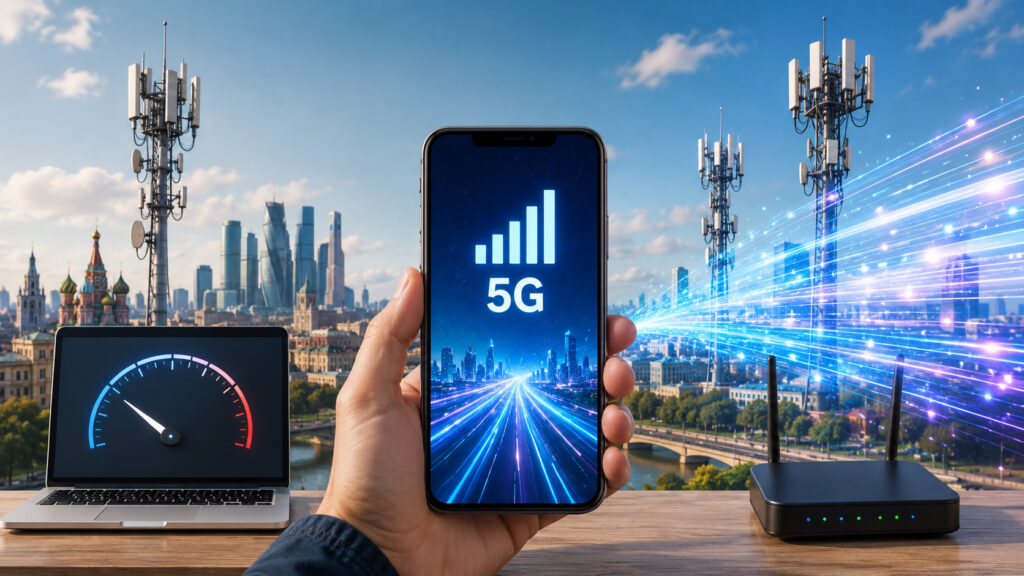
Expecting record speeds from 5G? I have bad news for you
The idea of 5G sounds great: gigabit speeds, instant downloads, minimal latency. But between a beautiful presentation and what ends up in your hand lies an abyss. And the main reason isn’t the money operators will spend on the launch. It’s about physics, frequencies, and what hardware is inside your phone.
Why 5G in Russia May Not Speed Up Mobile Internet
The most unpleasant thing about Russian 5G is the empty icon effect. A proud 5G icon will appear on your screen, you’ll think you’ve connected to a next-generation network, but in reality the speed won’t change by a single bit.
It sounds absurd, but the numbers confirm it. According to MTS research, in the frequency band allocated for Russia, only 3% of devices will actually be able to connect to 5G. The remaining 97% of phones will see the icon but will continue operating at the same speed as today’s LTE.
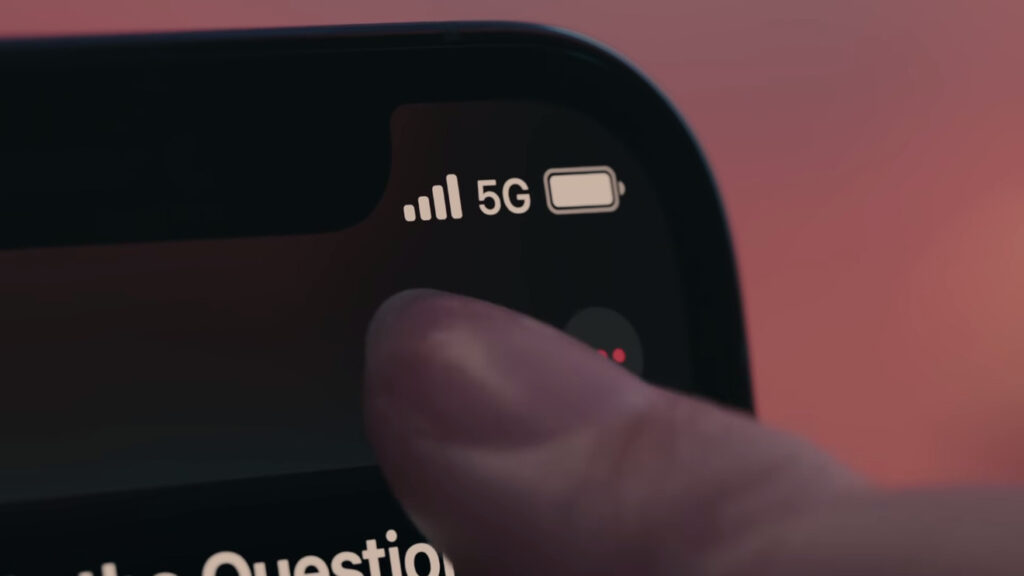
Not all smartphones on sale are ready for Russian 5G
Why is this the case? Each smartphone can only pick up the frequencies for which its modem and antennas are designed. Most devices that are being sold and already sitting in people’s pockets are not hardware-equipped for the Russian 5G frequency band. The network is technically available to them. But the icon may still light up regardless.
In other words, for most of us, the 5G launch in its first years will look like a cosmetic update: new icon, same experience.
5G Frequencies in Russia: Why It Matters
To understand where those 3% come from, we need to dig into frequencies. This is where the whole speed story is buried.
Operators in Russia have been allocated the 4.8–4.99 GHz band. In the rest of the world, the gold standard for 5G is the 3.4–3.8 GHz range — the so-called mid-band, an ideal balance between speed and signal range. This is what networks are built on in Europe, the US, and Asia, and this is what modems for global smartphone versions are designed for.
In Russia, however, these “proper” frequencies are occupied by military and security services, and nobody intends to hand them over to operators. So telecom companies were given a higher band — 4.8–4.99 GHz. And the higher the frequency, the worse the signal penetrates through walls and the faster it fades over distance.
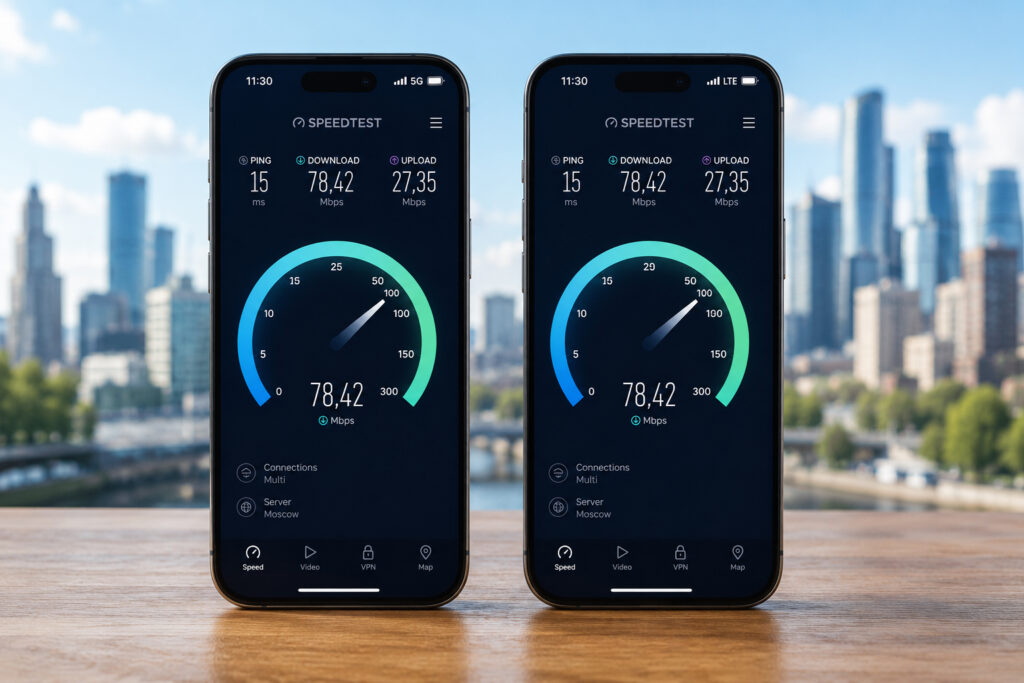
5G and LTE speeds will be identical. At least for the time being
This leads to two immediate problems for speed. First, this band requires 1.5–2 times more base stations to cover the same area. Until they’re installed densely enough, real-world speeds in urban conditions will fluctuate and drop. Second, very few smartphones are designed for this specific band — hence those 3%. Manufacturers simply didn’t include support for Russian frequencies in their global market models.
It’s a vicious circle: non-standard frequencies, almost no phones designed for them, and where the network does work — speed will be limited by tower density.
Real 5G Speed in Russia and Launch Timeline
Let’s be honest about what to expect in practice.
If your phone is among the 97% — nothing will change for you. Speeds will remain at the usual LTE level, no matter how beautifully the icon glows. You won’t feel any acceleration in downloads, streaming, or gaming.
If you’re lucky and your device is in the 3% — speed will directly depend on how many towers have been installed near you. And in the first years, that will be tough. The rollout is gradual and slow: in 2027, 5G will only be switched on in Moscow, St. Petersburg, and Novosibirsk. By 2029, networks will reach 16 cities with populations over a million. In the first year, operators are only required to cover 15% of a city’s territory, and only by the third year — 50%.
What does this mean for you? Even in a lucky city, you’ll constantly be jumping between 5G and LTE: you catch a fast network on one street, walk a block away — and it’s regular internet again. There’s no talk of stable gigabit speeds across an entire city for a long time — full nationwide coverage is expected only around 2035.
So if you were hoping 5G would instantly turn your mobile internet into home fiber — sorry. In the coming years, this will be a spotty experience for select areas and select devices.
Will 5G Work on iPhone in Russia
And here, iPhone owners are in for a separate surprise. Even if your iPhone somehow ends up among those 3% of devices with a compatible modem — that’s still no guarantee of speed.
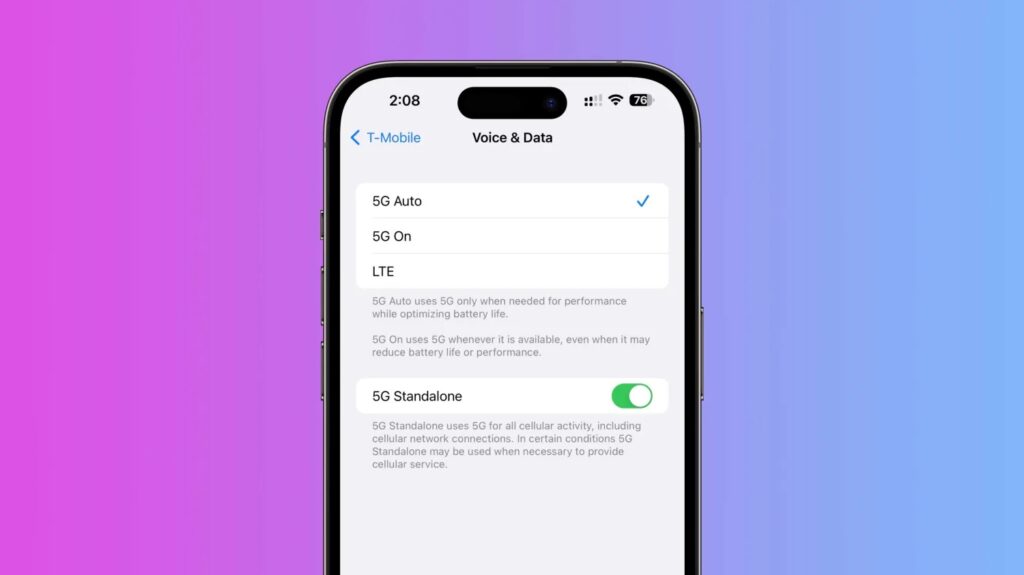
We most likely won’t see the coveted 5G toggle on iPhone in Russia
The thing is, 5G on iPhone doesn’t just turn on by itself. Network support must be activated by Apple itself, individually for each operator and only after its own testing. If the company hasn’t given the green light — the user won’t be able to connect to 5G, no matter how hard they try.
And Apple has effectively ceased interactions with Russian operators since 2022. Carriers currently have no way to submit a request for 5G activation, and experts estimate the probability of the icon actually working as close to zero.
Most likely, we’ll face the same situation as with VoWiFi: the technology exists in the iPhone, the hardware supports it, but in Russia it’s simply unavailable. As a result, for most iPhone owners the scenario is as grim as it gets — at best you’ll see an empty 5G icon with no speed improvement, and at worst you won’t even get the icon.
So before you replace your smartphone for the sake of the “new generation of connectivity,” take a sober look at the picture. Russian 5G in its current form is still more about a pretty icon than real speed. And on the iPhone, that icon may not light up at all.