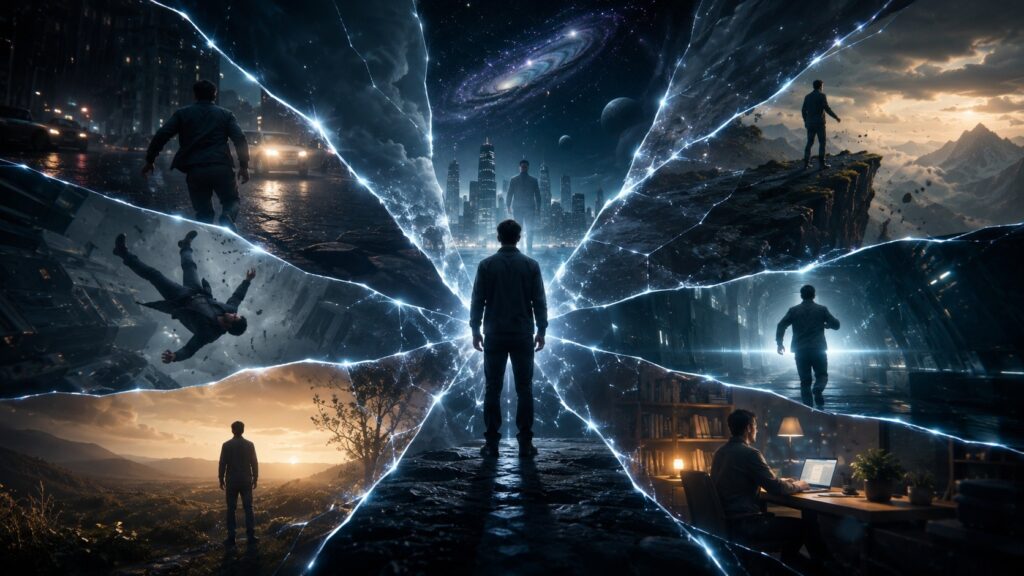
The idea of quantum immortality is complex but extremely fascinating
Many people think that death is the end. Darkness, silence, the end of the movie. But what if I told you that from the perspective of quantum physics, you cannot die at all? Not because the soul is immortal, but because mathematics forbids your consciousness from disappearing. Every time the Universe could put a period, it opens another reality and rewrites the story. You fall off a roof? In one version you hit the ground, in another you miraculously grab onto a ledge. And you remain in the version where you’re still alive. After this article, you’ll look differently at every story where someone miraculously escaped death.
What Is Quantum Immortality in Simple Terms
To understand the idea of quantum immortality, you first need to recall one of the interpretations of quantum mechanics — the many-worlds interpretation. It was proposed by American physicist Hugh Everett in 1957. It states that instead of “collapsing” into a single state, all possible outcomes of a quantum event are realized simultaneously, but in different, parallel universes.
Complicated? Then imagine you’re flipping a coin. In ordinary physics, you get either heads or tails. But according to the many-worlds interpretation, reality branches at that moment: in one universe it lands on heads, and in another — tails. And both universes are equally real.
Quantum immortality takes this idea further: it suggests that a conscious observer cannot experience their own death, because in any situation where death is one of the possible outcomes, the observer’s consciousness always “switches” to the universe where they survived. This happens even if the chances of survival were minuscule.
But quantum immortality is a theoretical concept that has not been scientifically proven. It is based on the many-worlds interpretation of quantum mechanics I mentioned above, and that interpretation itself remains one of several competing interpretations. This is not a discovery, but a thought experiment, and it shouldn’t be taken too seriously.
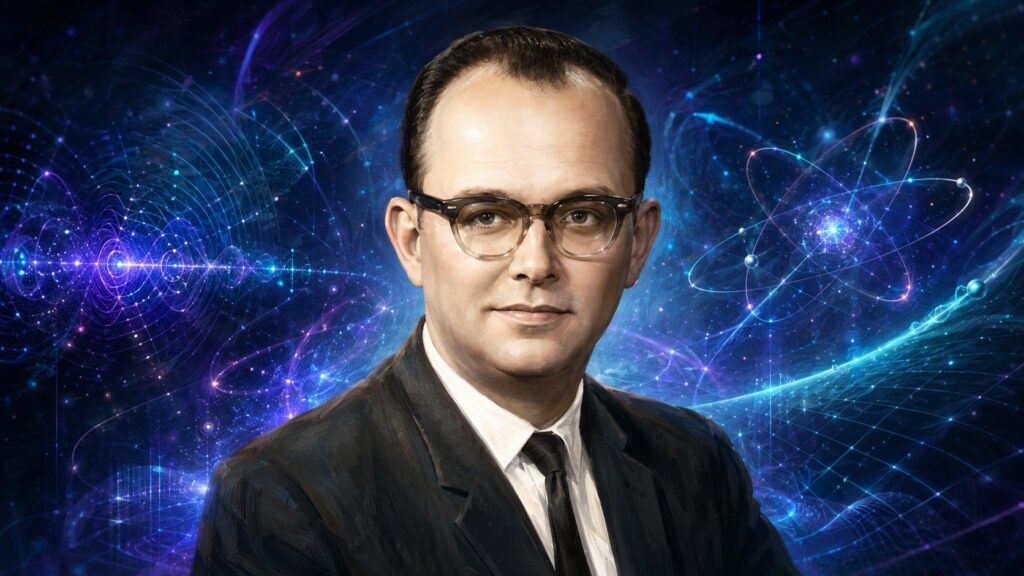
American physicist Hugh Everett
The Thought Experiment of Quantum Death
According to Sensational Tech, the foundation of quantum immortality is a thought experiment that physicists call quantum suicide. It was independently described by Hans Moravec in 1987 and Bruno Marchal in 1988, and in 1998 it was formally developed by physicist Max Tegmark.
The experiment works like this. A person stands before a device that measures the spin state of a quantum particle. If the particle is in the “down” state, the device fires. If “up” — it just clicks without firing. The probability of each outcome is exactly 50/50.
From the perspective of an external observer, it’s simple: after ten trigger pulls, the chances of survival drop rapidly. But from the perspective of the experimenter themselves, if the many-worlds interpretation is correct, with each trigger pull the universe splits: in one version the person dies, and in another — they survive. The version that survived doesn’t know about their death in the parallel world and continues living. This is quantum immortality.
This experiment is essentially a variation of Schrödinger’s thought experiment — only not with a cat, but with a person. And not from outside the box, but from inside.
Quantum Immortality and Parallel Worlds
The entire logic of quantum immortality is tied to the existence of parallel universes. Without them, the theory falls apart.
The main idea: the constant branching of the multiverse, according to the many-worlds interpretation, guarantees the existence of timelines in which the observer survives any dangerous situation. The more branchings there are, the more variants exist in which the person is alive.
But here lies the key question: do these parallel universes actually exist? The many-worlds interpretation is one of the most elegant mathematical models of quantum mechanics, but it has no experimental confirmation. We cannot peer into any of the alternative universes, send a signal there, or receive a message from one. The very idea of branching universes where the observer dies in some and survives in others remains a subject of debate among physicists and philosophers, and there is no experimental confirmation for it.
How Quantum Immortality Differs from Biological Immortality
Quantum immortality is not at all what people usually understand by the word immortality. Nobody is promising you eternal youth, invulnerability, or a life without illness.
It’s only about subjective experience. You still age. You still get sick. You still can suffer. Moreover, philosopher David Lewis in his 2001 lecture “How Many Lives Has Schrödinger’s Cat?” warned about one of the most disturbing consequences of this idea: if immortality through world-branching does exist, it leaves a person maimed, lonely, terminally ill (though not dead), and life under such conditions turns into eternal torment.
Simply put, quantum immortality is not “you live forever and are happy.” It’s “you can never completely cease to exist, but your life can keep getting worse.” Some philosophers have even called this scenario quantum torment.
Here are the key differences between quantum and biological immortality:
- The body is not protected from damage — it ages and deteriorates as usual;
- Immortality applies only to subjective experience: you “always” end up in the branch where you’re still alive;
- From the outside, other people see your death — you are “immortal” only to yourself;
- The theory does not imply any rejuvenation, regeneration, or superpowers.
Can Quantum Immortality Be Proven
The short answer is no. And this is one of the main problems with the theory.
The only way to “test” quantum immortality is to conduct the experiment on yourself and verify that you survive time after time. But you won’t be able to prove this to anyone else. For an external observer, you will most likely simply die on the very first attempt.
Max Tegmark himself now believes that the experimenter should expect only the ordinary probability of survival, not immortality. According to the anthropic principle, a person is less likely to find themselves in a world where their existence is less probable.
The anthropic principle is the idea that we see the Universe the way it is because only in such a Universe could observers like us have appeared. Roughly speaking, if conditions were incompatible with life, there would be no one to ask about it.
There is also another serious problem. Tegmark pointed out that death is not a binary event, as in the thought experiment. It is a gradual process with a continuous spectrum of states of declining consciousness. You don’t flip a switch between “alive” and “dead” — consciousness fades gradually. This means that the neat model of the thought experiment doesn’t work in the real world, where causes of death are usually gradual.

Modern quantum physics raises questions that still have no experimental answers
Why Scientists Debate Quantum Immortality
Quantum immortality is not a generally accepted scientific theory. It is a speculative hypothesis surrounded by heated debate, with critics significantly outnumbering supporters.
Most scientists who have written about quantum immortality felt it their duty to refute it. Here are the main arguments against quantum immortality:
- Death is not a binary switch: there is an entire continuum of states of gradually declining self-awareness, and the thought experiment ignores this;
- The theory has no evidence. It does not account for biological processes of aging, decomposition, and disease, which do not depend on quantum mechanical effects;
- Physicist David Deutsch, a supporter of the many-worlds interpretation, stated that the logic of quantum suicide does not follow directly from quantum theory and requires an additional assumption — ignoring those histories in which the experimenter is absent;
- Physicist Sean Carroll, also a supporter of the many-worlds interpretation, believes that future versions of a person after branching become different people, and you cannot choose one of them as the “real self.” Quantum suicide kills some of these future “selves,” and this is just as bad as if other worlds didn’t exist.
Even Hugh Everett’s biographer has raised similar concerns about extending the many-worlds interpretation to such speculative conclusions.