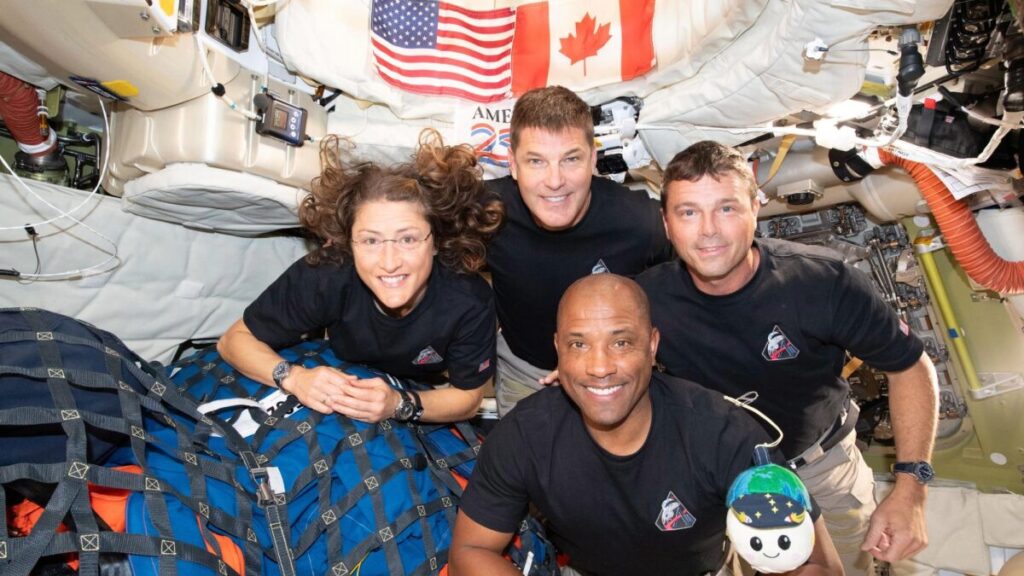
Astronauts in space sometimes face very unexpected problems
The Artemis 2 mission crew returned from a ten-day trip to the Moon, the first crewed flight beyond low Earth orbit in more than 50 years. The four astronauts splashed down in the Pacific Ocean on April 10, 2026, and set several records. But beyond the technical records, the mission highlighted something unexpected: a set of strange everyday skills that astronauts must master no less seriously than spacecraft operations.
How Astronauts Sleep in Zero Gravity
Even on Earth, insomnia is unpleasant. In space, it becomes a very serious problem. Day blends into night, outside there’s an endless list of experiments and checks, and in the back of your mind lurks the thought that any small malfunction could become critical.
But the main difficulty lies in physics. In zero gravity, the body doesn’t lie on a bed — it floats, so astronauts sleep strapped to a wall, often upside down or sideways, like bats. Mission Commander Reid Wiseman admitted that every time he fell asleep, he was woken by the sensation of tripping over a curb. A familiar feeling, but just imagine it in zero gravity, inside a capsule flying toward the Moon.
A full deep sleep under such conditions is more the exception than the rule. That’s why the ability to nap in any position and recover quickly is a skill that is trained long before the flight.
Why Crying in Space Is Dangerous
It might seem — what’s so complicated about crying? But in space, even tears behave differently. Without gravity, drops don’t roll down your cheeks. Instead, tear fluid collects right on the surface of the eye, forming a bubbly film that obstructs vision.
If an astronaut doesn’t notice in time that their eyes have become moist and doesn’t dab them dry, their vision can literally “flood” for a while. That’s why in space you need to be able to instantly detect a tear and quickly remove it, or, if possible, hold it back altogether.
Considering that the Artemis 2 crew witnessed Earthrise above the lunar horizon through their windows, holding back emotions was probably not easy.
Toothache in Space: What Astronauts Do
A toothache is unpleasant even on Earth. Now imagine that the nearest dentist is tens of thousands of kilometers away. That’s exactly why astronauts are required to maintain impeccable oral hygiene both before and during the flight.
This is especially critical for long-duration missions on the International Space Station. A sudden dental crisis caused by careless dental care could force an early mission abort. But in case a problem does arise, one crew member undergoes training in tooth extraction, practicing on special models.
The instruments are far from those in a dentist’s office, but when Earth is days of travel away, even such rough assistance can be lifesaving. According to NASA, dental problems are among the top five conditions most dangerous for long-duration space missions.
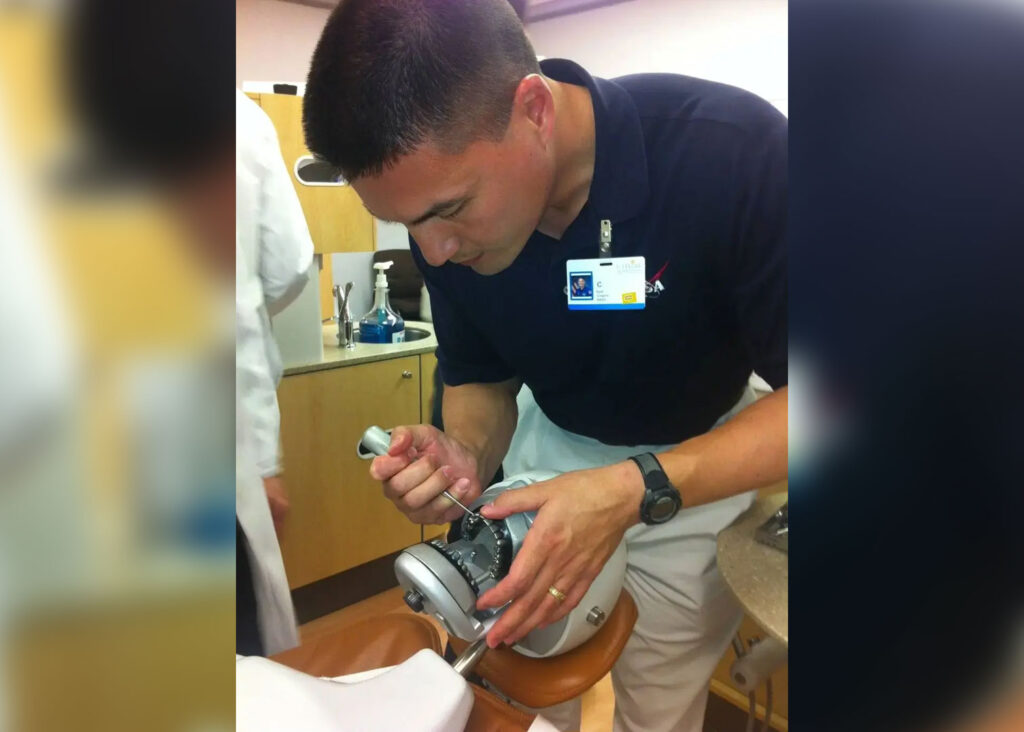
An astronaut practices extracting a tooth on a training model
How the Toilet Works on a Spacecraft
Artemis 2 became the first mission to the Moon with an actual toilet on board — the Universal Waste Management System (UWMS). It sounds impressive, but reality turned out to be more mundane.
Problems began on the very first day. A couple of hours after launch, the urine diversion fan jammed, and without it, liquid in zero gravity doesn’t reach the collection tank — it flies around the cabin. Christina Koch, the mission specialist, disassembled part of the structure and fixed the fan following instructions from Houston.
But the plumbing adventures didn’t end there. A few days later, frozen urine clogged the ventilation line through which waste was dumped overboard. Koch suggested rotating the capsule so that the frozen section faced the sunny side. The idea worked, although initially the toilet was restored only “for solid waste.” After this incident, Koch received the unofficial title of “space plumber.”
Why Astronauts Were Fixing Outlook on the Way to the Moon
Alongside the toilet problems, the crew encountered an issue familiar to millions of office workers. On the Microsoft Surface Pro tablets that astronauts use for scheduling and correspondence, Outlook stopped working.
Commander Reid Wiseman contacted Houston and reported that he had two instances of Outlook running, and neither was working. The ground team connected remotely and resolved the issue in about an hour by restarting the email client files.
An important detail: the critical onboard systems of Orion run on separate radiation-hardened hardware, while Outlook is part of the “civilian” software for the crew’s everyday tasks. But the situation instantly went viral — it turned out that even a flight to the Moon can’t save you from a glitchy Outlook.
Why Astronauts Are Taught to Survive in the Wild
Space and wilderness — what could they possibly have in common? But NASA seriously trains astronaut candidates in building fires, constructing shelters, finding water, and foraging for food. The reason is simple: if during re-entry the capsule lands somewhere other than planned, the crew will have to survive in a remote area until rescuers arrive.
This tradition dates back to the early days of the space program. Back in the 1960s, Neil Armstrong and other Apollo program astronauts took survival courses in the Nevada deserts and the jungles of Panama. Today, candidates train alongside instructors from the Army’s SERE survival school — learning to navigate terrain, build shelters from available materials, and maintain composure under stressful conditions.
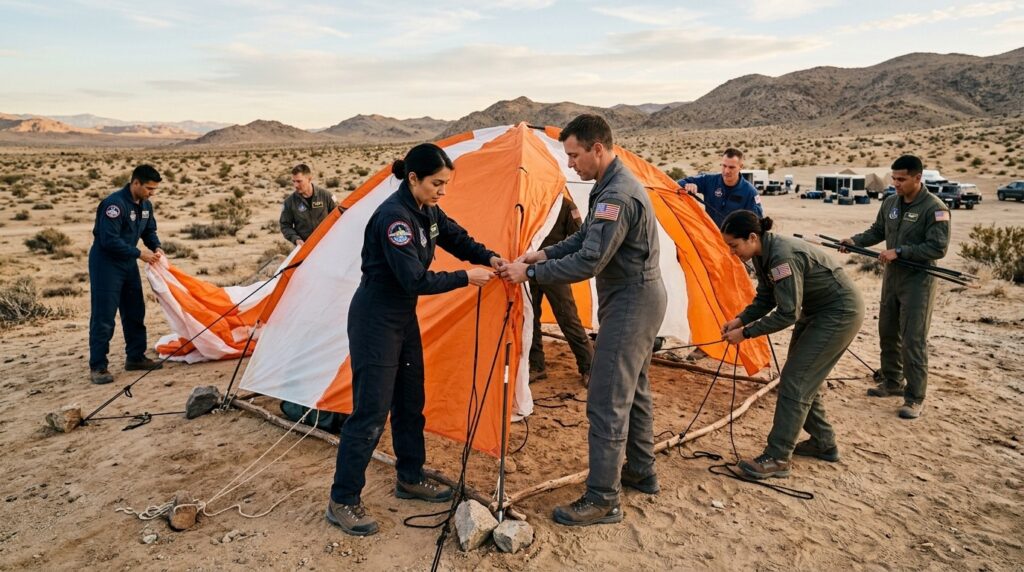
Astronaut candidates learn to build a shelter from parachute fabric in the desert
Astronaut Shannon Walker noted that such training helps future crew members better understand themselves and learn how they perform under stress — and space, she says, can be a very stressful environment.
The Artemis 2 mission concluded successfully: all four astronauts returned healthy, and the collected data will help prepare future flights with lunar surface landings. But the main lesson of this journey is perhaps that space exploration is not just about rocket engines and navigation calculations. It’s also about being able to fix a toilet on the fly, fall asleep upside down, and keep your cool when your email won’t open 250,000 miles from Earth.