
What cats fear the most: this list of fears may surprise even experienced owners.
Cats seem independent and fearless, but in reality they are much more anxious. Even a calm house cat can jump at an ordinary object or hide because of a noise that a human barely notices. Many of these reactions seem strange, but only at first glance — cats’ strange habits usually have a perfectly logical explanation. It’s all about instincts: cats are predators, but also prey at the same time, so their nervous system constantly scans the environment for danger. Veterinarians have long noticed that most cats share the same typical fears, and many of them we accidentally provoke ourselves. Let’s figure out what cats are most afraid of and how to make your pet feel calm.
Why Cats Are Afraid of Cucumbers, New Objects, and Sudden Changes
The famous cucumber videos look funny, but for a cat it’s no joke. Experts note that the animal is frightened not by the vegetable itself, but by the sudden appearance of an unfamiliar object near it.
Cats are very sensitive to changes in their environment. Any new object — from a brush to a box — can cause stress if it appears suddenly.
What to do:
- introduce your cat to new things gradually;
- let them sniff the object;
- don’t bring it up suddenly from behind.

Cats are afraid of the sudden appearance of a new object, and it’s not specifically about the cucumber.
Why Cats Are Afraid of Strangers and New Animals
Home for a cat is a safe territory, and any disruption to the usual order causes anxiety. That’s why many pets hide when guests arrive or hiss at new animals.
Causes of fear:
- unfamiliar smells;
- past negative experiences, including those involving children;
- lack of socialization during kittenhood.
How to help:
- don’t force the cat to socialize;
- give them the opportunity to observe from a hiding spot;
- use treats to create positive associations with guests.
Some cats hide from new pets, while others even attack to show who’s boss. Introductions should be done gradually to ease the process for both. To do this, first keep the pets in separate areas and give them each other’s belongings so they can get used to the scent.

Some cats are naturally more timid, but others may fear new people due to past experiences, such as rough handling by a child.
Why Cats Are Afraid of Loud Sounds, Carriers, and Punishment
A cat’s hearing is much more sensitive than a human’s. They can hear frequencies up to 60,000 Hz, so an ordinary vacuum cleaner, hair dryer, or coffee machine sounds like an explosion to them.
Common fears:
- loud household appliances;
- carriers associated with the vet;
- yelling and punishment.
It’s important to remember: punishment increases anxiety and destroys trust, so the cat begins to fear the owner rather than correcting its behavior. Moreover, cats don’t experience guilt in the human sense.
Better approach:
- get the cat used to the carrier in advance;
- leave it in the house as an ordinary object;
- reward calm behavior.
Some cats associate the carrier with leaving home, and therefore leaving their safe place. One way to get a cat used to the carrier is to create positive associations with it. Leave the carrier in the house and make it cozy (ideally — put a blanket or something with a familiar home scent inside), so the cat wants to spend more time in it.
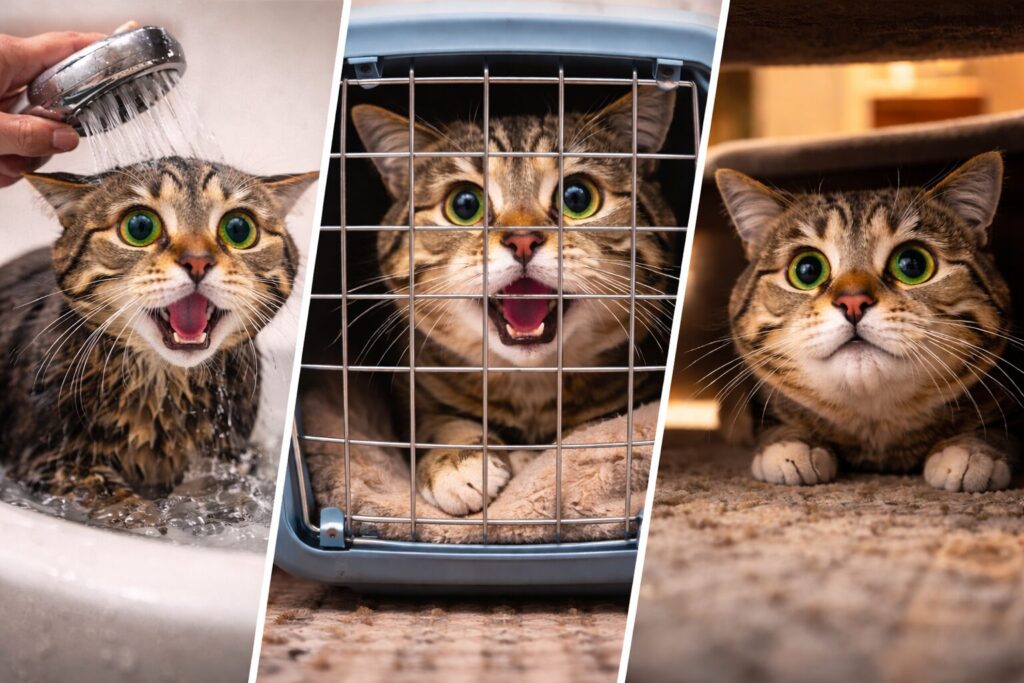
Cats are very sensitive to their surroundings and love consistency. Because of this sensitivity, they can easily be frightened by certain objects, sounds, and situations.
Why Cats Are Afraid of Water, Open Spaces, and Lack of Hiding Spots
Many cats, unlike dogs, don’t like water. It’s not about being fussy — their fur gets wet, becomes heavy, and the animal feels vulnerable. Additionally, cats descended from desert species that didn’t need bathing.
Another important fear is the lack of secluded places. If a pet has nowhere to hide, stress levels rise sharply. It’s no coincidence that cats love sitting in boxes.
What helps:
- cat houses, boxes, beds with a roof;
- high shelves or cat tree scratching posts;
- a quiet zone where no one intrudes.
How to Calm a Scared Cat and When to See a Vet
So, 8 vet-confirmed cat fears:
- new objects,
- new people,
- new animals,
- loud sounds,
- carriers,
- punishment,
- water,
- lack of hiding spots.
In most cases, fears can be reduced by providing your pet with a predictable, calm, and safe environment. And then even the most nervous feline will gradually become more confident.
Mild fright is normal, but constant stress is dangerous. Reasons to see a vet:
- the cat hides all the time;
- marks or goes outside the litter box;
- licks itself until bald patches appear;
- has become aggressive or extremely skittish.
If a cat has become especially anxious or suddenly started meowing loudly, it’s not always just fright. If the cat hides all the time while also losing appetite or drastically changing behavior — these could already be symptoms of a serious illness.