
Chewing sounds drive you into a rage? This could be a sign of serious mental health problems
Pen clicking, the crunch of an apple or chips, someone’s breathing during sleep — most people don’t even notice these sounds. But for millions of people around the world, ordinary everyday sounds trigger an instant wave of rage, panic, or an acute desire to flee. People are especially often irritated by loud chewing. This condition is called misophonia, and science has finally begun to take it seriously. Recent research shows that misophonia is closely intertwined with anxiety disorders, depression, and post-traumatic stress disorder (PTSD). Do sounds like these irritate you?
Misophonia: Why Ordinary Sounds Trigger Intense Anger
For a long time, it was believed that people who were driven crazy by the sounds of others chewing were simply too sensitive. But clinical psychologist Jane Gregory of Oxford University, having conducted a large-scale survey in 2023, found that misophonia may affect one in five people. And this is not about mild irritation, but about a deep emotional reaction to specific sounds — breathing, swallowing, finger tapping.
“Misophonia is much more than just being annoyed by certain sounds,” Gregory emphasizes. People with this condition perceive ordinary noises as an emotional threat. The rest of the population simply doesn’t register them.
It’s important to understand: misophonia differs from hyperacusis — a condition in which any sounds seem painfully loud. In misophonia, the reaction is triggered not by volume, but by a specific sound pattern: rhythmic chewing, clicking, tapping. Quiet chewing can be just as infuriating as loud chewing.
The Link Between Misophonia and Anxiety, Depression, and PTSD
Psychiatrist Dirk De Smit from the University of Amsterdam and his colleagues analyzed massive arrays of genetic data from the Psychiatric Genomics Consortium, UK Biobank, and the 23andMe database. The results, published in the journal Frontiers in Neuroscience, were impressive: people with misophonia significantly more often carry genes associated with severe mental disorders.
“We found a genetic overlap with PTSD,” says De Smit. According to him, this means that genes that increase sensitivity to post-traumatic stress simultaneously increase the likelihood of misophonia. Both conditions may rely on a shared neurobiological system.
This conclusion is supported by another major study published in March 2026 in the journal Psychiatry Research. Scientists surveyed a representative sample of American adults and found that 65% of people with misophonia have at least one additional psychiatric diagnosis. Nearly half of them struggle with depression, and roughly the same proportion deal with anxiety disorders.
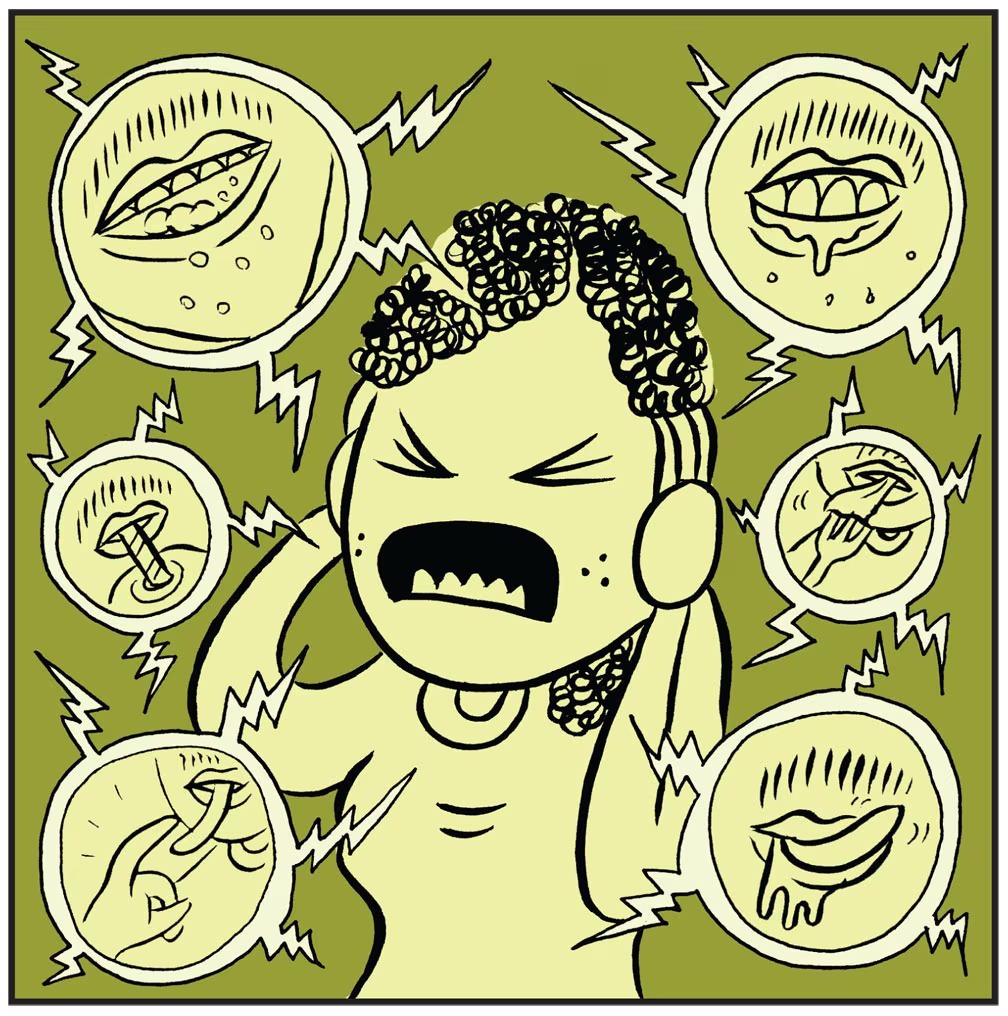
Genetic research has revealed shared roots between misophonia and a number of mental disorders
The practical significance of these findings is enormous. If misophonia and PTSD share common neurobiological mechanisms, then therapeutic methods developed for PTSD could potentially help people with misophonia as well.
How the Brain Reacts to Trigger Sounds in Misophonia
What exactly happens in the brain when a person with misophonia hears a trigger sound? Neuroimaging shows that at that moment the anterior insular cortex is activated — a brain region responsible for threat detection. A “fight or flight” response is triggered, as if in the face of real danger, when the brain recognizes dangerous sounds.
In most people, the brain quickly understands that there is no threat and redirects attention. But in misophonia, this doesn’t happen. Recent studies have found that people with severe misophonia have impaired affective flexibility — the brain’s ability to shift in emotionally charged situations.
Imagine that your brain is a radio that has tuned into an unpleasant station and the tuning dial is jammed. You hear an annoying signal and want to switch, but you can’t. That’s exactly how people with misophonia feel: their attention gets stuck on the trigger sound, and the negative emotion begins to replay endlessly.
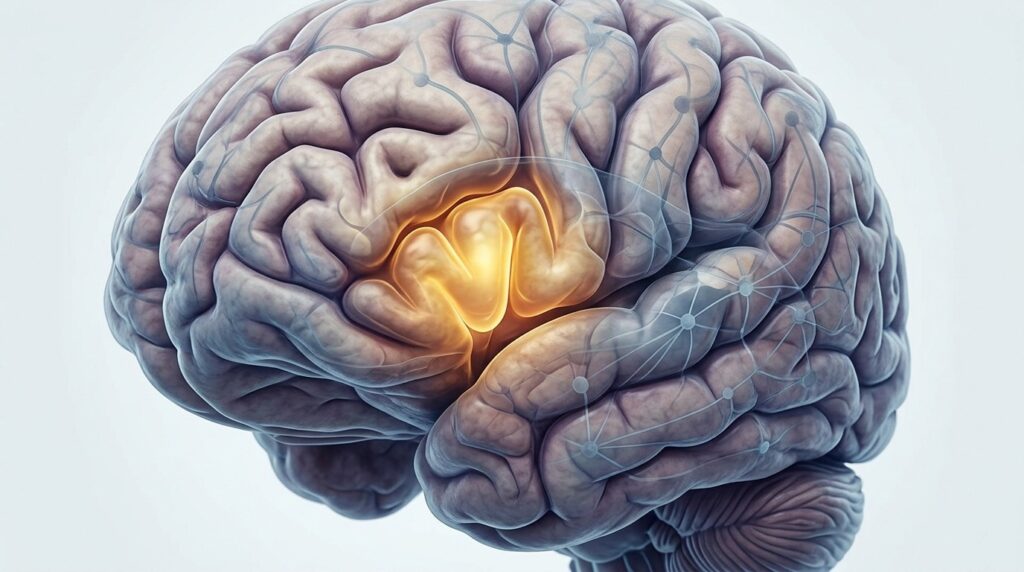
In misophonia, the anterior insular cortex — the threat detection center — is particularly active
This “mental dead end” gives rise to rumination — the obsessive replaying of the same thoughts over and over. The initial flash of anger turns into an internal echo chamber that amplifies suffering. Scientists cannot yet say for certain what comes first: whether cognitive inflexibility causes misophonia, or whether constant exhaustion from misophonia wears down the brain’s defense mechanisms. But the connection is measurable and reproducible.
People with misophonia also more frequently report elevated levels of anxiety, feelings of guilt, loneliness, and neuroticism. “Based on the genetics of the common symptom of misophonia, we conclude that it is most closely related to mental disorders and a personality profile characteristic of anxiety and PTSD,” summarizes De Smit’s team.
Is Misophonia Linked to Autism: What the Data Shows
One of the most surprising conclusions from the new research concerns autism. For a long time, many specialists assumed that misophonia was closely linked to autism spectrum disorders (ASD) — after all, people with autism also often have difficulty tolerating certain sounds.
However, genetic data showed the opposite. People with autism spectrum disorders are less predisposed to misophonia at the level of genomic variation than expected.
“Our results suggest that misophonia and ASD are relatively independent disorders in terms of genomic variability,” the study authors note.
This discovery forces a reconsideration of the boundaries of the condition itself. It’s possible that different forms of misophonia exist: one driven by a genetic predisposition to anxiety, and another formed through the conditioned reinforcement of negative emotions to specific sounds.
Another curious fact: more than 40% of people with misophonia report tinnitus — a constant phantom noise in the ears. This connection has been little studied so far, but it additionally points to the fact that misophonia affects deep-level sound processing mechanisms in the brain.
How Common Is Misophonia and Why It’s Being Ignored
Modern surveys show that in the United Kingdom, misophonia affects 18.4% of the adult population. At the same time, fewer than 14% of respondents even knew the word “misophonia” before participating in the study. Millions of people live with this condition for years, considering themselves simply irritable or “quirky.”
Historically, doctors diagnosed this condition extremely rarely. Misophonia was absent from all major diagnostic manuals for a long time, and many specialists treated patients’ complaints with skepticism.

Recognizing misophonia as a real disorder is the first step toward helping millions of people
New genetic and neuroimaging data are changing this situation. By placing misophonia in a biological and psychological context, science gives people with this condition something they have been lacking: confirmation that their reaction is not a choice and not a character weakness. Their brain truly processes the world differently.
This alone is not yet a cure. But understanding the genetic overlaps with PTSD and anxiety disorders opens the door to new therapeutic approaches.