The appearance of your street — not just its noise level — may affect how well you sleep. A recent international study analyzed data from over a thousand Tokyo commuters and more than 214,000 street-level panoramic images using AI, finding that people living on enclosed, densely built streets with overhanging trees slept measurably better than neighbors just a block away on open, wide-sidewalk corridors. The effect persisted even after researchers controlled for income, housing conditions, age, sex, and commuting habits.
What you need to know
- Residents on enclosed streets with dense buildings and tree canopy slept roughly 15 minutes longer per night and reported less insomnia than those on open streets.
- Streets with abundant wide sidewalks and pedestrian barriers were associated with shorter, more restless sleep — likely because in a hyper-dense city like Tokyo, such infrastructure signals a busy, high-alert thoroughfare rather than a calm neighborhood.
- Greenery alone did not directly correlate with longer sleep; it mattered only when trees contributed to a street’s perceived sense of safety and enclosure.
- This is an observational, cross-sectional study and cannot prove a direct cause-and-effect relationship between street design and sleep quality.
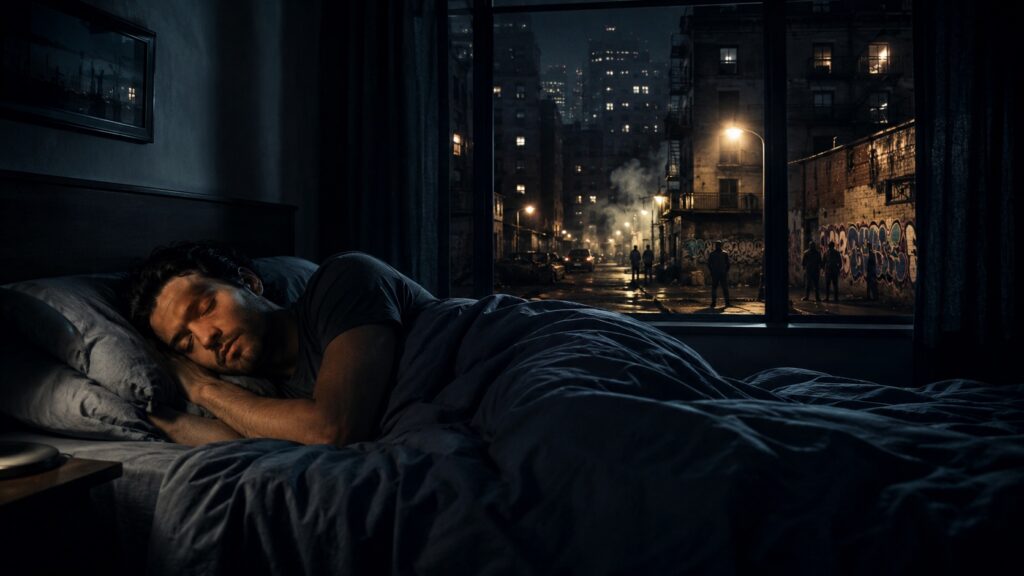
The appearance of a street may affect sleep more than commonly assumed.
How the study was designed
The research, published in the journal Building and Environment, focused on more than a thousand working adults aged 40–59 who commute daily into Tokyo. That age range was chosen because sleep patterns tend to stabilize in middle age even as work and family demands intensify. On average, participants slept just 5.9 hours per night — well below the seven-to-nine hours generally recommended by health authorities.
How AI scored Tokyo’s streets
Rather than relying on questionnaires about neighborhood aesthetics, the researchers downloaded over 214,000 pedestrian-level panoramic photographs from a mapping service and fed them to two neural networks.
The first network performed pixel-level segmentation, measuring:
- Visible greenery around roadways
- Quantity of pedestrian walkways and metal barriers
- Overall spatial enclosure — the ratio of building facades and tree canopy to open sky and pavement
A second neural network then estimated the subjective perception of each street scene. Trained on a global database of hundreds of thousands of photographs previously rated by nearly 100,000 people worldwide, this algorithm scored every intersection for perceived safety, liveliness, and beauty.
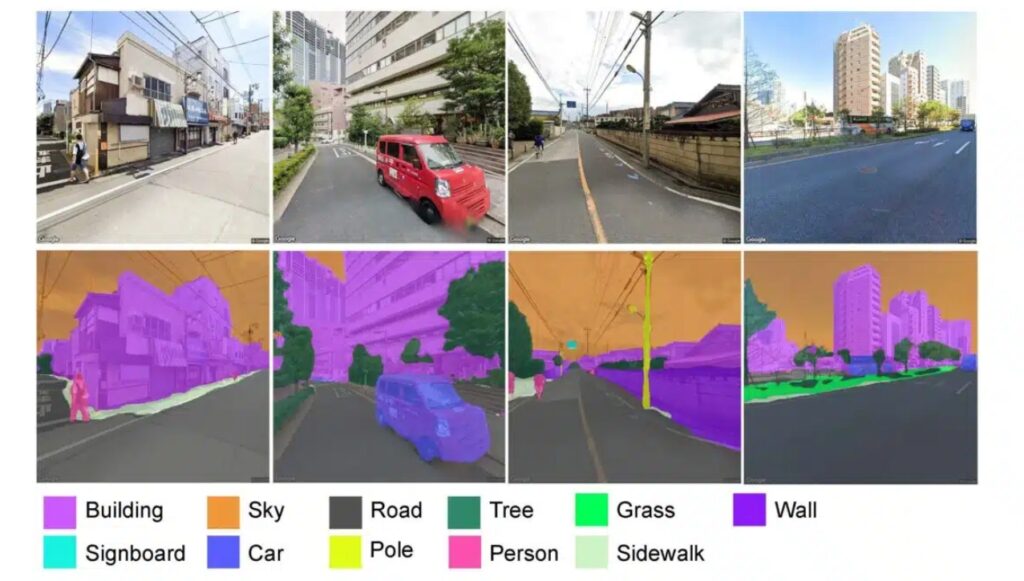
How AI evaluated Tokyo’s streets. Image source: studyfinds.com.
Why enclosed streets were linked to better sleep
The study’s central finding was that spatial enclosure — streets flanked by dense buildings and overhanging trees — correlated with reduced insomnia and roughly 15 additional minutes of sleep per night. The authors hypothesize that enclosed streetscapes create a psychological sense of order and safety, helping the mind unwind at the end of the day. Dense buildings and thick tree canopy may also act as physical barriers that limit the spread of traffic noise.
The sidewalk paradox
Perhaps the most counterintuitive result concerned pedestrian infrastructure. Wide sidewalks and abundant pedestrian barriers are typically considered hallmarks of a well-designed, healthy neighborhood. Yet in this study, streets with extensive pedestrian pathways were associated with shorter and more restless sleep.
The researchers suggest a psychological explanation specific to a hyper-dense metropolis like Tokyo: an abundance of fences and oversized sidewalks signals a busy, high-traffic arterial road — a place that triggers alertness rather than relaxation.
Greenery, meanwhile, showed no direct statistical link to sleep duration on its own. Its benefit appeared to be indirect: when trees contributed to a street’s perceived safety score in the AI model, residents on that street tended to sleep better. In other words, it was the sense of shelter and comfort the trees created, not the foliage itself, that mattered.
Important limitations
The study’s authors are explicit about its constraints. This is an observational, cross-sectional analysis — a single snapshot in time — and it cannot establish direct causation. Moving to a narrow, tree-lined lane will not necessarily cure chronic insomnia.
Additional caveats include:
- The street-level photographs were captured primarily at intersections, not on the quieter stretches between buildings where residents actually spend their evenings.
- All participants were working adults in a single Asian megacity; results may differ in cities with different building cultures and climates.
- Sleep is influenced by a vast number of personal factors — stress, health conditions, screen habits — that no street-image algorithm can capture.
What this means for urban planning
Despite these limitations, the research adds a new dimension to the conversation about how cities are designed. Before widening a road beneath residential windows or clearing mature trees for parking, urban planners may want to consider the downstream effects on residents’ mental state and sleep. What people see every day on their walk home may quietly raise stress levels — and, according to this study, keep them awake at night.