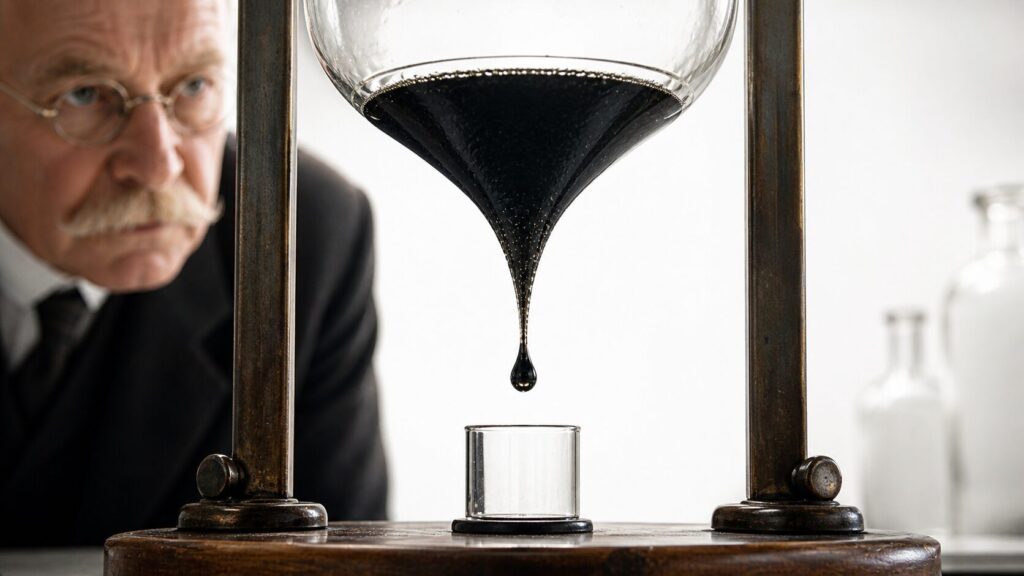
The longest scientific experiment in history is still revealing the secrets of physics.
In 1927, Australian physicist Thomas Parnell poured heated pitch into a glass funnel — and created an experiment that continues to this day, and the process itself can now be watched via live stream. In nearly one hundred years, only nine drops have fallen from the funnel. The tenth is forming right now, and in 2027 the experiment will mark its centenary. So what is the point of the experiment, you ask?
How the Experiment That Has Lasted Nearly 100 Years Began
The most famous version of the experiment was started in 1927 by Thomas Parnell at the University of Queensland in Brisbane, Australia, to demonstrate to students that some substances that appear solid are actually extremely viscous liquids. Parnell chose pitch — another name for bitumen or asphalt. At room temperature, this substance seems completely solid: if you hit it with a hammer, it will shatter like glass. But heat it up — and it becomes fluid.
Parnell poured a heated sample of pitch into a sealed glass funnel and allowed it to cool and settle for three years. In 1930, the bottom of the funnel was cut open, and the pitch began to flow. Or rather, it began trying to: the first drop only fell eight years later — in December 1938.
Parnell’s idea was not so much a scientific breakthrough as a pedagogical device. He wanted students to understand: the boundary between “solid” and “liquid” is not always obvious. Some substances simply flow so slowly that we don’t notice their movement throughout our entire lives. Another vivid and non-obvious example of this is glass — which is also considered a liquid.
Why Solid Pitch Flows Like an Extremely Thick Liquid
To understand the scale of what’s happening, you need to understand the concept of viscosity — it’s a measure of how much a liquid resists flowing. Water flows easily. Honey resists much more strongly. And pitch resists so fiercely that a single drop can take over ten years to form.
The eighth drop fell on November 28, 2000, and this allowed experimenters to calculate that the viscosity of pitch is approximately 230 billion times greater than the viscosity of water. For comparison: honey is only 2,000–10,000 times more viscous than water. That means pitch is “thicker” than honey by approximately 20–100 million times. This is exactly why drops fall so rarely.
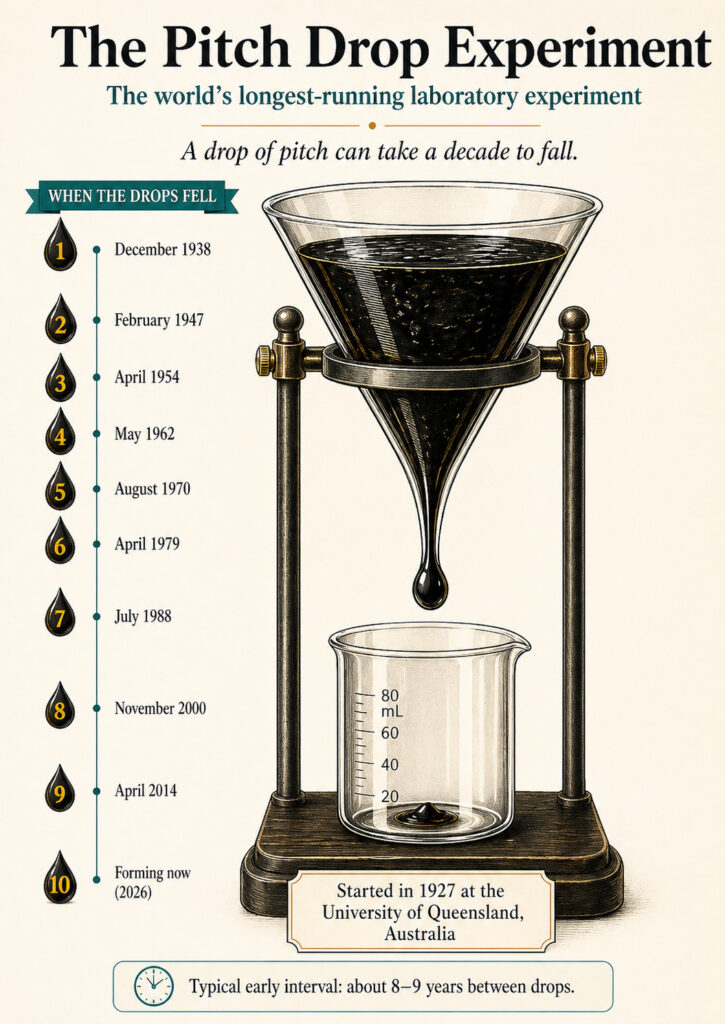
The key factor in this experiment is viscosity — a measure of a liquid’s resistance to flow. Water flows easily, honey resists, and pitch resists so strongly that it can take over ten years for a single drop to separate.
The average time for the first seven drops was approximately 8 years. However, after the seventh drop in July 1988, the interval increased. The eighth drop fell in November 2000 — 12.3 years later, and the ninth — in April 2014, another 13.4 years later. The reason is that air conditioning was installed in the building, which lowered the average temperature and increased viscosity.
For a substance like pitch, a difference of just a few degrees has enormous significance. It’s like slowing down an already unimaginably slow process even further. And in fact, matter has more unusual forms than the familiar “solid, liquid, and gas”: for example, there are unusual states of matter.
Why Nobody Has Seen a Drop Fall in Nearly 100 Years
The pitch drop experiment is famous not only for its incredible slowness but also for the astonishing bad luck of its observers.
Parnell showed the apparatus to generations of students, but he died in 1948 without ever seeing a drop fall with his own eyes. The apparatus could have remained a forgotten curiosity forever if it weren’t for physicist John Mainstone, who discovered it when a colleague said: “I’ve got something strange in the cupboard.”
John Mainstone was the custodian of the experiment for 52 years. He returned the apparatus to public display and turned it into one of the most beloved laboratory attractions in the world. But even he never managed to personally witness a single drop falling.
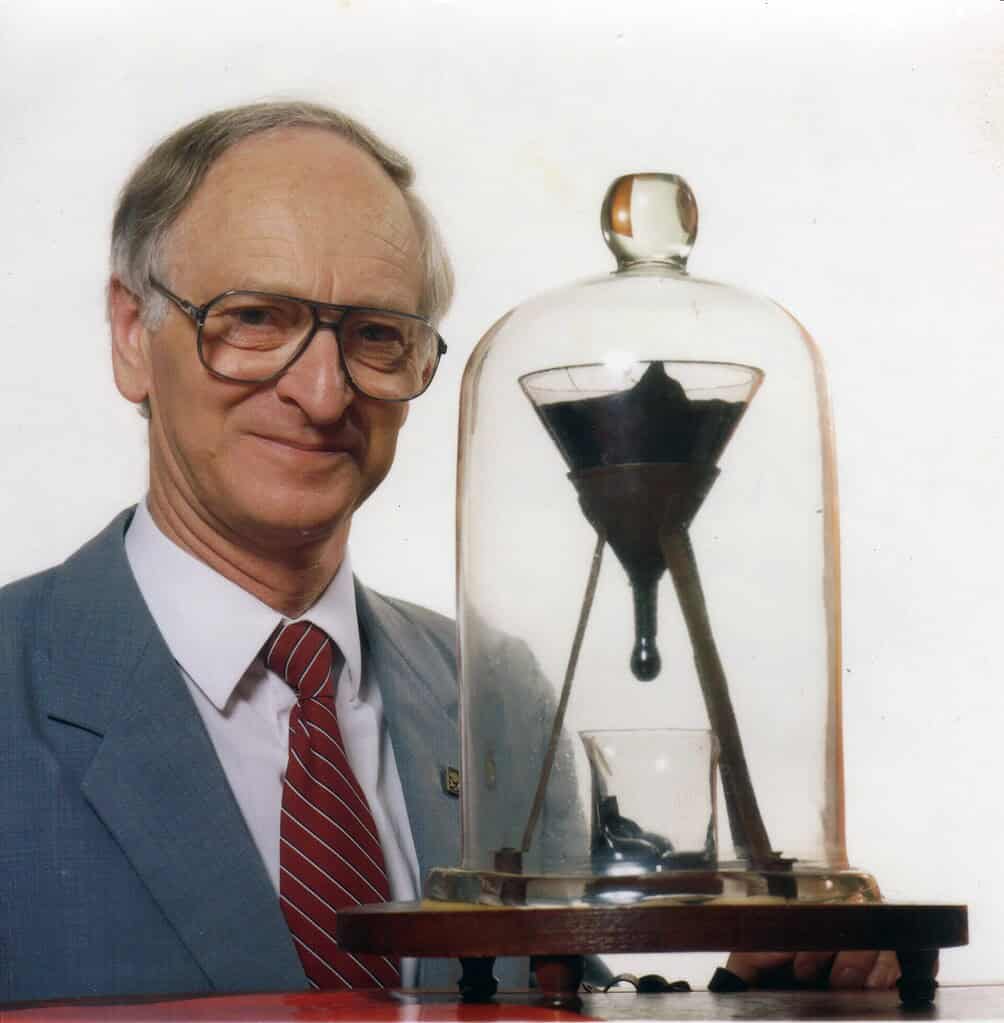
Experiment custodian John Mainstone next to the apparatus
The pitch drop experiment makes no allowances for weekends (the 1979 drop), coffee breaks during conferences (1988), or broken video cameras (2000). In 2000, a webcam was pointed at the apparatus to finally capture the historic moment. But technical problems prevented the recording of the drop falling in November 2000.
Mainstone died on August 13, 2013, at the age of 78 after a stroke — just a few months before the ninth drop finally separated in April 2014.
Ig Nobel Prize for the Longest Experiment
In October 2005, Mainstone and Parnell were awarded the Ig Nobel Prize in Physics — a parody of the Nobel Prize — for the pitch drop experiment. This award is given for work that “first makes people laugh, and then makes them think,” and it has long had its own collection of absurd scientific investigations. Mainstone received his Ig Nobel Prize from the hands of a real Nobel laureate — Sheldon Glashow (Nobel Prize in Physics 1979).
After Mainstone’s death, custodianship passed to Professor Andrew White. White made an important decision: the ninth drop touched the eighth on April 12, 2014, but was still attached to the funnel. On April 24, White decided to replace the beaker containing the previous eight drops while the ninth hadn’t merged with them — otherwise the further formation of drops would have been permanently disrupted.
Incidentally, it was the Dublin counterpart of the experiment at Trinity College that became the first where a pitch drop was successfully recorded on camera — this happened on July 11, 2013.
Where Else Are Pitch Drop Experiments Being Conducted
The Queensland experiment is the most famous, but far from the only one. A similar experiment was started at Trinity College in Dublin in October 1944. In 2014, an experiment begun as early as 1914 was rediscovered at Aberystwyth University in Wales — 13 years before the Queensland one. But the pitch there is more viscous, and the first drop has never fallen — according to estimates, it will take more than a thousand years.
The University of St Andrews also launched its experiment in 1927, independently of Parnell, but there the pitch flows in a continuous, though extremely slow stream, rather than as individual drops.
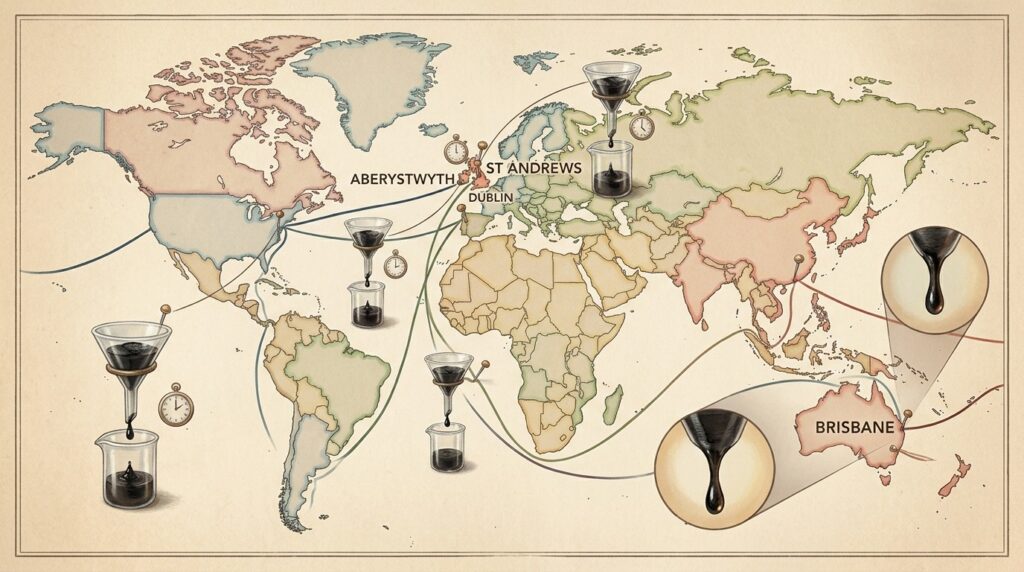
Pitch drop experiments are conducted at several universities around the world
Another demonstration with pitch in a funnel was started in 1902 at the Royal Scottish Museum in Edinburgh, but its history is only partially documented. And the Hunterian Museum at the University of Glasgow houses two demonstrations by Lord Kelvin from the 19th century: he placed bullets on top of a dish of pitch and corks on the bottom — over time the bullets sank and the corks floated. Science does love strange experiments, especially when they look almost absurd.
When Will the Tenth Drop Fall and What Is Happening Now
The experiment, which was conceived as a simple teaching demonstration, has outlived its creator, its main custodian, and several generations of students. In 2027, it will be exactly one hundred years since Parnell first poured pitch into the funnel.
The experiment is listed in the Guinness Book of Records as the longest continuously running laboratory experiment, and it is expected that there is enough pitch in the funnel for at least another hundred years. And right now something curious is happening with the experiment: the tenth drop is forming faster than the previous two. A total of nine drops have fallen.