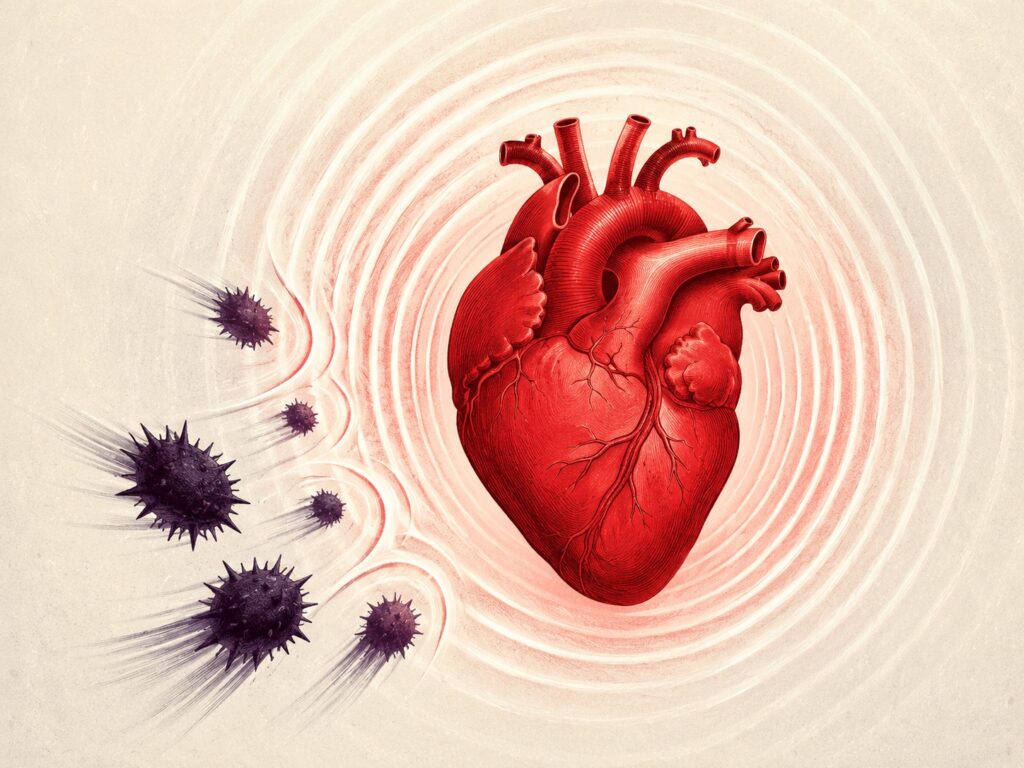
Scientists have revealed the main secret: why cancer almost never affects the heart.
Cancer cells travel through the blood and can reach almost any organ. They affect the lungs, liver, bones — but almost never take hold in the heart. A new study by scientists proposes for the first time a mechanism for this protection: the very beating of the heart can suppress tumor growth at the molecular level.
Why Heart Cancer Is So Rare
Heart disease and cancer are the two leading killers in the world. Yet cancer of the heart itself is exceptionally rare. According to large autopsy series, primary cardiac tumors are found in only 0.001–0.03% of the deceased, and the vast majority of them turn out to be benign.
This is a paradox. The heart receives abundant blood supply, and cancer cells spread precisely through the blood. Logic suggests the heart should be a convenient site for metastases. But in reality, tumors from other organs reach it 20–40 times less frequently than one might expect.
For many years, doctors simply accepted this fact without having a clear explanation. Various hypotheses were proposed: perhaps it was due to the heart’s immune characteristics, its metabolism, or the fact that heart muscle cells almost stop dividing after birth. But there was no convincing evidence — until now.
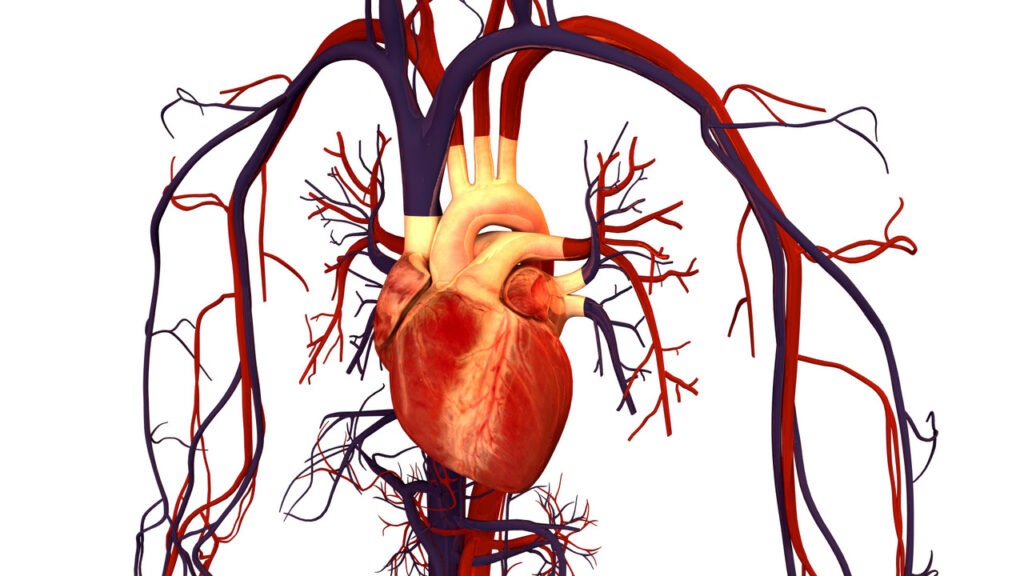
What happens when a cancerous tumor appears in the heart?
The Two-Heart Experiment: How Scientists Tested the Hypothesis
If heart cells stop dividing after birth, could the same mechanism also suppress cancer cells? After all, cancer is essentially uncontrolled cell division. To test this, scientists from the International Centre for Genetic Engineering and Biotechnology in Trieste (Italy), led by Giulio Bhatt Ciucci and Serena Zacchigna, conducted a series of experiments on mice.
First, they used genetically modified animals in which oncogenic mutations were activated simultaneously in several organs — the liver, heart, and skeletal muscles. Tumors appeared everywhere except the heart. But the most elegant experiment was yet to come.
Mice were transplanted with a second heart — into the neck area. It was alive and received blood, but did not pump it through the body, meaning it did not experience normal mechanical load. When cancer cells were injected into both hearts, the result was striking: in the “unloaded” transplanted heart, tumors grew rapidly, while in the working heart, cancer cells barely proliferated at all.
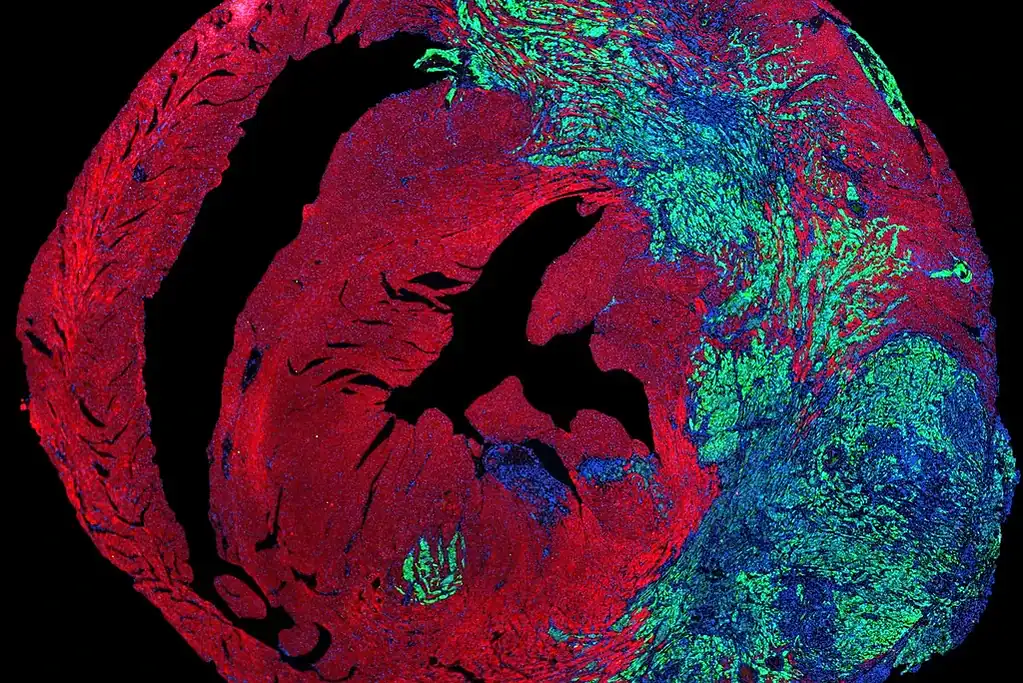
Lung cancer cells (green) growing in a mouse heart.
The same pattern was confirmed in artificially grown heart tissues. The higher the mechanical load on the tissue, the slower the cancer cells grew — lung cancer, melanoma, and colon cancer alike.
How the Heartbeat Blocks Cancer Growth
The scientists didn’t stop at observation — they figured out the mechanism. The key player turned out to be the protein Nesprin-2, which acts as a physical link between the cell’s outer membrane and the nucleus, where DNA is stored.
Simply put, Nesprin-2 works like a cable that transmits the force of heart contractions directly to the cancer cell’s nucleus. When the heart beats, this protein is activated and triggers a chain of events inside the cell.
DNA in a cell is not packed randomly — it is wound around special spool-like proteins (histones), and how tightly it is coiled determines which genes can be “switched on.” The mechanical load from the heartbeat, transmitted through Nesprin-2, enhanced chromatin compaction — the DNA coiled more tightly, and genes responsible for cell division became blocked. In simple terms, the heartbeat “locked away” cancer genes.
To confirm that Nesprin-2 played the decisive role, scientists “switched off” this protein in cancer cells before injecting them into the hearts of mice. The result was unambiguous: without Nesprin-2, cancer cells began actively growing again even in a beating heart. The molecular brake was disengaged — and the tumor proliferated where it previously could not.
How Cancer Bypasses the Heart’s Defense
Although the main work was conducted on mice and laboratory tissues, the researchers also verified their findings using human material. They studied samples from those rare cases where cancer did metastasize to the heart.
It turned out that these tumors shared a common molecular “signature” — regardless of which cancer had metastasized. They revealed changes in chemical marks on histones — those same spool-like proteins around which DNA is wound. These changes indicated that the mechanism blocking growth genes had been disrupted.
Essentially, cancer cells that managed to take hold in the heart had somehow bypassed the protective barrier. This confirms the overall picture: the heart creates an environment hostile to tumors. But sometimes, with certain molecular breakdowns, this defense does fail. Nature has various methods of cancer protection, and the heart appears to use one of the most unusual.
Can Cancer Be Treated with Mechanical Force
The most provocative conclusion from the study is a practical one. If mechanical load suppresses cancer in the heart, can this effect be reproduced for tumors in other parts of the body?
The team of scientists is already working on this. Together with engineers, they are developing devices that can be placed on the skin to rhythmically press on tumors located close to the surface — for example, in certain forms of skin cancer or breast cancer.
However, the study authors themselves emphasize: real-world application is still far off. Questions that need answering include:
- which types of tumors respond to mechanical force at all;
- what pressure is needed and at what frequency it should be applied;
- whether such stimulation could cause unwanted side effects.
Cancer cells are highly diverse, and a mechanism that restrains one tumor may prove useless for another. Moreover, in a real organism, a tumor is surrounded by immune cells, blood vessels, and scar tissue — all of which create an environment that cannot be fully reproduced in the laboratory.
But devices are not the only option scientists are considering. Now that it is understood which proteins and DNA changes are involved in this mechanism, they hope to create drugs that can trigger the same effect without mechanical intervention.
What remains an open question for now: does this mechanism work exactly the same way in the human body, can it be used therapeutically, and why skeletal muscles (also contracting tissue) are not protected from cancer as reliably as the heart. This paradox has already attracted the interest of other research groups.
In any case, this is the first serious evidence that the physical force of the heart’s contraction affects not just blood flow, but directly influences the behavior of cells within it. The heart, which we are accustomed to thinking of as a pump, has turned out to also be a natural cancer blocker. And this principle — that movement can control genes — opens an entirely new direction in oncology.