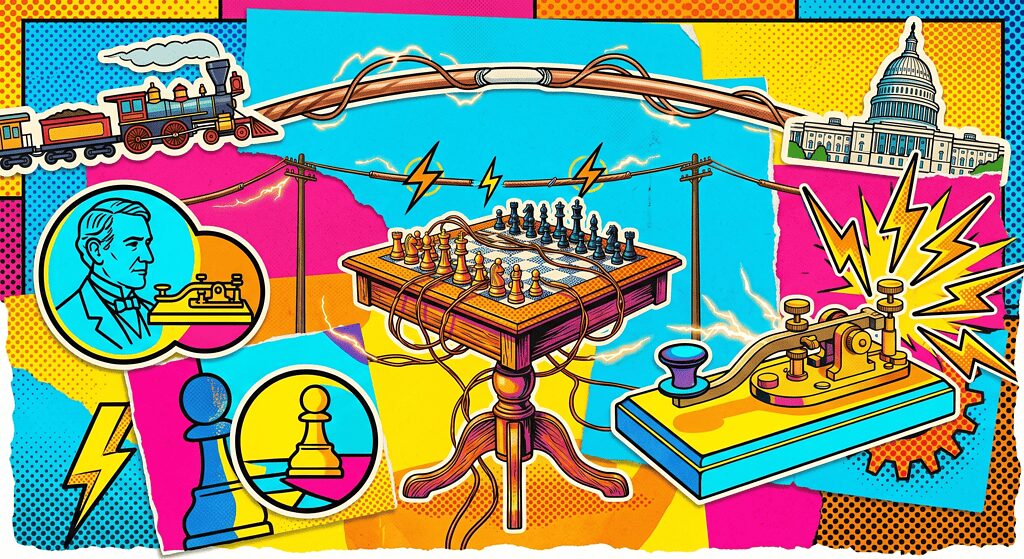
Esports appeared in 1844 and looked quite different from today
In November 1844, chess players from Washington pushed a pawn to the center of the board. Their opponents were sitting in Baltimore — 60 kilometers away, and each move flew along a telegraph wire. Long before multi-million dollar Dota tournaments and Twitch streams, chess became the first game to “go over the wires” — and gave birth to an idea that is still alive today.
How Chess Arrived at the First Telegraph Match in 1844
Modern chess grew from a game that is about one and a half thousand years old. The earliest known ancestor of chess — chaturanga — appeared in India around the 6th century. The name translates as “four divisions of the military” and refers to the four branches of the Indian army: elephants, chariots, cavalry, and infantry. Essentially, it was a tabletop battle simulator for rulers and commanders.
From India, the game reached Persia, where it was reworked and turned into shatranj. From there, through Arab conquests, it made its way to Spain and then spread across Europe. By the 15th century, the rules and pieces had acquired roughly the form we know today.
But for centuries, chess remained entertainment for the elite. Everything changed in the 19th century, when the growing middle class gained more leisure time. Enthusiasts began forming clubs and organizing tournaments. Newspapers across Europe and America started publishing chess columns. Correspondence chess was already popular in parallel, but the mail worked agonizingly slowly: a single game could drag on for years. And then the telegraph appeared.
The First Telegraph Game in 1844 and How It Happened
In May 1844, Samuel Morse sent his famous first message via the electric telegraph from Washington to Baltimore. But just six months later, the wires began transmitting not just words — but moves.
On November 15, 1844, Morse’s assistant Alfred Vail in Washington suggested to telegraph operator Henry Rogers in Baltimore that they get out a checkerboard and play a game. They started with checkers — just for fun. Rogers devised a system in which each of the 64 squares on the board was assigned a unique number. Instead of writing out “pawn to the queenside,” a player simply tapped out: “11 to 27.”
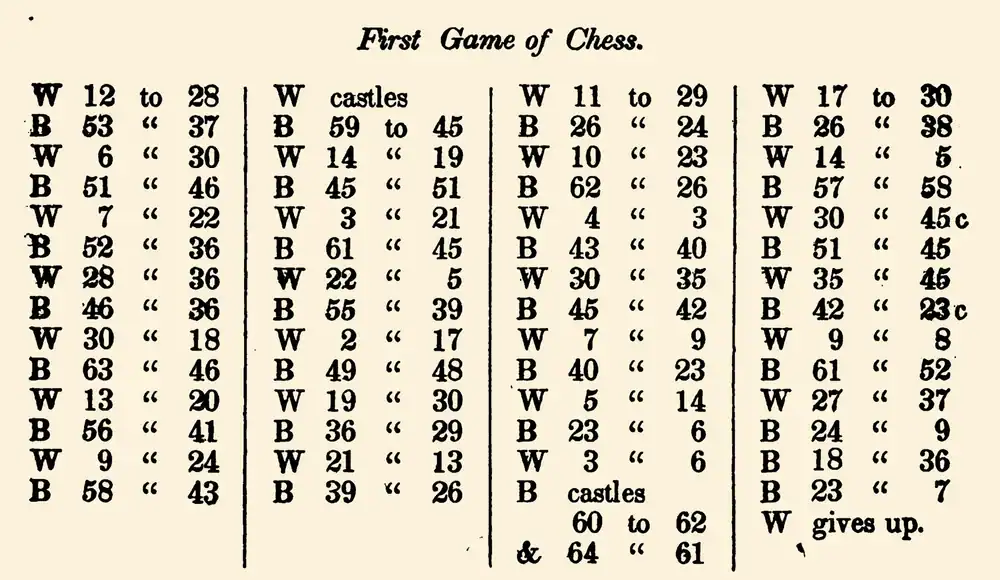
To designate positions on their chessboard, Alfred Vail and Henry Rogers assigned each of the 64 squares a unique number. Incidentally, in the first game of telegraph chess, white lost.
Over the next few days, they played seven chess games. All 686 moves were transmitted without a single error or interruption. This was not just an experiment — it was proof that the telegraph worked reliably.
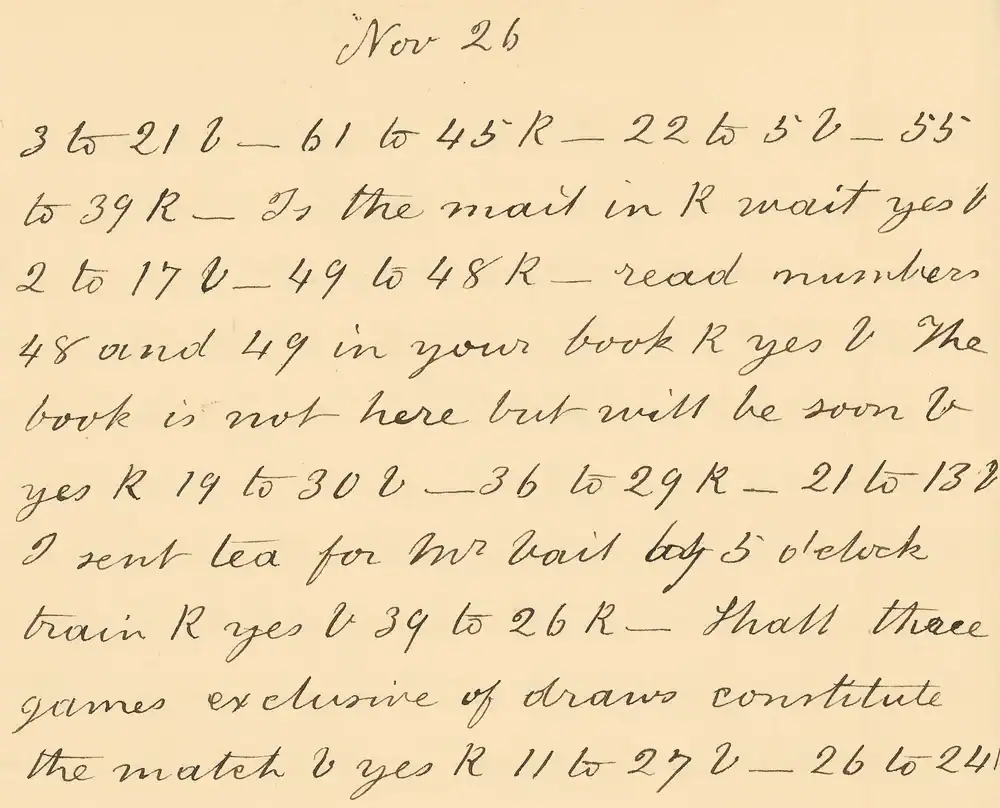
Records of player moves in a chess game played on November 26, 1844, made via telegraph. The note also mentions things like “I sent tea for Mr. Vail on the five o’clock train.”
And here’s what’s interesting: Morse was no romantic about games. Telegraph companies used chess matches to demonstrate the speed, accuracy, and range of the new communication medium.
Chess was the ideal demonstration subject — orderly, measurable, and yet spectacular enough to attract the attention of the public and congressmen. Telegraph operator Orrin Wood reported “considerable excitement” around the games, and Morse himself later used this experience for lobbying purposes, convincing officials that one could play over the telegraph “with the same ease as if the players were sitting at the same table.”
How Telegraph Chess in Britain Turned Into a Spectacle
America invented telegraph chess, but it was Britain that turned it into a show. In 1845, British telegraph pioneer Charles Wheatstone organized a match along the new South Western Railway line, connecting chess legend Howard Staunton with an opponent across the distance between Portsmouth and London. The game lasted all day.
The game itself was unremarkable, but the point wasn’t the moves. People were fascinated by the technology itself. The London News wrote enthusiastically about a game played over a distance of nearly 90 miles.
The match helped advertise the telegraph line, and soon the single-needle telegraph became widely adopted across British railways. Chess worked in roughly the same way that video games and esports platforms later became drivers for the development of computers, broadband internet, and streaming infrastructure.

Magnus Carlsen — five-time World Chess Champion (2013–2023), six-time World Rapid Chess Champion, and nine-time World Blitz Chess Champion. As of April 2026, he is the highest-rated chess player in the world.
How 19th-Century Chess Tournaments Drew Thousands of Spectators
By the 1890s, chess players were already using undersea cables to challenge opponents on the other side of the ocean. From 1896 to 1911, a series of annual matches over the transatlantic cable took place between teams from the USA and Great Britain. The series turned out to be incredibly close: each team won six matches, one ended in a draw, and the overall score of individual games was 39:39 with 50 draws. And, most amazingly — people came to watch.
Historian Simone Müller-Pohl reports that the Newnes Cup in 1895 drew more than 3,000 spectators — an astonishing crowd for chess. The New York Times noted that the audience included many ladies who attentively followed the moves on demonstration boards.
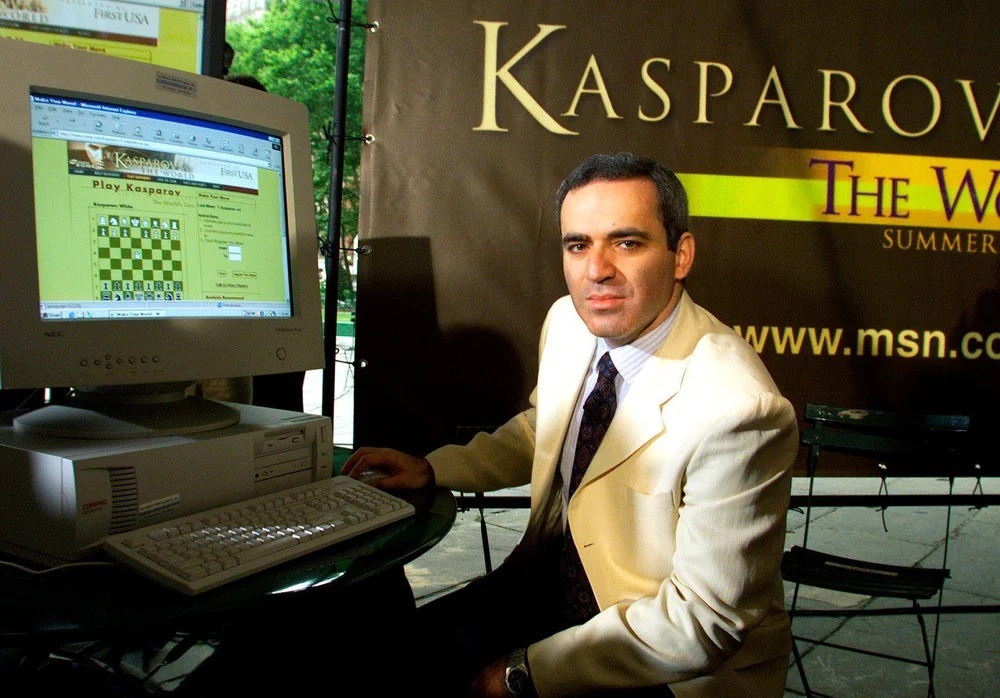
In a promotional game in 1999, Russian grandmaster Garry Kasparov played an online game against “the whole world.”
Long before Twitch existed, thousands of people gathered to watch a game that unfolded over copper wires.
Why Chess Is Always First to Adopt New Communication Technologies
After the telegraph, chess easily leaped to the telephone, radio, teletype, email, internet forums, and finally online servers. Each new communication medium promised to conquer distance — and chess was always there to prove the promise had been fulfilled.
Today, Chess.com alone hosts up to 20 million games a day — from blitz on the subway to serious rated matches. Chess is officially recognized as an esport and sits alongside video games at global tournaments.
Why chess specifically, and chess programs? They are perfectly compatible with telecommunications because they are transmitted as brief and precise information. A single move is just a few characters. No graphics, sound, or broad bandwidth are needed.