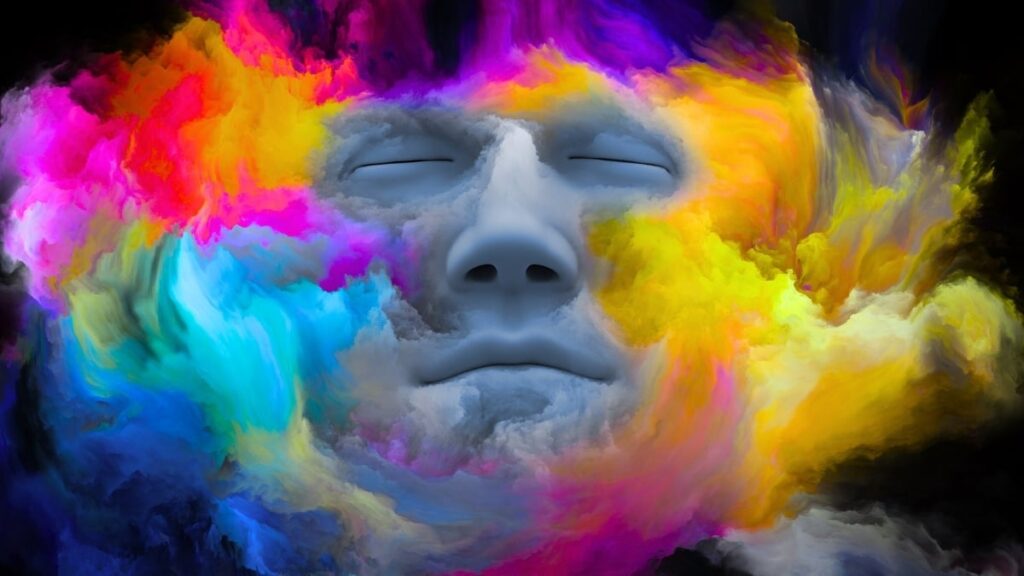
The ability to smell music is called synesthesia
Imagine that every letter of the alphabet is colored in a specific hue for you, music paints colorful spots before your eyes, and someone’s name has a distinct taste. This is how the world works for people with synesthesia — a neurological phenomenon in which one sensation automatically triggers another, seemingly completely unrelated one. Neurobiologists have explained what is currently known about this phenomenon.
What Is Synesthesia and How Many People Have It
Synesthesia (from the Greek for “together” and “sensation”) is a phenomenon in which the activation of one sense, such as hearing, involuntarily triggers a response in another, such as vision. A person with synesthesia hears a sound and simultaneously sees a color, or reads text and perceives each letter as colored in a specific shade.
According to researchers’ estimates, between 1 and 4% of people possess this perceptual trait. There is evidence that synesthesia is more common in women, although this may be related to sampling characteristics in studies. There is also evidence of the genetic nature of the phenomenon.
There are dozens of varieties of synesthesia. Here are the most studied ones:
- Grapheme-color — letters and numbers are perceived as colored. For example, “A” is always red, “7” is always blue;
- Audiovisual (chromesthesia) — sounds evoke visual images: a melody transforms into colored spots or shapes;
- Mirror-touch — a person physically feels touches that they see on another person’s body;
- Lexical-gustatory — spoken words trigger taste sensations.
It’s important to understand that synesthesia is not a disease or a disorder. It causes no harm and doesn’t interfere with daily life, although in some situations it can be tiring. For example, fatigue may occur if a person feels pain every time they see someone get hurt.
How a Synesthete Hears Colors and Tastes Words
In everyday life, our brain already combines signals from different sensory organs. When you watch a person speaking, the brain merges the image of the lips and the sound of the voice so you can better understand speech. In synesthetes, these cross-sensory connections work slightly differently: a sound can, for example, trigger a visual experience, but the mechanism itself may rely on the same basic processes as in everyone else.
At the same time, synesthetic sensations are involuntary and stable. A person doesn’t choose which color they will “see” when hearing a sound — it happens on its own. And if the letter “A” looks red today, it will very likely remain the same years later.
Many synesthetes don’t even suspect they have this trait — for them, it’s simply a natural way of perceiving the world. They are surprised to learn that for other people, letters are colorless and music doesn’t “look” like anything.
Two Main Theories About the Causes of Synesthesia
Scientists still don’t know exactly what causes synesthesia. But there are two main hypotheses being discussed in science.
The first is the cross-activation theory. According to it, synesthetes have more neural connections between different brain areas because their brain didn’t eliminate the “extra” connections between nerve cells.
Normally, during brain development, a process called synaptic pruning occurs — a “weeding” process where unused connections between neurons are removed. The cross-activation theory suggests that all people are born with an excess of such connections, but in most people they are removed in the first months of life. In synesthetes, some of these connections are preserved, and the brain area responsible for letter recognition ends up directly connected to the color processing zone.
The second hypothesis is that the difference lies not in brain structure but in brain activity. According to it, neural connections in synesthetes are the same as in everyone else, but certain pathways work more strongly or are less inhibited. A simple example: when you see a gray banana in a picture, your brain remembers that bananas are yellow, and this is reflected in its activity. In synesthetes, a similar mechanism may work more powerfully — so that when seeing black letters, the brain activates very specific colors.
Essentially, the debate comes down to one question: is the synesthete’s brain structured differently, or does it simply work differently? There is no definitive answer yet.
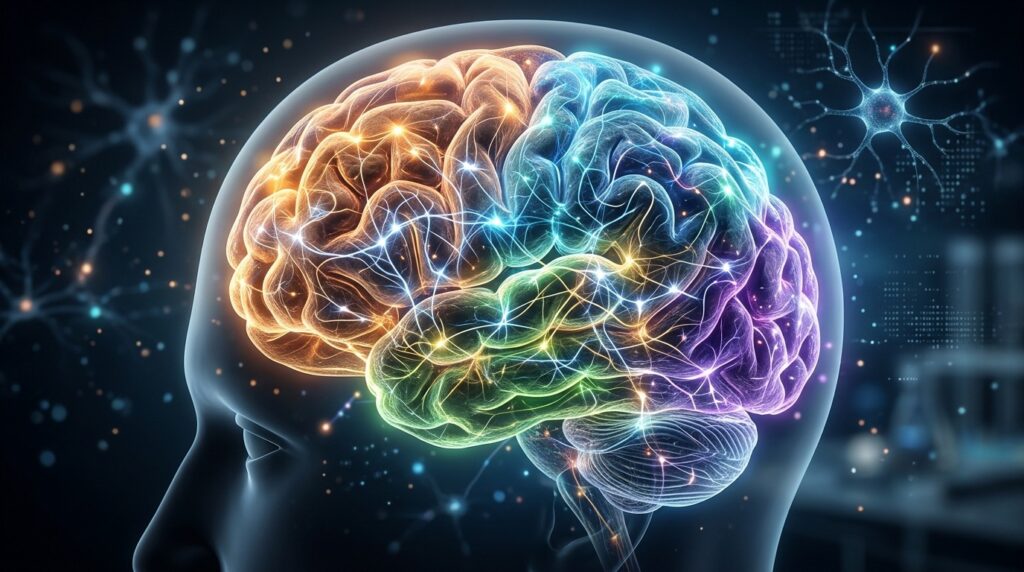
According to one theory, the brains of synesthetes retain additional connections between sensory areas
Does Synesthesia Help Creativity
Among famous synesthetes, there are many creative people. It is believed that synesthesia may have inspired Wassily Kandinsky to take up painting — he claimed to hear colors and see music. New Zealand singer Lorde has sound-color synesthesia and says this trait helps her compose music.
And these are not isolated cases. According to a large Australian survey, about 24% of synesthetes worked in creative professions: as artists, musicians, architects, and graphic designers. In the general population, such professions account for less than 2%. The gap is impressive, although its causes are not yet fully understood.
One explanation: synesthetes connect ideas and sensations in unusual ways, which may help with unconventional thinking. There is evidence that people with certain types of synesthesia form more vivid memories and have a more vivid imagination — but only to a limited degree. Calling synesthesia a “superpower” would be an exaggeration.

Some musician-synesthetes literally “see” their music in color
What Synesthesia Tells Us About Humans
Synesthesia is interesting not only as an exotic trait. It’s a window into how each of our brains constructs a picture of the world. We’re accustomed to thinking that everyone perceives reality the same way: sound is sound, color is color, taste is taste. But in reality, perception is not a passive recording of data from the sensory organs. It’s an active process in which the brain constantly supplements, combines, and interprets signals.
Synesthetes can be considered living proof that this process can be organized in much more diverse ways than we think. Synesthesia reminds us that perception is not a universal template but something the brain actively constructs, often in more diverse and richer ways than one might expect.
Science is still far from fully understanding the mechanisms of synesthesia. It’s unknown which of the two main theories is closer to the truth, and it’s possible that the answer will turn out to be a combination of both. But even now, research on synesthesia helps us better understand how perception works in all people, and how differently each of us may experience the same reality.