
There could have been a ninth planet in the Solar System, but it disappeared for mysterious reasons
A stone found in the Sahara Desert gave scientists reason to believe that a ninth planet of the Solar System once existed in space long ago. The meteorite called NWA 12774 turned out to be a fragment of a massive celestial body that could have rivaled Mars in size. What exactly happened to it, nobody knows, but something clearly prevented it from surviving to the present day and taking its place alongside Mercury, Venus, Earth, and the other planets. And that’s far from the most interesting thing about it.
A rare meteorite in the Sahara Desert
The meteorite NWA 12774, found in the sands of the Sahara, belongs to angrites — one of the rarest types of meteorites. It looks like an ordinary rock, but its internal structure tells an astonishing story. This was reported by the authors at Popular Science.
Angrites are interesting because they formed inside large celestial bodies. They were in places where rocks melted, crystals formed, and other geological processes took place. In other words, such a stone could not have been born on a small asteroid. It required entirely different conditions.
How the Sahara meteorite surprised scientists
When researchers examined the meteorite under X-rays, they noticed several oddities. First, the crystals inside the meteorite had very sharp, well-defined edges. This indicates that the meteorite formed not at the very center of its parent body, but closer to the surface.
Second, the composition of the meteorite differed noticeably from that of Earth and Mars. This meant that this fragment came not from planets familiar to us, but from something entirely separate.
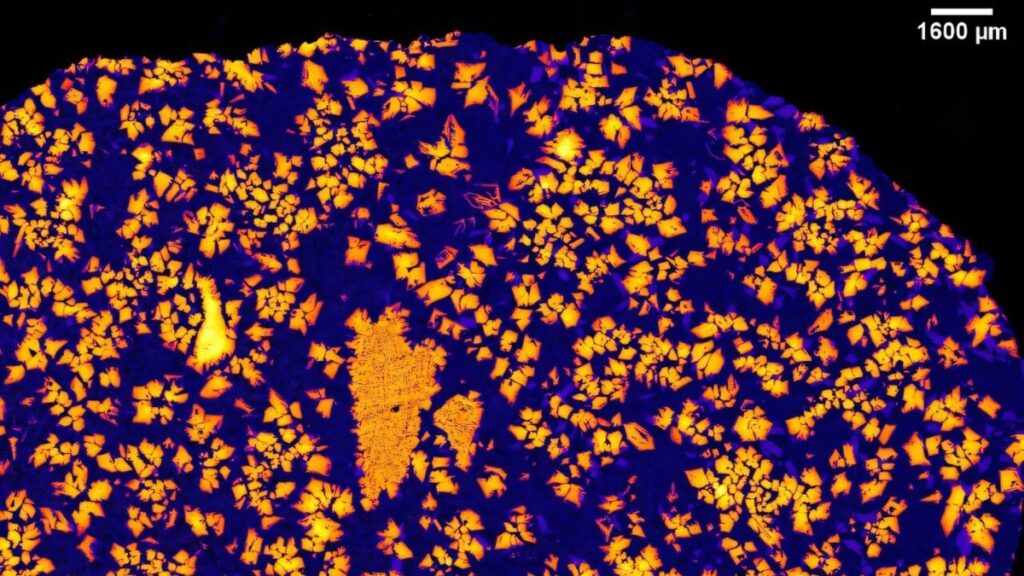
X-ray image of the NWA 12774 meteorite
As one of the study’s authors, geologist Aaron Bell, explains, the materials that made up the angrite’s parent body are completely different from the “ingredients” of Earth and Mars. This points to a separate, independent path of planetary development in the early history of the Solar System.
What is a protoplanet in simple terms
To understand why this matters, you need to learn one word — protoplanet. Put simply, it is a planet in embryo, or a world at the very earliest stage of development. Imagine a house that already has a foundation and some walls, but no roof yet, and it’s unknown whether it will ever be finished. That’s what a protoplanet is.
Billions of years ago, dust, gas, and debris circled the young Sun. Gradually, they clumped together into increasingly larger bodies. Some of them grew into full-fledged planets — that’s how Earth, Mars, and Venus were born. Others perished along the way, because some collided with each other, while others were destroyed or swallowed by larger neighbors.
The meteorite NWA 12774, by all appearances, was precisely a piece of such an unfinished planet. And we’re not talking about a small asteroid, but a fairly large object.
What the protoplanet in the Solar System could have looked like
Based on the composition, crystal structure, and formation conditions, astronomers concluded that the meteorite’s parent body was a protoplanet with a radius of approximately 1,000 to 3,300 kilometers. That’s a very wide range, but even its lower limit is impressive.
The upper estimate means that this lost protoplanet could have been the size of Mars. In other words, in the early Solar System there could indeed have existed another full-fledged world that, under different circumstances, would have become the ninth planet.
How the ninth planet of the Solar System disappeared
Where the protoplanet that could have become part of the Solar System went, scientists do not know. But one likely scenario is a collision with another planet of the early Solar System.
Back then, the neighborhood of the Solar System was far less calm than it is now. Young planets and protoplanets moved along orbits that hadn’t fully stabilized, constantly approaching and crashing into each other. Essentially, it was a long series of cosmic accidents from which some bodies emerged as winners and became planets, while others shattered into fragments.
How meteorites help reveal the past of planets
The main value of the find is that it preserved evidence of an entirely different path of planetary formation. Meteorites in this sense work like time capsules. They freeze at the moment of their birth and carry information about those conditions through billions of years.
By studying such fragments, scientists reconstruct a picture of the past that is impossible to observe directly. No telescope can show a planet that perished billions of years ago. But its fragment, lying in the desert sand, can reveal information about the composition, pressure, and depth at which it was formed.
This changes our understanding of how diverse the early Solar System was. It turns out that alongside the worlds familiar to us, there could have existed planets built from literally different materials. And not all of them survived to the present day.
It’s important to understand that this doesn’t mean the Sun had a planet “taken away” or that the official list of Solar System planets will change. This is about the distant past — a world that existed at the dawn of the Solar System and did not survive. But it is precisely such discoveries that gradually piece together a more accurate and far more turbulent history of how our cosmic home was formed.