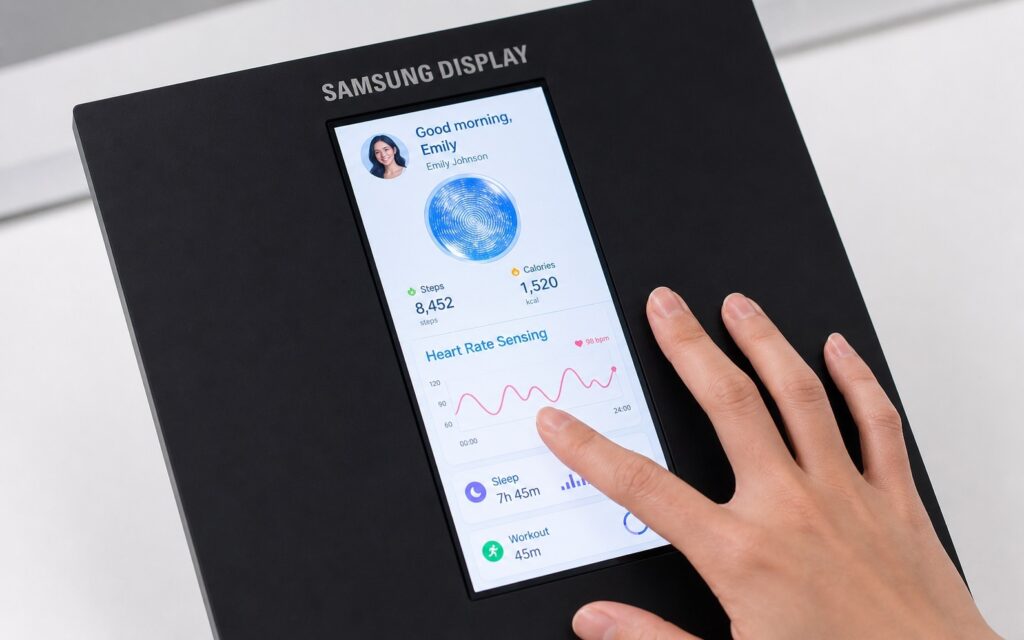
Despite the fact that Samsung has issues with the Galaxy S26 Ultra screen, the Korean company continues to be one of the leaders in developing this component for smartphones. Moreover, it is a driving force of progress. Samsung has unveiled Sensor OLED technology, which turns a smartphone screen into a full-fledged health sensor. Simply place your finger on the display to get heart rate and blood pressure data. The prototype was shown at the SID Display Week 2026 exhibition in the USA, and it is one of Samsung’s most interesting announcements in recent times, although a finished product is still far off.
Samsung taught a smartphone screen to measure blood pressure without special sensors
How Samsung’s Screen Measures Blood Pressure Without a Tonometer
The working principle of Sensor OLED is based on an optical method similar to what is used in the best fitness bands and smartwatches of 2026. The screen emits light that penetrates through the skin of the finger, reflects off blood vessels, and is captured by sensors built into the display. Based on the characteristics of the reflected light, the system determines heart rate and estimates blood pressure.
The system determines pulse through skin illumination.
The key difference from conventional solutions is that no separate optical module on the back panel or a separate device like a tonometer is needed. Everything happens right on the screen surface. This is not simply moving a sensor from the body to the display, but an attempt to make any screen multifunctional.
Accuracy of Blood Pressure Measurement Through a Smartphone Screen
It’s important not to be misled here. Samsung has so far shown the technology at an exhibition booth, not in a production device. The source does not provide data on measurement accuracy, margin of error, or certification for medical use. This is a fundamental point.
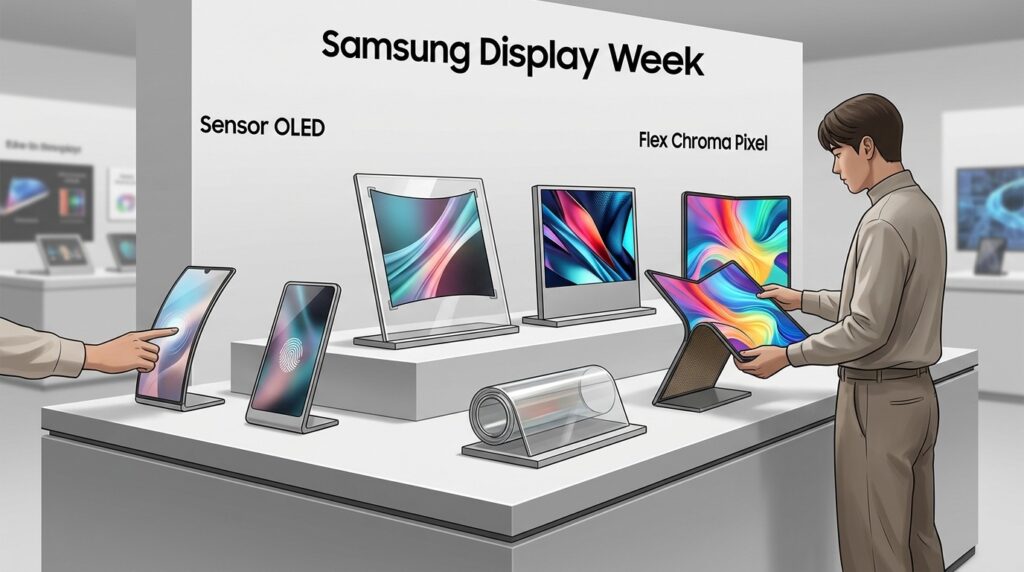
Samsung showed many screen technologies at the exhibition
For comparison: even the Galaxy Watch, which has been functioning as a watch with blood pressure measurement for several years, requires calibration with a regular tonometer and does not replace medical devices. Results from the watch are more of a guideline than a diagnosis. It is logical to assume that the screen sensor will initially work with similar limitations, and possibly with greater margin of error. After all, the contact area of the finger with the screen and measurement conditions are different each time. If you are actually monitoring blood pressure for medical reasons, a classic upper-arm tonometer has not been replaced by anything yet. The screen sensor may be useful for a quick on-the-go check, but not for serious diagnostics.
Will Blood Pressure Measurement Appear on iPhone
Sensor OLED is a Samsung Display development, and for now it exists only within the Samsung ecosystem. Apple uses its own OLED panels from Samsung and LG, but Apple has not announced or demonstrated this specific technology with built-in biometric sensors.
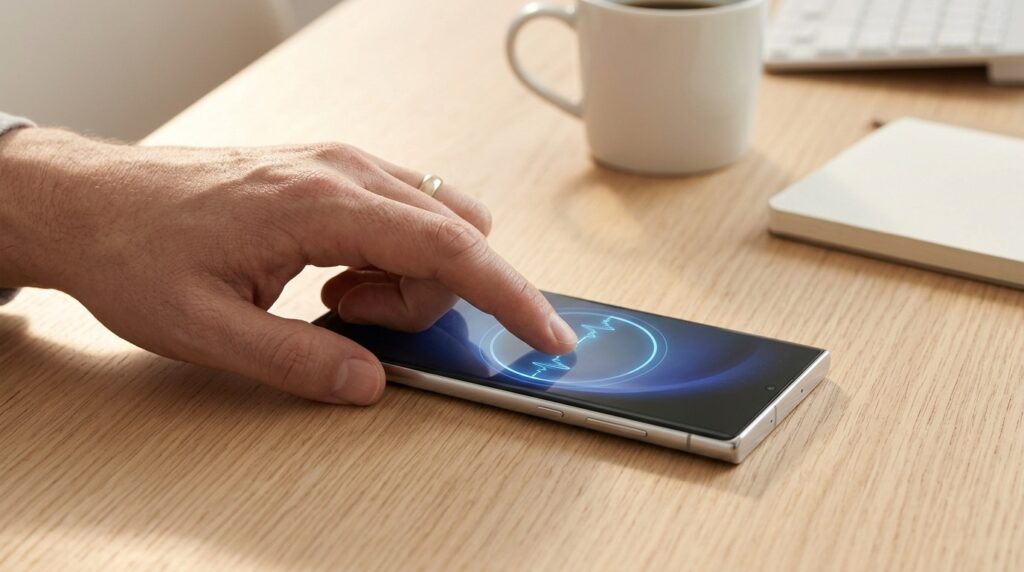
Similar technology could also appear on Apple devices
Theoretically, nothing prevents any manufacturer from embedding optical sensors into a screen, but in practice, Apple usually goes its own way. The iPhone doesn’t even have a permanent heart rate monitor yet, and all rumors about Apple Watch with a tonometer have been circulating for years. So there is no reason to expect something similar in the iPhone in the foreseeable future. At least, the source gives no grounds for this.
What Else Samsung Showed at Display Week 2026
In addition to Sensor OLED, other technologies were displayed at the booth that could influence future devices:
- Flex Chroma Pixel — a screen with brightness up to 3,000 nits and 96% coverage of the BT.2020 color space. Simply put, this is a bid for a very bright and color-accurate display for flagship smartphones that also consumes less battery power.
- Flex Magic Pixel — a viewing angle restriction technology. It allows hiding screen content from prying eyes without applying an anti-spy film. Useful for messages, banking apps, and medical data.
- Stretchable Micro LED display — a development for automotive applications, where screens need to fit into non-standard cabin shapes.
All of these technologies were shown as prototypes. Samsung did not name specific devices or timelines for when they would appear in production products.
Benefits of Measuring Blood Pressure with a Phone
Right now, the technology offers nothing practical. Sensor OLED, Flex Chroma Pixel, and other developments are not tied to specific smartphones or release dates. This is a demonstration of the direction in which Samsung is taking its display technologies.
Don't expect these technologies to appear in Samsung's upcoming new products.
But the direction itself is interesting. If in a couple of years the Galaxy S or Galaxy Z screen learns to quickly measure pulse and blood pressure without additional gadgets, it will simplify life for those who monitor their health. Placing a finger on the screen is easier than putting on a watch or getting out a tonometer. This is not a replacement for medical devices, but a sensible addition for daily monitoring. For now, however, it should be seen as an exhibition demonstration — promising, but with no guarantees that the final product will work exactly as shown at the booth.