Robot dog or guide dog: which is better
Robots are getting smarter by the day: they read to-do lists from whiteboards, take out the trash, and even walk real dogs. But when it comes to helping people with visual impairments, real guide dogs still outperform any machine. A new study from Finland explains why — and the answer turns out to be not entirely technical.
How Guide Dogs Are Trained and How Much It Costs
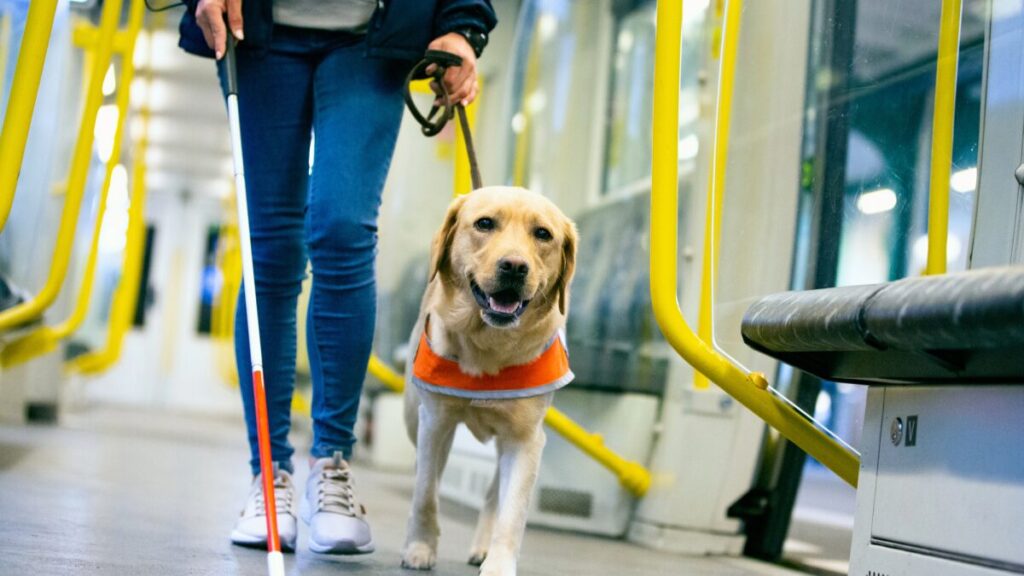
Training a guide dog is a long and expensive process. Puppies are selected according to strict criteria, and not all make the cut: a significant portion of candidates are eliminated during the training stage. Training one guide dog costs between 1.5 and 3 million rubles per dog (≈ $15,000–30,000) in Russia. That is 1.5 to 3 times cheaper than in the US, where it costs around $50,000. And the process itself takes from one and a half to two years.
Several hundred dogs are placed each year across the entire country, while demand for such animals far exceeds supply. According to Assistance Dogs International statistics, by the end of 2024 more than 7,600 people were on the waiting list for an assistance dog, and the wait can stretch from one to five years. Only about 2% of blind and visually impaired people worldwide use guide dogs — the rest get by with a cane, smartphones for the blind, or have no specialized navigation aids at all.
Important clarifications:
for a blind person, a guide dog is provided free of charge (through government programs and NGOs); the main operator is the Russian Guide Dog Training School of the All-Russian Society of the Blind (VOS); funding comes from the government (Social Insurance Fund/Social Fund of Russia) + partly from charitable donations.
Even when a person manages to get a dog, the owner needs to feed it, take it to the vet, ensure walks and care. For a person with a disability, this is an additional burden that not everyone can handle.
Why a Robot Guide Is Better Than a Dog: Technology and Features
Robot guides are a logical alternative. They don’t get sick, don’t shed, don’t need food or veterinary check-ups. Modern models are equipped with 360-degree cameras, obstacle detection systems, and built-in GPS — similar principles are already used in smart glasses for the blind that help navigate safely in space.
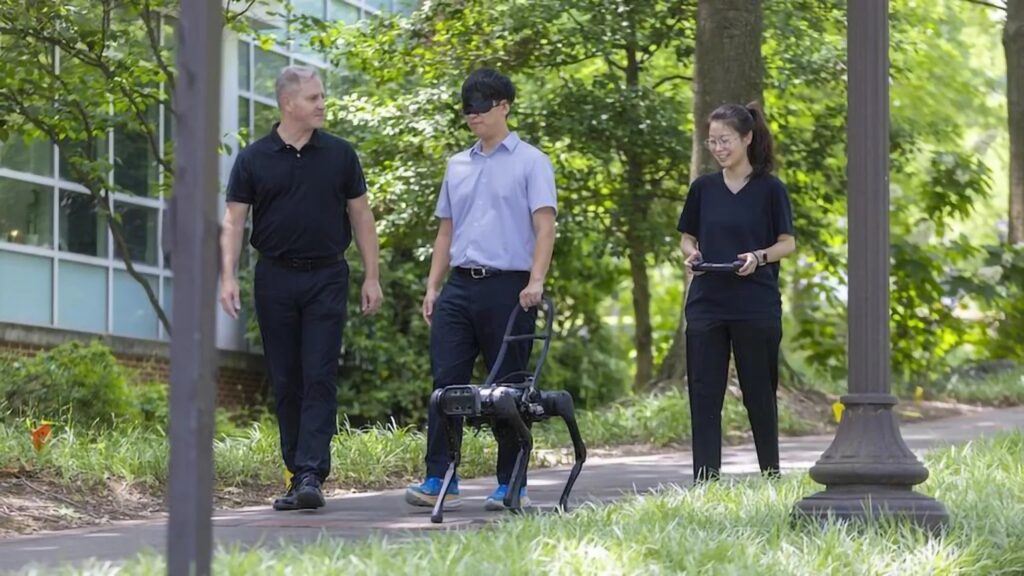
Researchers are working on creating a robot dog prototype based on feedback and preferences of people with visual impairments.
Thanks to the integration of large language models (like ChatGPT), robots now understand far more commands than a living dog. A typical guide dog masters 20–30 commands, while a robot with a language model can process instructions in natural language — with virtually no vocabulary limitations. Some devices can call emergency services if a person falls — a dog, despite all its loyalty, can’t dial 112. These systems are based in part on computer vision — that’s how AI recognizes images and objects around a person.
One of the most interesting examples is the Glide device from the company Glidance. It’s a two-wheeled assistant robot the size of a small vacuum cleaner with a telescopic handle. A person simply pushes it ahead, and Glide plots a safe route on its own, avoiding obstacles. The retail price is about $1,500, which is tens of times cheaper than training a living dog.
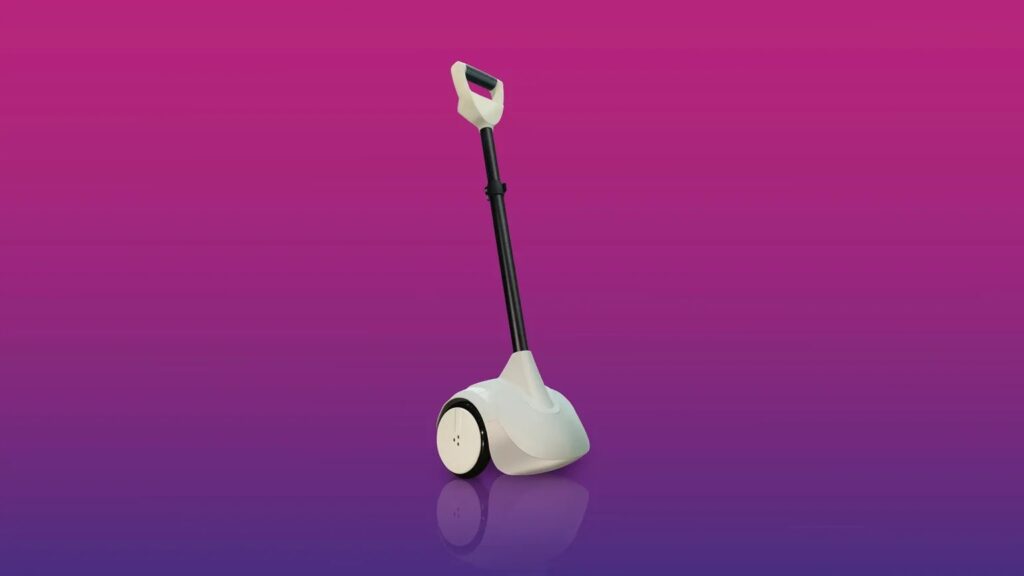
The Glide robot guide uses a combination of built-in sensors and cameras borrowed from self-driving cars to detect obstacles and help people with visual impairments reach their destination.
Why a Guide Dog Gives More Than Technology
Researchers from the University of Turku and Aalto University in Finland studied the daily lives of 13 assistance dogs and their owners. The results, published in the journal Human Relations in April 2026, describe a phenomenon the scientists called the “invisible world of care.”
The point is that the relationship between a dog and a person is not simply “the owner gives commands, the dog obeys.” It’s a genuine partnership where both participants take turns being the caregiver and the one being cared for. A dog reads the owner’s emotional state, picks up on the subtlest gestures, movements, and habits — and responds to them in ways no robot is yet capable of.
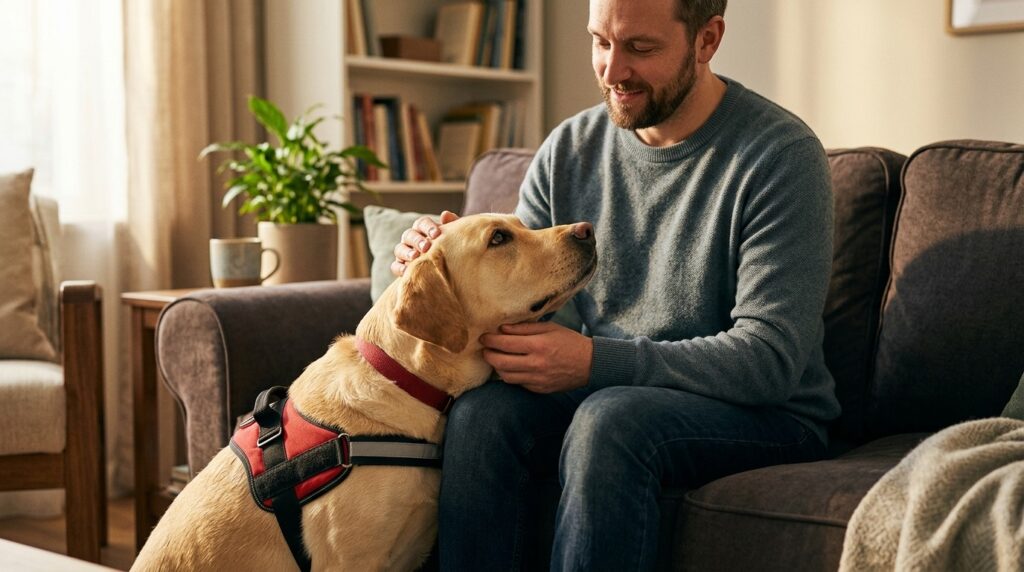
A guide dog next to its owner at home — not just a helper, but a companion
One study participant who lost his sight described getting a guide dog as a turning point in his life: he had to learn to let go of control and completely trust the animal. Another participant compared her dog to a “weighted blanket” (the kind that helps with anxiety) and called their bond a symbiosis in which it’s hard to tell where the person ends and the dog begins. This effect is no accident: research has long shown that people feel calmer around dogs, and they are rightly called the best remedy for stress.
How Guide Dogs Make Decisions Without Commands
The Finnish researchers highlight an important detail: assistance dogs are not passive executors. Yes, they follow mandatory commands like “sit” and “stay.” But beyond that, they voluntarily take on additional functions — for example, pressing close to their owner when they’re upset, or initiating physical contact on their own. This is not part of the dog’s “job description” — it does this by its own choice.
This kind of emotional intuition is the result of a deep evolutionary partnership between humans and dogs that has formed over thousands of years. Robots have no such experience, and none is expected in the near future. A machine can flawlessly recognize an object on camera, but it doesn’t “feel” when its owner needs support.
The scientists also note that trust between a dog and a person works both ways. The person learns to rely on the animal’s instincts and yield control in certain situations. The dog, in turn, trusts the person to meet its basic needs. It is precisely this mutual exchange that creates that “invisible care” which is currently impossible to program.
What the AI-Powered Spot Robot Can Do and Why It Matters
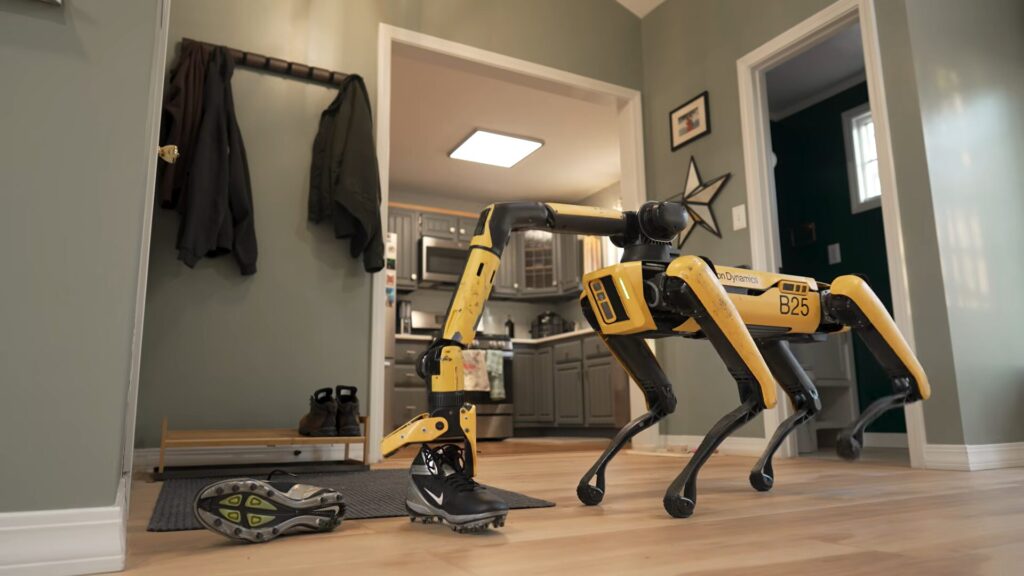
Nevertheless, robots are progressing rapidly. Boston Dynamics announced the integration of Google DeepMind’s Gemini Robotics-ER 1.6 model into its quadruped robot Spot. In a demonstration video, Spot reads a handwritten to-do list from a whiteboard, then independently tidies up shoes, takes out the trash, folds scattered clothes into a basket, and even picks up a leash to walk a real dog.
The system combines computer vision, natural language understanding, and action planning. This is fundamentally different from classical robotics, where every step needs to be programmed manually. However, engineers from IEEE Spectrum noticed a telling detail: the robot grabs a soda can sideways, which with a full can would have ended badly. Robots still lack the everyday experience that we accumulate over a lifetime — and this applies to more than just cans.