Two newly confirmed exoplanets are roughly the size of Jupiter yet astonishingly light — so light, in fact, that their density is lower than that of cotton candy. Researchers at the University of Oxford calculated that TOI-791 b has a density of just 0.038 grams per cubic centimeter, while its companion TOI-791 c comes in at about 0.047 g/cm³. For comparison, cotton candy sits around 0.05 g/cm³, and Jupiter — the least dense planet in our solar system — has a density of 1.33 g/cm³. That makes these worlds 28 to 35 times less dense than Jupiter, challenging existing models of how giant planets form and survive.
What you need to know
- TOI-791 b and c are Jupiter-sized exoplanets with densities of 0.038 and 0.047 g/cm³ respectively — lower than cotton candy (~0.05 g/cm³).
- The two planets share a rare 5:3 orbital resonance, which allowed astronomers to calculate their masses from transit-timing variations.
- Only four planetary systems in the Milky Way are known to contain more than one “super-puff” planet.
- The James Webb Space Telescope is expected to be used next to search for carbon, nitrogen, and oxygen in the planets’ atmospheres.
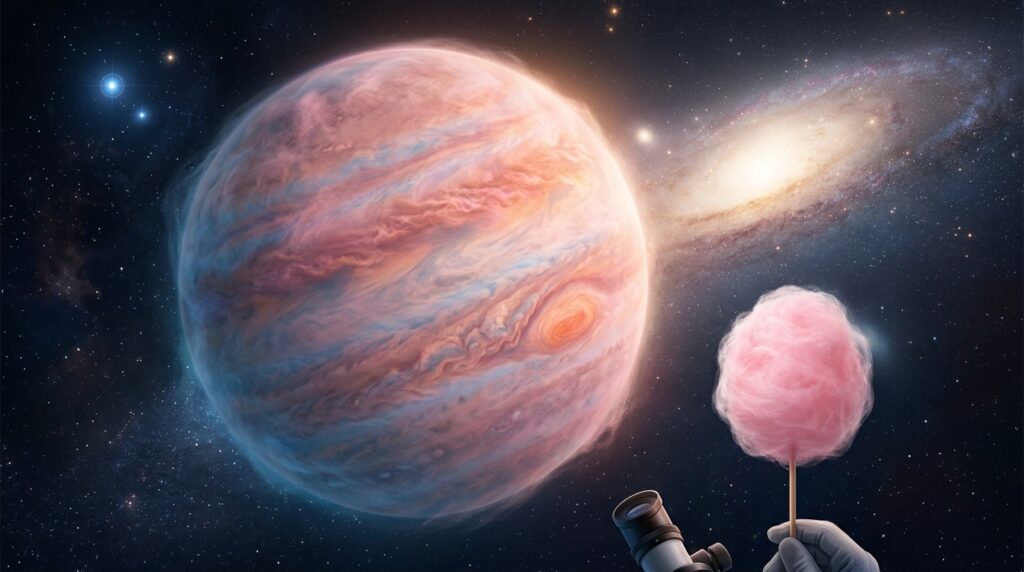
Scientists found planets that resemble cotton candy in density
How astronomers weighed planets light-years away
According to Refractor, traces of these planets were first spotted by volunteers in the citizen-science project Planet Hunters TESS in 2019 and 2023. Confirming the discovery and calculating the planets’ physical properties required combining data from multiple telescopes around the world.
The key breakthrough was the realization that both planets are locked in a rare 5:3 orbital resonance: for every five orbits the inner planet completes around its host star, the outer planet completes exactly three. This regular gravitational interaction causes measurable effects:
- Telescopes detect periodic dips in the star’s brightness each time a planet transits — passes directly in front of — the stellar disk.
- Because the two planets tug on each other gravitationally, the exact timing of each transit shifts slightly.
- By measuring the magnitude of those shifts, astronomers can calculate each planet’s mass with high precision.
This transit-timing variation method is what confirmed that the objects are genuinely “super-puff” planets rather than an instrumental error.
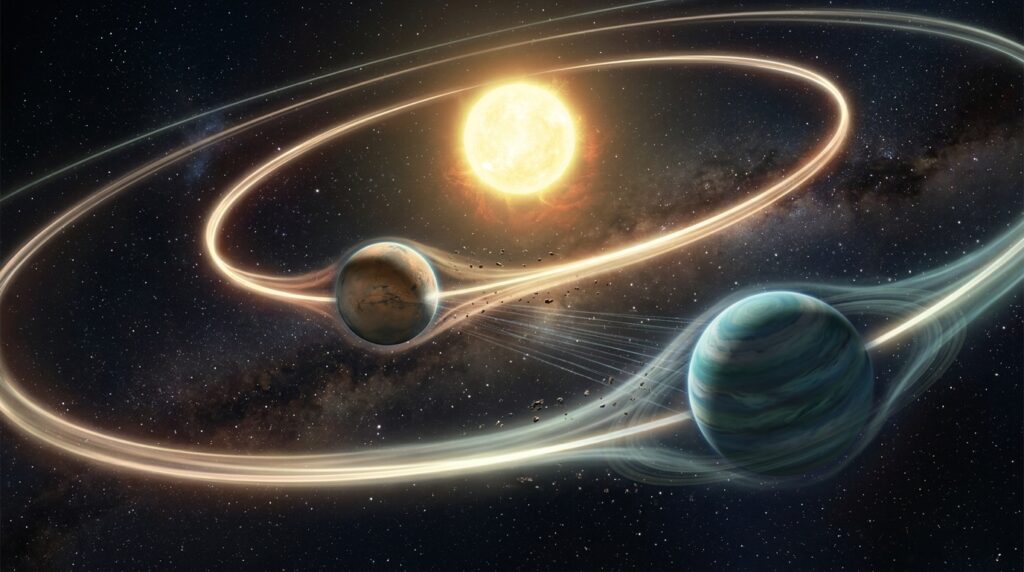
Gravitational interaction between two planets shifts the timing of their transits across the star’s disk
How could such lightweight giants form?
The central puzzle is how a planet can maintain Jupiter’s volume while containing so little matter. A leading hypothesis holds that the bulk of each planet is a vast gaseous envelope of hydrogen and helium surrounding a relatively small solid core.
Such an enormous atmosphere could have formed only under specific conditions:
- The planets originated in the cold outer regions of a protoplanetary disk, far from the heat of their parent star.
- Low temperatures allowed gas to cool rapidly and accumulate around the core in enormous quantities.
- The planets may have subsequently migrated inward toward the star while retaining their diffuse envelopes.
It is important to note that this formation scenario remains a hypothesis. To test it, the research team plans to use the James Webb Space Telescope. The expectation is that JWST’s instruments will be sensitive enough to detect traces of carbon, nitrogen, and oxygen in the super-puff atmospheres. The chemical composition of the gas envelopes would provide critical clues about where — and how quickly — TOI-791 b and c formed.
Why it matters
Super-puff planets are exceedingly rare. The Milky Way contains only four known planetary systems hosting more than one such world. Each new discovery offers scientists a chance to study the formation processes behind these exotic objects in greater detail. If follow-up observations with JWST confirm the hypothesized formation pathway, it could prompt significant revisions to current models of planetary formation and atmospheric evolution.