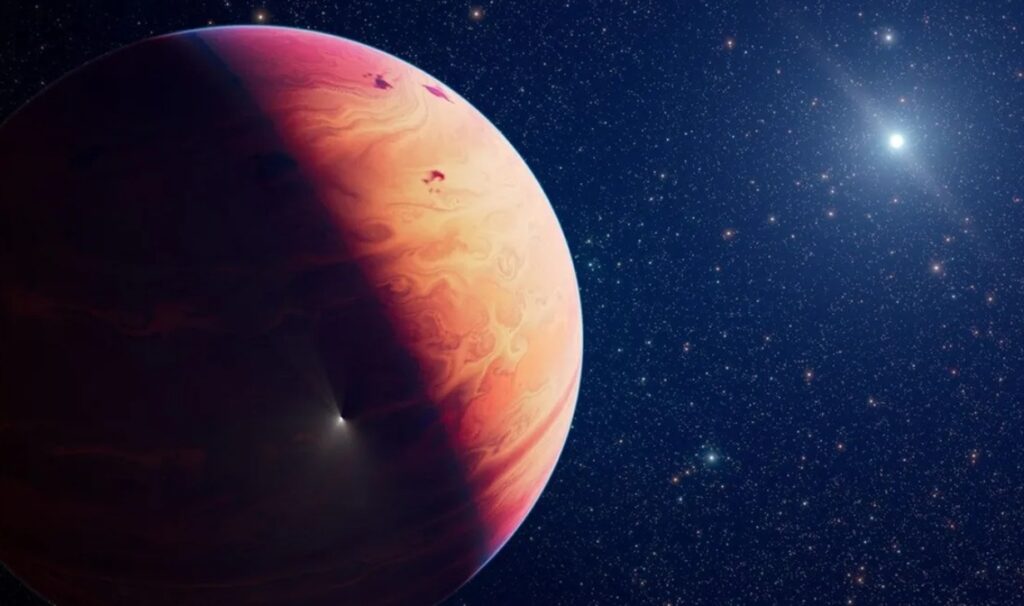
Gas giant 29 Cygni b is the size of a brown dwarf, yet it is a planet. Image source: IFL Science
The gas giant 29 Cygni b is 15 times heavier than Jupiter, and yet it is still considered a planet. Observations by the James Webb Space Telescope have shown that this colossal object formed in the same way as ordinary planets, not like a star. This new scientific study forces a reconsideration of the conventional boundary between planets and brown dwarfs.
Where a Planet Ends and a Star Begins
According to IFL Science, planets form from the bottom up: dust grains stick together to form pebbles, pebbles combine into boulders, boulders into planetary embryos, which then accumulate gas and become giants like Jupiter. Stars, on the other hand, are born from the top down: a massive cloud of gas collapses under its own gravity and fragments.
Between these two processes lies a gray zone occupied by brown dwarfs — objects too light to ignite hydrogen thermonuclear fusion but massive enough to burn a heavier hydrogen isotope (deuterium). The boundary between planets and brown dwarfs has traditionally been drawn at roughly 13 Jupiter masses: anything heavier was considered a stellar object.
But here’s the problem: this boundary is based on mass, not on how the object was born. And this is exactly where 29 Cygni b turned everything upside down.
What Is the Exoplanet 29 Cygni b
The star 29 Cygni is located in the constellation Cygnus, approximately 130 light-years from Earth. Its companion, the gas giant 29 Cygni b, weighs as much as 15 Jupiters — formally exceeding the 13-mass threshold that would normally classify it as a brown dwarf. It orbits its star at a distance of 2.4 billion kilometers, roughly the same distance that separates Uranus from the Sun.
It was precisely this borderline mass that made 29 Cygni b the ideal test subject. According to lead researcher William Balmer, computer models show that gas disk fragmentation can easily produce objects much heavier than 29 Cygni b, making 15 Jupiter masses practically the minimum for such a process. But at the same time, it is nearly the maximum for planetary accretion. The object turned out to be right at the crossroads of the two scenarios.
How the Webb Telescope Determined the Planet’s Origin
Balmer’s team used the near-infrared camera NIRCam aboard the James Webb Space Telescope in coronagraphic mode: a special wedge blocked the star’s light, allowing the planet itself to be seen. By selecting filters, the astronomers searched for characteristic absorption signatures of carbon dioxide (CO₂) and carbon monoxide (CO) — markers of heavy chemical elements that astronomers collectively call “metals.”
The result was telling. The planet is enriched in heavy elements compared to its host star, whose composition is similar to the Sun’s. The total mass of heavy elements in the atmosphere of 29 Cygni b is equivalent to roughly 150 Earth masses. This is a direct indication that the object accumulated material from a protoplanetary disk rich in solid particles — in other words, it grew from the bottom up, like an ordinary planet.
If 29 Cygni b had formed through gas cloud fragmentation — the way stars and brown dwarfs are born — its composition would have been roughly the same as that of its parent star. But the planet’s chemistry told a different story.
Why the Planet’s Orbit Confirms Its Origin
Chemical composition was not the only argument. The team additionally used the ground-based optical interferometer CHARA to determine whether the plane of the planet’s orbit aligns with the star’s rotation axis. It was confirmed: the orbit of 29 Cygni b is well aligned with the star’s rotation, just as observed for the planets of our Solar System.
Such alignment is expected for an object that grew inside a protoplanetary disk — a flat, rotating structure of gas and dust from which planets form. A brown dwarf born from cloud fragmentation would be far more likely to have a random orbital inclination.
Study co-author Ash Messier from the same university emphasized that the planet’s orbital inclination matches the star’s rotation axis — just like the planets in our system.
What This Discovery Changes in Astronomy
All the evidence — the metal-enriched chemical composition and the alignment of the orbit with the star’s rotation — points in one direction. 29 Cygni b formed through rapid accretion of metal-rich material in a protoplanetary disk, not through gas fragmentation. Put simply, it was born as a planet, not as a star, despite its enormous mass.
This calls into question the rigid 13-Jupiter-mass boundary as a criterion for separating planets from brown dwarfs. It turns out that the formation mechanism matters more than mass when determining the nature of an object. Instead of considering 29 Cygni b a failed star, it is more accurate to call it simply a very massive planet.
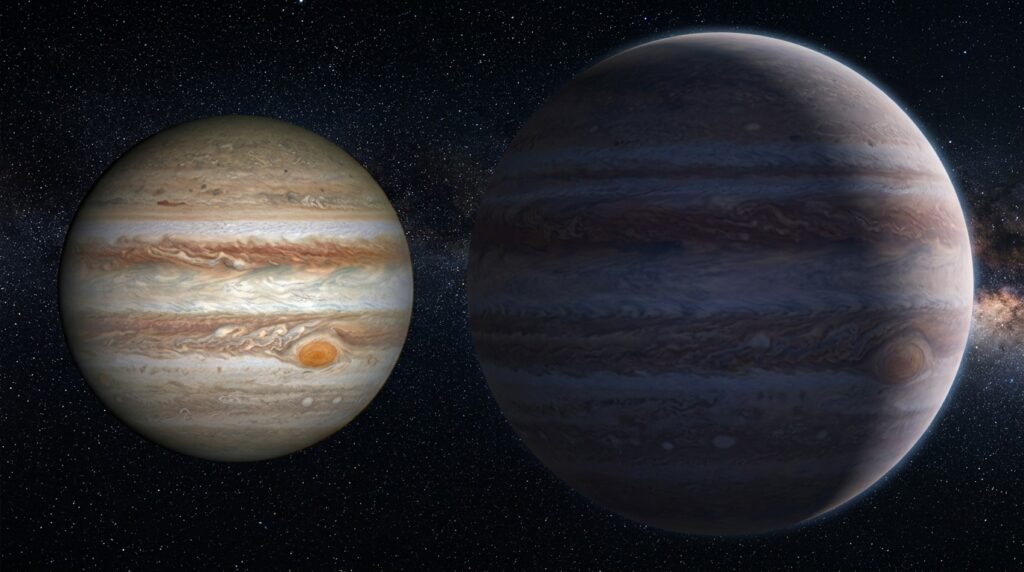
Size comparison: the gas giant 29 Cygni b next to Jupiter
29 Cygni b became the first of four targets in Balmer’s observational program. The remaining objects have masses ranging from 1 to 15 Jupiter masses, and the team plans to look for compositional differences between less massive and more massive planets. This will help better understand where exactly accretion gives way to stellar fragmentation and whether a clear boundary even exists.
The results of this work do not yet put a definitive end to the matter: we are looking at one study of one object. But it convincingly demonstrates that planets are capable of growing to masses that were previously considered exclusively “stellar territory.” If the next three targets of the program show a similar picture, astronomers will have to seriously reconsider a classification they have used for decades. And that means our understanding of how planetary systems work — including our own — could become significantly richer.