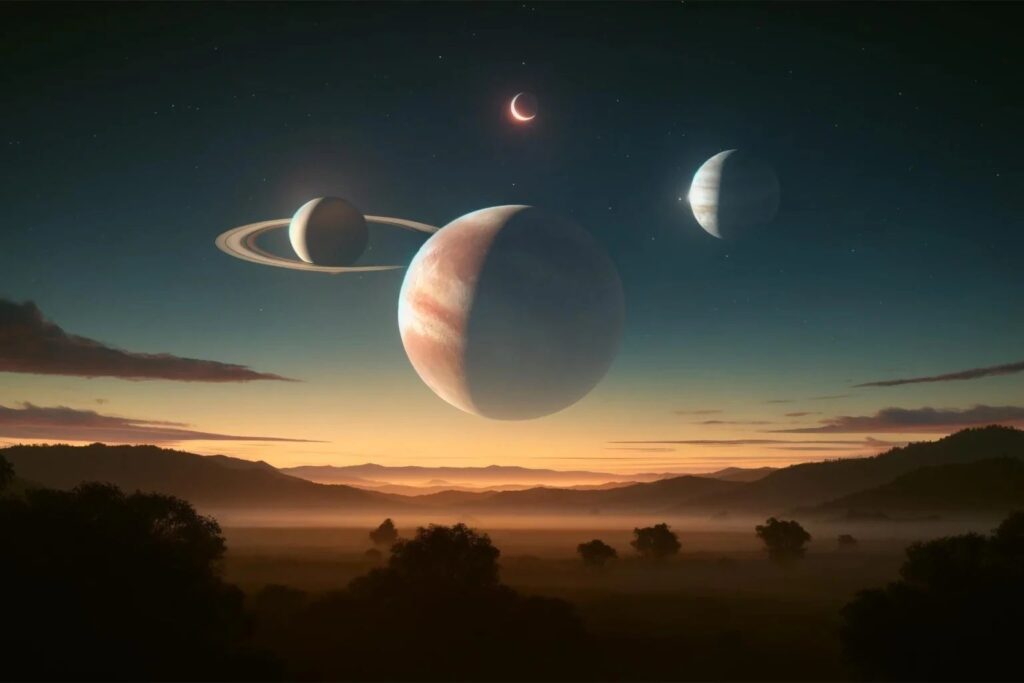
April 2026 planetary parade. Which planets will be visible in the sky? Image source: scitechdaily.com
Four planets of the Solar System are gathering into a compact group in the pre-dawn sky — this is one of the most notable astronomical events of 2026, unfolding right above the eastern horizon. The best dates for observation are April 18–20, 2026, but the chances of seeing the parade depend not so much on the calendar as on where you are and how open your horizon is. We explain when exactly to look, where to direct your gaze, and which planets can actually be seen without a telescope.
What Is a Planetary Parade and How Does It Look in the Sky
A planetary parade, or alignment, refers to the moment when several planets of the Solar System appear close together in the sky — visually lining up along the ecliptic, the imaginary line along which the Sun moves. This doesn’t mean the planets have lined up in a perfect straight line in space: they have simply ended up on the same side of the Sun, and from Earth this looks like a compact group of bright dots.
The term “planetary parade” is not strictly scientific, but it has become so established that even NASA and major planetariums use it. Parades are classified by the number of participants: three planets — a mini parade, four — a minor parade, five to six — a major parade, and when all are visible — a full parade. The April 2026 event is a minor parade, featuring Mercury, Mars, Saturn, and Neptune.
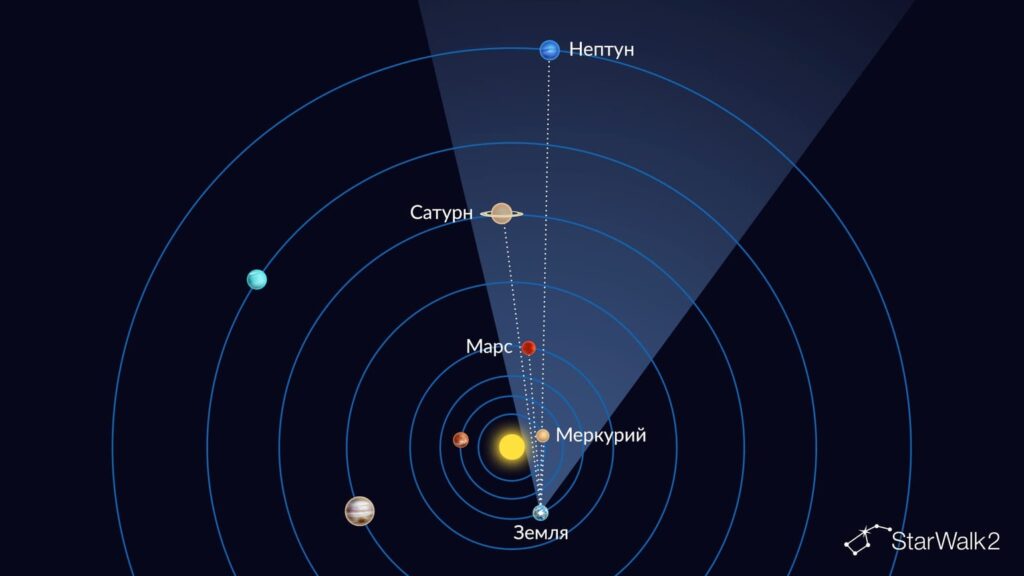
Planetary alignment on April 18, 2026, as seen from above the plane of the Solar System. Image source: starwalk.space
It’s important to understand: alignments of three to four planets happen fairly often. But each time the geometry and observing conditions are different — and that’s exactly why it’s worth knowing what to expect from a specific parade.
Which Planets Will Be Visible in the April 2026 Parade
Four planets are participating in this morning alignment, but seeing them will not be equally easy:
- Mercury (apparent magnitude −0.1) — the brightest participant of the parade, although it’s usually hard to spot due to its proximity to the Sun. On these days it will be fairly visible low above the horizon.
- Saturn (apparent magnitude 0.9) — bright enough, but will be positioned lower than the others, so haze and light pollution near the horizon may “hide” it.
- Mars (apparent magnitude 1.2) — easily recognizable by its reddish tint. It will be at roughly the same height as Mercury.
- Neptune (apparent magnitude 7.8) — invisible to the naked eye. Even with a telescope, finding it in the pre-dawn twilight will be extremely difficult.
Apparent magnitude is a scale of brightness for celestial objects. The lower the number, the brighter the object. With the naked eye under good conditions, you can see objects up to +6, and Neptune at +7.8 is already beyond the capabilities of the eye.
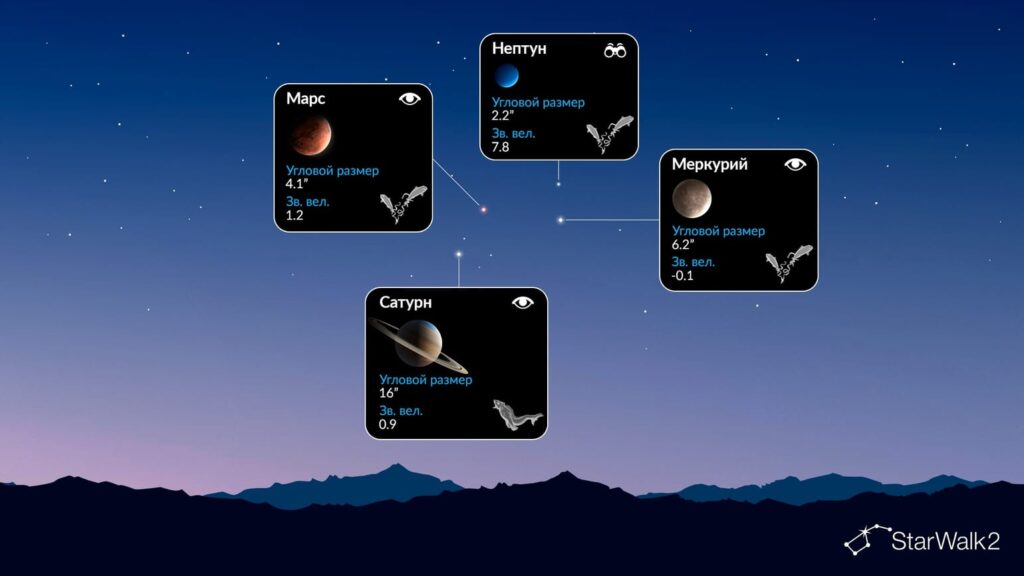
Diagram of the planetary alignment on April 18, 2026 for the Northern Hemisphere. Image source: starwalk.space
In total, the realistic targets for naked-eye observation will be three planets — Mercury, Mars, and Saturn. Neptune remains a bonus for telescope owners.
When to Observe the Planetary Parade in April 2026
This is not a one-morning event. The planets will be near each other approximately from April 16 to 23, with peak dates being April 18–20. Day by day the configuration will change noticeably, because Mercury and Mars move quickly along the ecliptic.
Here’s the “schedule” of the most interesting moments:
- April 15–16 — a thin crescent Moon passes through the same area of the sky, serving as a convenient reference point.
- April 18 — the main date: all four planets gather as compactly as possible.
- April 19 — Mars passes near Saturn, one of the best dates for observing three planets with the naked eye.
- April 20 — Mercury, Saturn, and Mars line up in a straight line only about 1.6° long (roughly three full Moons side by side). One of the most photogenic moments.
- April 21 — the trio of planets rearranges into a neat triangle.
Observations must be done strictly before sunrise. In the Northern Hemisphere, start approximately 30 minutes before sunrise — the planets will appear low in the east in a rapidly brightening sky. In the Southern Hemisphere, the observation window is wider: you can start 60–90 minutes before dawn.
Will the Planetary Parade Be Visible in Russia and Europe
For residents of Russia and most of Europe, this parade will be a challenging test. The problem is that in spring in the Northern Hemisphere, the ecliptic passes at a shallow angle to the horizon — and the planets end up very low, in the zone of bright pre-dawn haze.
Here are approximate observation start times for Russian cities (April 18):
- Moscow — around 04:47 (sunrise at 05:17)
- Saint Petersburg — around 05:04 (sunrise at 05:34)
- Sochi — around 05:04 (sunrise at 05:34)
- Vladivostok — around 05:57 (sunrise at 06:27)
The best chances in Russia are in the south of the country, in places with an open eastern horizon: no buildings, trees, or hills. Mercury and Mars will likely be the most accessible targets. Saturn can be attempted in perfectly clear air, and Neptune without a telescope is not even worth thinking about.
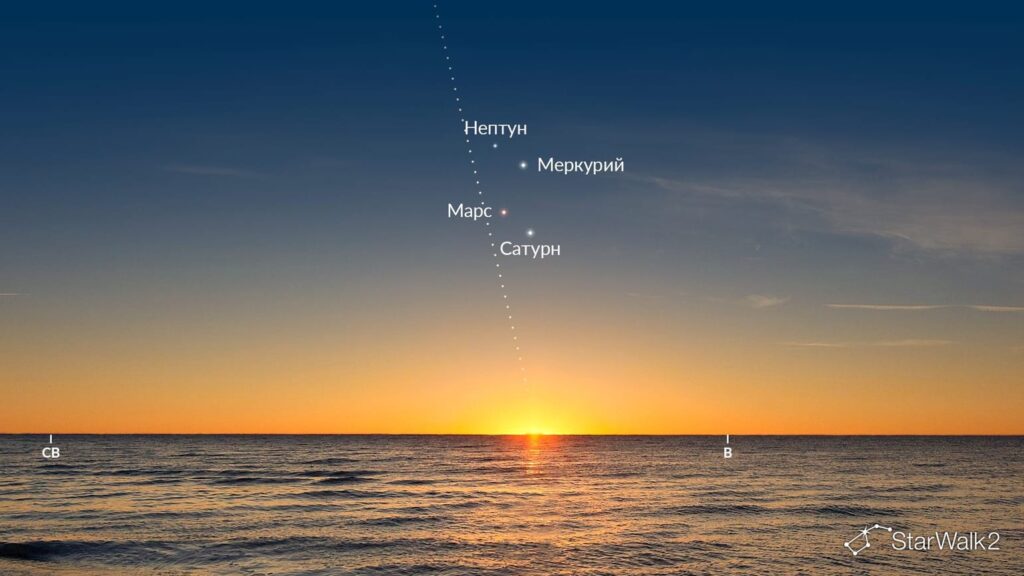
Planetary parade on April 18, 2026, simulated view for the Southern Hemisphere (view from Sydney, Australia). Image source: starwalk.space
Astronomer Lyudmila Koshman from the Moscow Planetarium, in a comment to TASS, even called this event an “invisible minor planetary parade” — all its participants will be in the bright rays of the Sun, making observation extremely difficult for most Russian latitudes.
In Europe, the situation is similar: the farther south, the better. Observers in Spain, Italy, or Greece have better chances than those in Scandinavia or the United Kingdom, but even in southern Europe this event will require patience and luck with the weather.
Where to Observe the Planetary Parade to Definitely See It
As reported by Star Walk, the leader in observing conditions is the Southern Hemisphere. In Australia, South Africa, and the southern part of South America, the planets rise along a steeper trajectory and end up noticeably higher above the horizon before the sky becomes too bright. This provides a longer observation window and much better chances of seeing all three planets with the naked eye at once.
Mercury from southern latitudes may turn out to be unexpectedly high in the sky — it will be easy to spot. Mars and Saturn are also generally visible without much difficulty. Even Neptune in the Southern Hemisphere is positioned higher than the other parade participants, so it suffers less from haze — although binoculars or a telescope are still needed for it.
The main rule for any latitude: find a location with the most open eastern horizon possible. A beach, a lakeshore, a field, a desert, a rooftop of a tall building — anything that removes obstacles between you and the dawn side of the sky. And remember: never point binoculars or a telescope toward the Sun. If there are only a few minutes until sunrise, put away the optics — sunlight can instantly and irreversibly damage your eyes.
Comet PanSTARRS During the Planetary Parade in April 2026
During the same April days, you can also try to spot another interesting object in the pre-dawn sky — comet C/2025 R3 (PanSTARRS), one of the most notable comets of 2026. It reaches perihelion (its closest point to the Sun) on April 19 and is located approximately 15° from the group of planets.
This comet was discovered on September 8, 2025, by the Pan-STARRS telescope in Hawaii.