A leaked solder-ball layout attributed to Apple’s upcoming A20 Pro chip, expected to power the iPhone 18 Pro, points to a seven-core GPU and a wider 96-bit memory bus. Run through a rough teraflop comparison, those changes would place the phone roughly between a PlayStation 4 and a PlayStation 4 Pro in raw graphics compute, and more than three times short of a PlayStation 5. The diagram comes from an unverified leak and the method used to interpret it is approximate, so the figures below should be treated as estimates rather than specifications.
What you need to know
- The leak, posted by a Weibo user with a track record on Apple chips, suggests a seven-core GPU (up from six in the A19 Pro) and a 96-bit LPDDR5x memory bus instead of 64-bit, a 50 percent bandwidth increase.
- The CPU layout reportedly stays at two performance cores and four efficiency cores, with the efficiency cluster’s shared L2 cache growing from 6 MB to 8 MB.
- Supply-chain reports say the chip is built on TSMC’s 2 nm process, with insiders estimating around 18 percent higher overall speed and up to 30 percent better energy efficiency.
- Estimated GPU output of roughly 3 TFLOPS compares with 1.84 for the PS4, 4.2 for the PS4 Pro and 10.3 for the PS5.
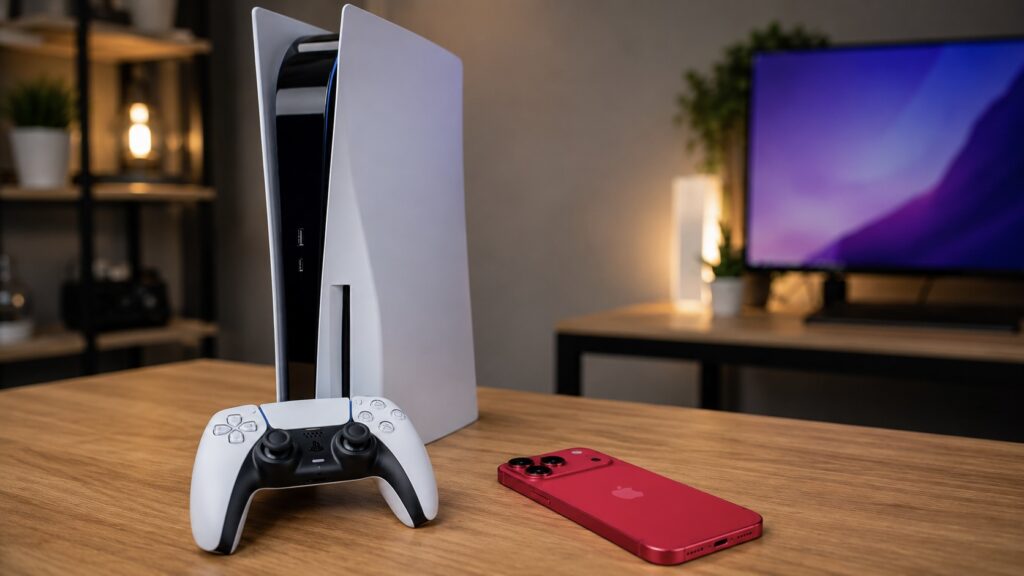
Render of a PS5 next to an iPhone 18 Pro
What the A20 Pro leak actually shows
The information comes from a Weibo user who has previously posted accurate details about Apple silicon. Notably, no die photo was published. Instead, the leaker took the arrangement of solder balls on the chip’s package substrate, overlaid it on existing die images, and used that grid to estimate where each processor block sits. This is an inference, not a measurement, so the numbers derived from it carry real uncertainty even if the overall picture looks plausible.
The headline change is graphics. According to the diagram, the A20 Pro moves to a seven-core GPU, up from six cores in the A19 Pro, an increase of roughly 16 percent in core count. The memory subsystem is arguably the bigger story: the leak indicates a 96-bit memory bus for LPDDR5x rather than the current 64-bit bus. That would raise bandwidth by 50 percent. Because GPU workloads are highly sensitive to memory speed, the real-world graphics gain could exceed what the extra core alone would deliver.
The processor for the iPhone 18 Pro and Pro Max
2 nm process and modest CPU changes
Supply-chain reports place the A20 Pro on TSMC’s new 2 nm process, a step down from the current 3 nm node. A smaller process allows more transistors on the same die area and lets them run more efficiently. Industry insiders are currently estimating roughly 18 percent higher overall performance and up to 30 percent better energy efficiency. These are preliminary figures, but the direction is consistent: Apple appears to be prioritizing graphics, memory bandwidth and on-device AI acceleration, the same areas that link its A-series mobile chips to the M-series processors used in Macs.
The CPU side changes less. The configuration reportedly stays at two performance cores and four efficiency cores. The efficiency cores would gain a shared 8 MB L2 cache in place of the current 6 MB, while the performance cores keep their 16 MB. The size of the system-level cache is not yet known, though it is unlikely to shrink, since the new image signal processor and neural engine will need somewhere to hold their data.
Gaming graphics: how it stacks up against PlayStation
The most tangible question for buyers is what this means for games, and whether a phone can realistically approach console-class output. The simplest, if crude, yardstick is teraflops, a measure of raw floating-point compute.
The six-core GPU in the A19 Pro delivers about 2.5 TFLOPS. If the A20 Pro achieves the 20 to 30 percent uplift that leaks suggest, it would land around 3 TFLOPS. For reference, Sony’s consoles rate as follows: the standard PlayStation 4 at 1.84 TFLOPS, the PlayStation 4 Pro at 4.2 TFLOPS, and the PlayStation 5 at 10.3 TFLOPS.
The arithmetic is sobering. On raw numbers, the iPhone 18 Pro would sit between the PS4 and PS4 Pro, closer to the base console and not quite reaching the Pro. The PS5 is a different tier entirely, more than three times higher. Talk of PS5-level graphics in a phone is not supported by these figures.
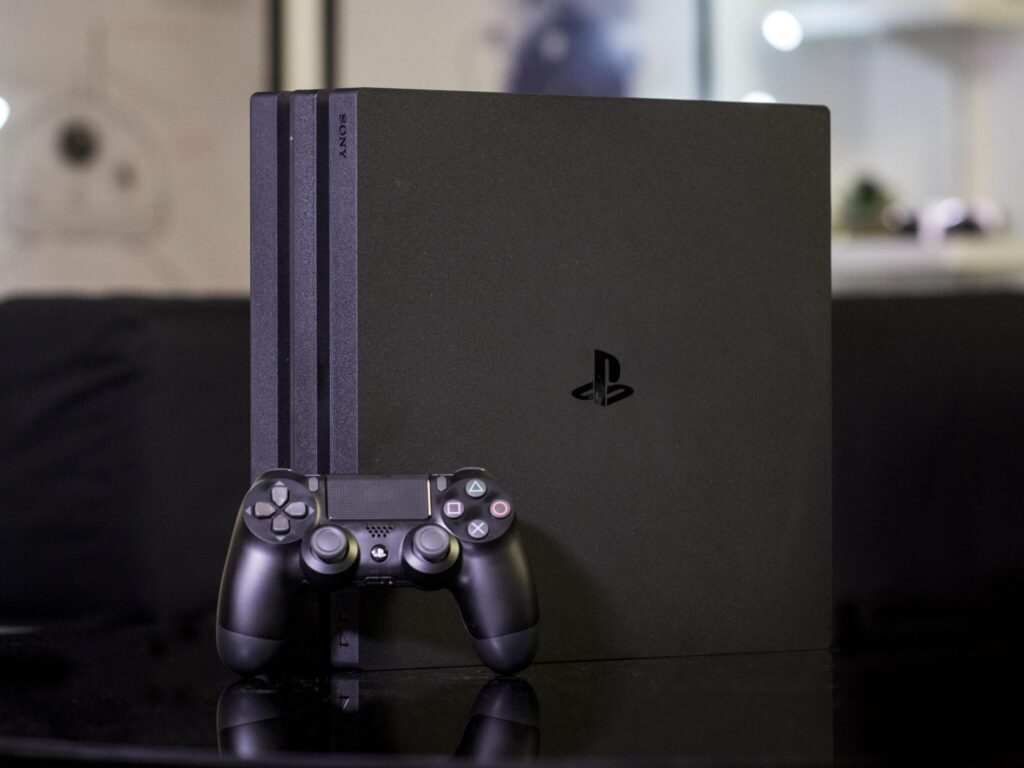
The PlayStation 4 Pro, the console the new iPhone is closest to
Why teraflops don’t tell the whole story
There is an important caveat. Comparing teraflops across different GPU architectures is not a like-for-like exercise. Apple’s graphics architecture works differently from the desktop-derived GPUs in consoles and tends to extract more from each unit of compute. A phone screen is also far smaller than a television, which lowers the rendering burden. In practice, full console titles such as Resident Evil Village, Assassin’s Creed Mirage and Death Stranding already run on current iPhones. The perceived experience is therefore likely to feel closer to a console than the raw numbers imply, but the honest comparison point is roughly PS4 Pro-class, not PS5.
When to expect the iPhone 18 Pro
The chip is expected to debut at Apple’s September 9 event, with the phone going on sale shortly afterward. Leaked cases for the iPhone 18 Pro Max have also circulated, giving an early look at the camera and button layout, though none of this is confirmed by Apple.
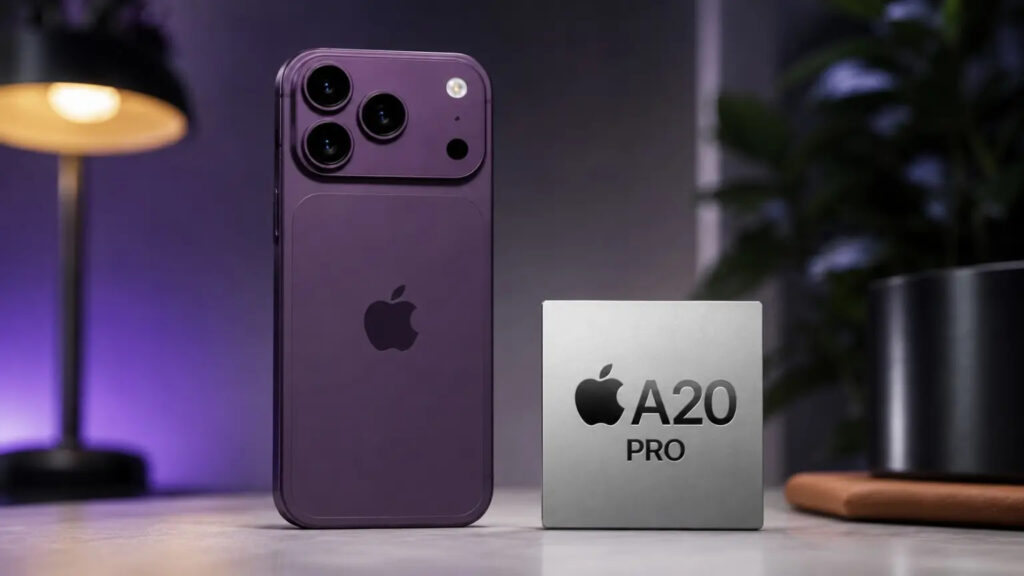
Render of the iPhone 18 Pro and its processor
Rumors also suggest the same chip could appear in Apple’s first foldable iPhone. In a thin chassis with limited thermal headroom, Apple would likely disable one GPU core, mirroring the approach it took with the iPhone Air. The result would be a slightly cut-down variant of the A20 Pro that runs cooler.
What this means for buyers
If the leak holds up, the iPhone 18 Pro should bring a meaningful step up in graphics and memory bandwidth over the already fast A19 Pro, which matters for demanding games and heavy apps. But expectations should stay grounded: this is not PlayStation 5-class hardware. Realistically, it would be the most powerful mobile chip on the market, capable of running console ports comfortably, while remaining bound by the heat and battery limits of a smartphone. Until Apple publishes specifications, every figure here remains an estimate built on an unofficial diagram.