Bright air freshener packaging hides a far from harmless chemical composition
Recently, I stumbled upon a detailed breakdown of air freshener ingredients and, honestly, I was unpleasantly surprised. It turns out that the familiar sprays promising us “ocean breeze freshness” or “lavender aroma” are actually packed with chemical compounds, some of which are recognized carcinogens. Here’s what I found out and what I decided to change in my home.
The Real Composition of Air Fresheners
The pretty pictures of flowers and fruits on the packaging have nothing to do with the actual product composition. In 2010, the International Fragrance Association (IFRA) published a list of more than 3,100 chemical compounds used by fragrance product manufacturers. The direct link to the source no longer works, but information about this can be found on many websites, for example on The Alternative Daily. Among these compounds were carcinogens, allergens, endocrine disruptors, and reproductive toxins. A single spray can contain more than 100 different chemicals, and none of them are required to be listed on the label.
The main components that concern researchers:
- Volatile Organic Compounds (VOCs) — they evaporate easily at room temperature, turning into an invisible gas that we inhale;
- Formaldehyde — a recognized carcinogen;
- Phthalates — a group of substances that disrupt hormonal balance;
- Dichlorobenzene — a substance toxic when inhaled.
I know, these are complex terms. But let’s break down each of these substances in more detail, because it was the specifics that really got to me.
Why Is Formaldehyde in Air Fresheners Dangerous
Formaldehyde is a colorless gas with a pungent odor that is used in air fresheners as the primary odor absorber. Sounds great, but there’s a problem: the International Agency for Research on Cancer (IARC) in 2012 reclassified formaldehyde from Group 2A (“probable carcinogen”) to Group 1 — “carcinogenic to humans.” This is the highest level of evidence — in the same group as asbestos, benzene, and cancer-causing tobacco smoke.
According to the data from the source, formaldehyde is directly linked to nasopharyngeal and throat cancer. Additionally, it causes chronic respiratory tract irritation, frequent nosebleeds, and can trigger asthma. A 2013 study involving more than 2,000 pregnant women showed that those who used air fresheners during pregnancy were statistically more likely to give birth to children with serious lung infections.
It is said that the use of air fresheners is especially dangerous in small bathrooms or bedrooms — where the concentration of formaldehyde can reach levels capable of causing upper respiratory tract irritation.
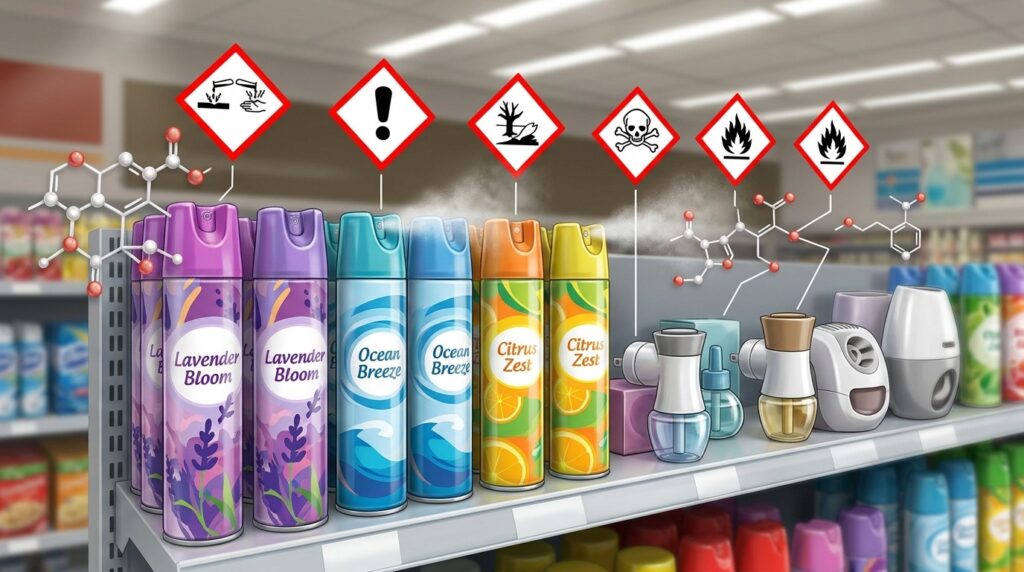
I no longer fall for these bright labels
The Harm of Phthalates in Air Fresheners
Phthalates (esters of phthalic acid) are perhaps the most insidious component. They are used as fragrance fixatives, and it’s thanks to them that the scent lasts a long time. The problem is that they are virtually impossible to detect without laboratory analysis.
Why are phthalates dangerous? They can accumulate in the kidneys and liver and affect the human hormonal system. Studies show that phthalates suppress the production of the male hormone testosterone and are linked to reproductive disorders: developmental anomalies of reproductive organs, reduced sperm count, and infertility.
And what is especially alarming: even trace amounts of phthalates can accumulate in the body and cause negative effects over time. The risk increases not from a single exposure, but from regular and prolonged contact — and many air fresheners operate in apartments around the clock.
How Dichlorobenzene Shuts Down Your Sense of Smell
This component shocked me the most. Dichlorobenzene is a known carcinogen, and it is found in most air fresheners. The reason it is used is that it numbs the nerve endings lining the nasal passages. In other words, this substance temporarily blocks the ability to smell odors.
So the new generation of air fresheners doesn’t so much “freshen” the air as it chemically disables your sense of smell. The unpleasant odor hasn’t gone anywhere — you’ve simply stopped noticing it.
In laboratory experiments, dichlorobenzene caused tissue damage and cancer of the lungs, kidneys, and testes in rodents. Studies in humans have linked it to decreased lung function and increased rates of asthma.
Natural Alternatives to Air Fresheners
After reading all of this, I decided to completely give up store-bought air fresheners. Here are the safe ways to freshen the air at home that I found:
- Essential oils with water. A few drops of essential oil (lemon, orange, lavender) in a spray bottle with distilled water reportedly makes a natural air freshener. Essential oils can also be added to some humidifiers. But it’s important to understand that if you have pets at home, you need to check which oils are safe for them — some (for example, tea tree oil) are toxic to cats;
- Spices on the stove. Online sources also recommend wrapping cloves and cinnamon sticks in cheesecloth and boiling them in water. After that, the kitchen fills with a warm aroma without any chemicals;
- Dried herbs and bouquets. Dried lavender in vases or sachet bags works as a gentle natural air freshener;
- Citrus peels and fresh herbs. Mint leaves, lemon or orange peels, and a sprig of rosemary blended together should absorb and mask unpleasant odors;
- Houseplants. These aren’t just decoration. Aloe vera filters benzene and formaldehyde from the air, spider plants neutralize xylene and carbon monoxide, and gerbera daisies effectively remove trichloroethylene;
- Baking soda. The simplest option: baking soda in an open jar with a perforated lid, placed in a corner of the kitchen or bathroom, absorbs odors excellently. You can also dissolve baking soda in water and spray it from a bottle.
Personally, for me the best replacement for an air freshener turned out to be a humidifier. The air in my home was already dry, so I killed two birds with one stone. I’m also thinking about essential oils in a spray bottle, but I haven’t gotten around to that yet.
The main takeaway I reached for myself: the problem with air fresheners isn’t that one specific spray will necessarily harm your health. The problem is the daily, years-long contact with dozens of toxic substances that accumulate in the body and act imperceptibly. All the sources I’ve seen say that these substances pose the greatest risk with prolonged, regular exposure. It’s worth at least trying safer alternatives — especially since the smell of cinnamon and cloves, honestly, appeals to me far more than synthetic “ocean breeze.”