
Scientists found at least two reasons for the Great Pyramid’s resilience to earthquakes
The Great Pyramid of Giza has stood for more than four and a half thousand years, and during that time it has survived dozens of earthquakes, including quite severe ones. A new study has for the first time explained exactly which structural features make the Great Pyramid so resilient. The answer has nothing to do with mysticism — only physics, geology, and the ingenious engineering solutions of the pyramid builders.
What Earthquakes Has the Great Pyramid Survived
The Great Pyramid, also known as the Pyramid of Khufu, was built approximately 4,600–4,450 years ago as a pharaoh’s tomb with hidden chambers. Since then, the Giza area has been shaken repeatedly.
In 1847, an earthquake of magnitude 6.8 struck here, which is a very powerful blow. And in 1992, tremors of magnitude 5.8 with an epicenter just 35 kilometers from Cairo destroyed or damaged more than 129,000 residential buildings, killing hundreds of people.
Yet the pyramid itself suffered no serious damage. During the 1992 earthquake, only one large block fell from it, despite the fact that thousands of modern buildings around it were destroyed. To understand the secret, Egyptian seismologist Asem Salama and geophysicists from Egypt, along with colleagues, conducted the first detailed study of vibrations directly inside the pyramid. The results of the study were published in Scientific Report.
How Scientists Measured the Strength of the Great Pyramid
The researchers recorded ambient vibrations — microscopic oscillations that constantly pass through any structure from the movement of the Earth’s crust, wind, and urban noise. Measurements were taken at 37 points, inside the pyramid’s chambers, in passages, and in the surrounding ground.
The majority of measurements inside the pyramid — 76% — showed a vibration frequency in a narrow range of 2.0 to 2.6 hertz, with an average value of 2.3 hertz. This means that mechanical stress is distributed very evenly throughout the structure. For a massive edifice made of millions of stone blocks, such uniformity is truly exceptional.
Why the Great Pyramid Doesn’t Fall Apart
One of the key findings of the study concerns the difference in frequencies. Vibrations in the surrounding soil had a frequency of about 0.6 hertz, which is nearly four times lower than inside the pyramid itself. Why does this matter?
Imagine two people on swings. If they swing at the same rhythm, the amplitude grows — this is resonance. It is precisely resonance that destroys buildings during earthquakes: the ground oscillates at a certain frequency, and if a building responds at the same frequency, the vibrations are amplified many times over. This doesn’t happen with the pyramid because the frequencies of the pyramid and the ground are widely separated, so they don’t amplify each other. This naturally reduces the risk of destructive resonance.
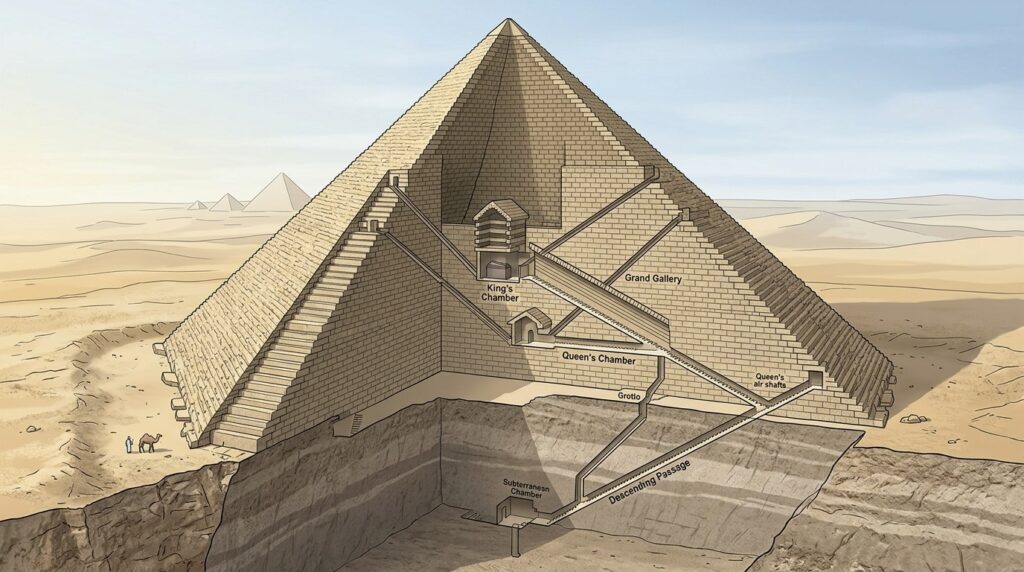
Diagram of the internal chambers of the Great Pyramid of Giza
Additional protection is provided by the solid limestone bedrock on which the pyramid stands. The researchers determined that the bedrock foundation has low seismic vulnerability — in other words, it barely amplifies underground tremors. Soft soils, on the contrary, can increase the amplitude of oscillations several times over, which is exactly what happened to many buildings in Cairo in 1992.
Earthquake Protection of the Pyramids
Another finding relates to the internal structure of the Great Pyramid. Scientists discovered that vibration amplification increases with height toward the top: the higher the measurement point, the stronger the oscillations. The maximum was recorded in the King’s Chamber, a burial room at a height of about 49 meters.
But then something unexpected happened. Directly above the King’s Chamber are five relieving chambers — small cavities separated from each other by massive granite slabs weighing up to 80 tons each. Traditionally, it was believed that the relieving chambers were needed to distribute the weight of the masonry and protect the King’s Chamber ceiling from collapse.
The new study showed that in these chambers, vibration amplification doesn’t increase but actually decreases. The authors of the study believe that the cavities act like dampers in skyscrapers — they absorb oscillations and prevent them from dangerously accumulating in the most important part of the structure. This gives the pyramid additional seismic stability.
How the Egyptians Learned to Build Pyramids
It is noteworthy that the researchers do not claim that the Egyptians specifically designed the pyramid for earthquake protection.
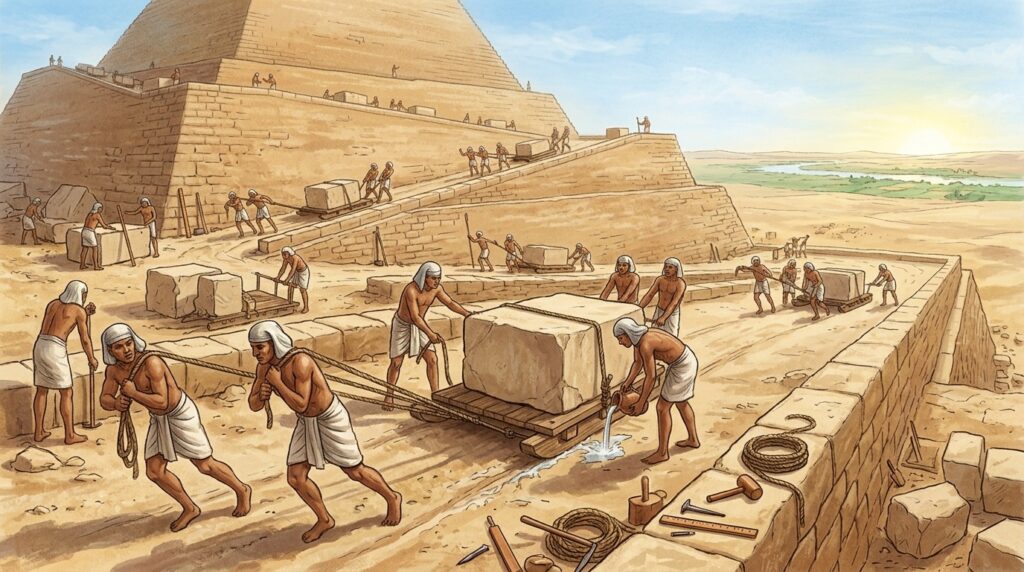
Pyramid construction — the result of centuries of trial and error
According to the authors of the study, the pyramid’s resilience is more likely the result of construction practices developed through centuries of experimentation, observation, and continuous improvement. The Egyptians started with simple rectangular tombs, then moved on to step pyramids like the Pyramid of Djoser, experimented with slope angles — and not always successfully.
By the time the Great Pyramid was built, the builders already had several centuries of accumulated experience. Their solutions turned out to be brilliant from a seismological perspective, even if they were driven by entirely different considerations.
What Modern Architects Can Learn from Pyramid Builders
The study’s findings are interesting not only for Egyptologists. Here are some tricks that architects can borrow from Egyptian builders:
- A wide base and pyramidal shape — the center of gravity is positioned low, making the structure extremely resistant to overturning;
- Frequency separation between the structure and the ground — modern buildings use special isolators for this, while the pyramid achieved the same effect through its mass and rigidity;
- Solid bedrock foundation — a foundation on hard rock instead of soft soil minimizes the amplification of seismic waves;
- Internal cavities that dampen vibrations — analogous to modern damper systems in skyscrapers.
Of course, nobody is going to build a skyscraper shaped like a pyramid today. But the principles themselves could become the basis for new engineering solutions in the construction of new architectural masterpieces.
This was the first scientific study in which the properties of the Great Pyramid were measured directly rather than calculated using models. This gives scientists data that simply didn’t exist before. The authors hope that further research will definitively confirm the role of each factor and possibly extract even more engineering lessons from the ancient monument.