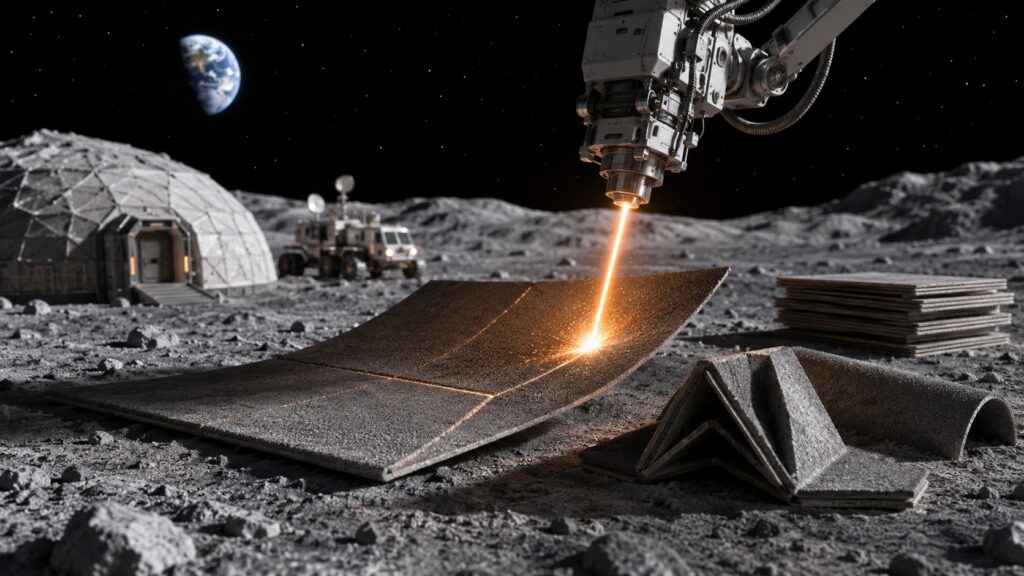
Scientists propose building homes on the Moon from regolith using a laser
Delivering even a kilogram of cargo to the Moon costs an exorbitant amount of money, so hauling bricks and concrete there is an almost hopeless endeavor. That’s why researchers propose building lunar bases directly from lunar dust, sintering it with a laser and folding it into the needed shapes. This technology is already being compared to origami, only instead of paper, regolith will be used, and instead of hands — a laser beam.
Why Building Materials Can’t Be Delivered to the Moon
The main problem with constructing buildings on the Moon is simple physics and economics. Every kilogram of cargo sent to the Moon costs tens and hundreds of thousands of dollars, because it needs to be accelerated to escape velocity, carried across hundreds of thousands of kilometers of space, and carefully landed.
If you build a base from materials brought from Earth, the costs become astronomical in both the literal and figurative sense. Walls, floors, protective domes — all of this weighs tons. That’s why engineers have long been looking for a way to use what’s already lying beneath the feet of future colonists. We’re talking about lunar regolith.
How to Use Lunar Regolith as a Building Material
According to scientists, lunar regolith can be made solid using a laser, and the technology is fairly straightforward. According to the authors at Interesting Engineering, a laser beam can heat regolith to its melting temperature, causing dust particles to sinter together, and after cooling, a solid, strong material is produced. This process is called selective laser sintering, and it has long been used in terrestrial 3D printing with metals and ceramics.
Researchers went beyond simply turning dust into flat tiles. They propose sintering thin sheets of regolith so that they can be bent and folded into three-dimensional structures. Hence the comparison to origami.
Here’s roughly how it works:
- the laser passes over a layer of regolith and sinters it into a thin, flexible plate;
- at the required spots, the beam creates fold lines where the material is thinner;
- along these lines, the sheet folds into a beam, panel, or dome element.
This approach allows complex parts to be made from a flat sheet without welding, bolts, or fasteners brought from Earth. All that’s needed is the laser’s energy and the lunar dust itself.
Why Buildings Can’t Be 3D-Printed on the Moon
The idea of printing buildings on the Moon from regolith has been discussed for a long time, but classic 3D printing has a weak spot. The thing is, it requires bulky equipment and large volumes of material to be sintered for each wall. Foldable structures made from thin sheets save both energy and mass.
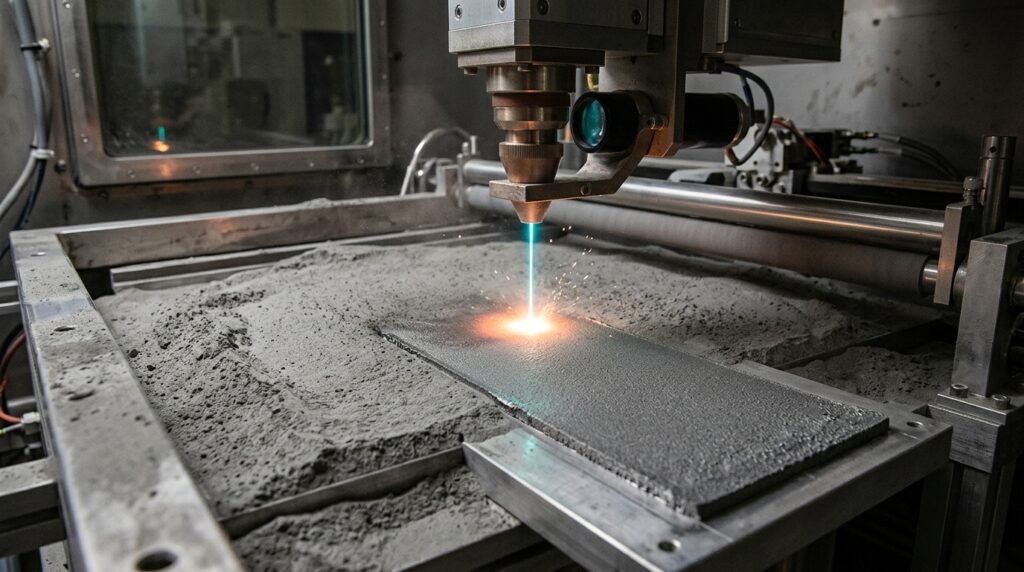
A laser sinters lunar dust into a thin, flexible sheet
A thin sheet is faster to sinter, easier to move across the surface, and folding provides a strong form with minimal material. This works on the same principle by which a folded sheet of paper holds weight better than a flat one. This is especially important where every watt of energy and every gram of equipment counts.
Additionally, compact foldable elements are convenient to manufacture in advance and assemble on-site, which reduces the workload on the few astronauts or construction robots available.
Where on the Moon Will Bases Be Built
Building homes using the origami method is just one of many approaches to lunar development, and it fits well into the overall picture of future missions. NASA, Blue Origin, and private companies are already preparing landings whose goal is a permanent base, not a one-time visit.
Various sites and architectures are being considered. For example, China plans to build bases on the Moon in natural lava caves that protect against radiation and temperature fluctuations. Other countries have their own plans too — for instance, Japan wants to build bases on Mars and the Moon, even considering artificial gravity.
In any of these scenarios, the ability to construct buildings from lunar soil becomes key. The fewer materials need to be shipped from Earth, the more realistic a permanent human presence beyond our planet becomes.
Problems with Building Homes from Lunar Regolith
It’s important to understand that the technology described above is still just a concept, not a ready-made solution. Most tests are conducted in terrestrial laboratories using artificial lunar soil.
Real regolith behaves in more complex ways because it is sharp, abrasive, electrostatically charged, and highly dependent on the collection site. On the Moon, additional challenges arise, such as low gravity, vacuum, extreme temperature swings, and the need for a reliable power source for the laser.
Therefore, it’s too early to talk about finished lunar homes folded like origami. But the idea itself shows the direction in which space construction is heading. Instead of delivering prefabricated structures, scientists need to enable manufacturing on-site from whatever is available.
If the approach proves effective under real conditions, it could become one of the foundations of future lunar infrastructure — literally assembled from what has simply been lying around as gray dust for billions of years.