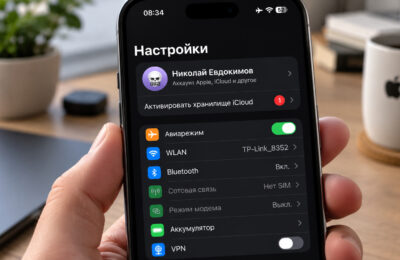
Just yesterday, a large portion of Russian services and apps stopped working with VPN, and today about 20 telecom operators have signed a moratorium on expanding communication channels connecting Russia with Europe. Every day brings a new twist. According to RBC, the initiative comes from the Ministry of Digital Development and is aimed at combating VPN. The idea is to make foreign traffic more expensive and slower — but this will affect not only those who bypass blocks.
Russia has seriously taken on VPN and come up with a new way to restrict it
Moratorium on Communication Channels to Europe — What Is It
According to RBC, the document was signed at one of the meetings with head of the Ministry of Digital Development Maksut Shadayev. The moratorium was signed at one of the recent meetings dedicated to VPN restrictions. Among the signatories are MSK-IX, Transtelecom, MTS, VimpelCom (Beeline), T2, Ufanet, and Rascom. In total — about 20 companies that own international communication channels.
The essence is simple: operators commit not to increase the bandwidth of channels leading from Russia to Europe. If the load on these channels grows — and it is growing along with the number of VPN users — the internet will start lagging or become significantly more expensive.
Operators are already coordinating expansion of international channels with Roskomnadzor. The moratorium introduces additional approval — from the Ministry of Digital Development. At the same time, for the decision to have legal force, the Ministry needs to receive the appropriate authority through amendments to the law or a government decree. As soon as the Ministry of Digital Development acknowledged that it’s difficult to block VPN on iPhone, they came up with a new way out of the situation. Formally, the procedure will look like this: the operator requests permission to expand from Roskomnadzor, and the latter denies it. Operators were not told the duration of the moratorium.
Internet Speed Reduction in Russia in 2026
The regulator’s logic is based on simple arithmetic. VPN service traffic looks like international traffic to operators: the more the use of such services grows, the more international traffic volumes increase. The bandwidth reserves for passing international traffic are limited, and the natural growth of traffic will lead to their saturation.
The problem is that the restriction will affect not only VPN traffic, but all international traffic indiscriminately. This includes regular access to foreign websites, cloud services, and CDN servers where data of many Russian and international services is stored. If the channels are not expanded while the load continues to grow, users will notice a speed reduction when working with any resources whose servers are located outside Russia.
The problem in this case will arise even when connecting to the App Store
For owners of iPhone, iPad, and Mac, this means that app updates from the App Store, iCloud synchronization, Apple Music, Apple TV+, and other Apple services with servers abroad — all of this could potentially slow down.
VPN Blocking in Russia — How the Moratorium Will Help Authorities
The moratorium on communication channels is just one element of a large-scale campaign by the Ministry of Digital Development, which the agency has been conducting since late March 2026. In late March, the head of the Ministry of Digital Development asked operators at a meeting to introduce a fee for using more than 15 GB of international traffic per month on mobile networks. The discussed cost is 150 rubles for each gigabyte over the limit. The estimated implementation date is starting May 1, 2026.
Using VPN on iPhone is becoming increasingly inconvenient
In parallel, the largest Russian internet platforms — from Yandex and VK to Ozon and Wildberries — are expected to begin independently identifying and restricting access for users who connect through VPN.
The moratorium on communication channels supplements these measures with economic pressure. When the bandwidth fills up, operators themselves will become interested in fighting VPN — because international traffic will become too expensive for them. Either the operators or the subscribers will have to pay for it.
By the end of February 2026, Roskomnadzor had restricted access to 469 VPN services. But users continue to find workarounds. The moratorium is an attempt to solve the problem not with targeted blocks, but by narrowing the very “bottleneck” through which all international traffic flows.
Access to Foreign Websites and Services Without VPN
An important point: the restrictions will affect not only those who use VPN. Any foreign resource may work slower if communication channels with Europe are not expanded as the load grows. This applies to regular services that are not blocked in Russia but whose servers are located abroad.
VPN internet speed may become very low
The source also mentions the flip side: the moratorium could push foreign services operating in Russia to install servers within the country. If their data is stored and processed within Russia, the access speed to them will not decrease. For users, this is potentially good news — provided that companies actually take this step.
Experts note that technically separating VPN traffic from legitimate international traffic (for example, requests to CDN or cloud services) is extremely difficult. That is precisely why the moratorium hits everyone — both those who bypass blocks and those who simply use foreign services.
Proxy for Telegram Under Traffic Slowdown Conditions
A separate question is how the moratorium will affect alternative ways to bypass restrictions. On April 10, 2026, the level of Telegram blocking in Russia approached 100%. It is being restricted more heavily than other messengers. VPN and proxy servers help cope with this. Recently, Telegram received an update that improves proxy performance.
Proxy servers for Telegram work on a different principle than VPN: they only pass messenger traffic through themselves, not the entire connection. Proxies work only within the Telegram app. They do not change the IP for other websites and apps. However, in 2026, TSPU equipment (deep traffic analysis systems on the provider’s side) has learned to recognize characteristic patterns of MTProto proxies, so the stability of their operation is already in question.
Setting up proxy in Telegram on iPhone