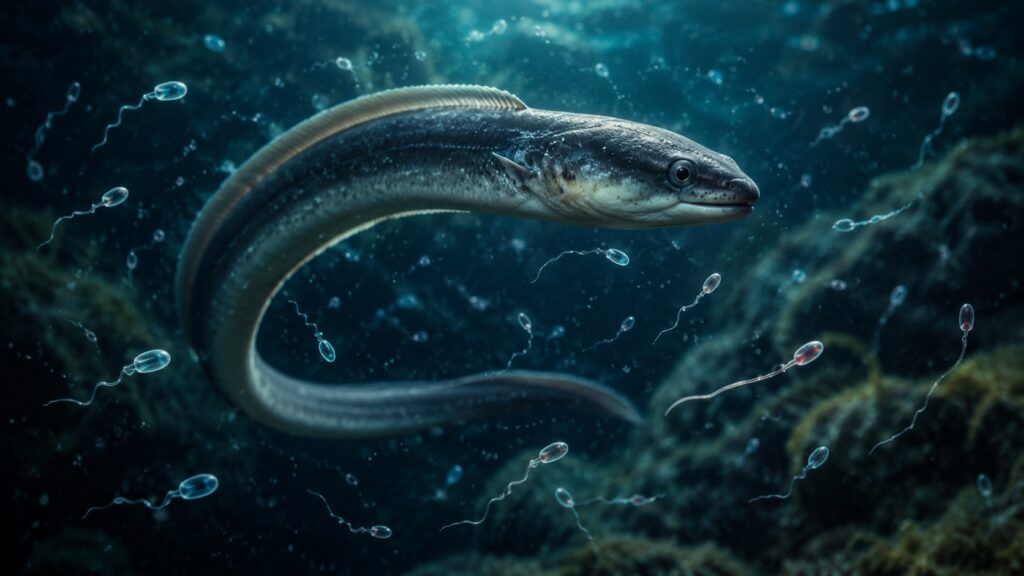
Japanese eels, which can hide from prying eyes, have suddenly surprised scientists
Male Japanese eels produce two completely different types of sperm cells, and scientists don’t yet understand why. This discovery, made by researchers from China, could shed light on why eels are impossible to breed in captivity.
Scientists Don’t Know How Eels Reproduce
The Japanese freshwater eel (Anguilla japonica) is one of the most mysterious fish on the planet. Eels are born far out in the open ocean, and then their larvae drift toward the shores of East Asia, where juvenile individuals enter rivers and coastal waters. After years, in autumn and winter, adult eels begin the return journey to the ocean to reproduce. They spawn in waters west of the Mariana Islands, and that’s where scientists’ knowledge of these creatures ends.
The final part of the Japanese eel’s life cycle is still full of mysteries. It is believed that somewhere in the open sea, the eels’ gonads mature, after which the fish spawn. Scientists have still not observed eel spawning in the wild. And it is precisely how eels reproduce that is important for science and their captive breeding.
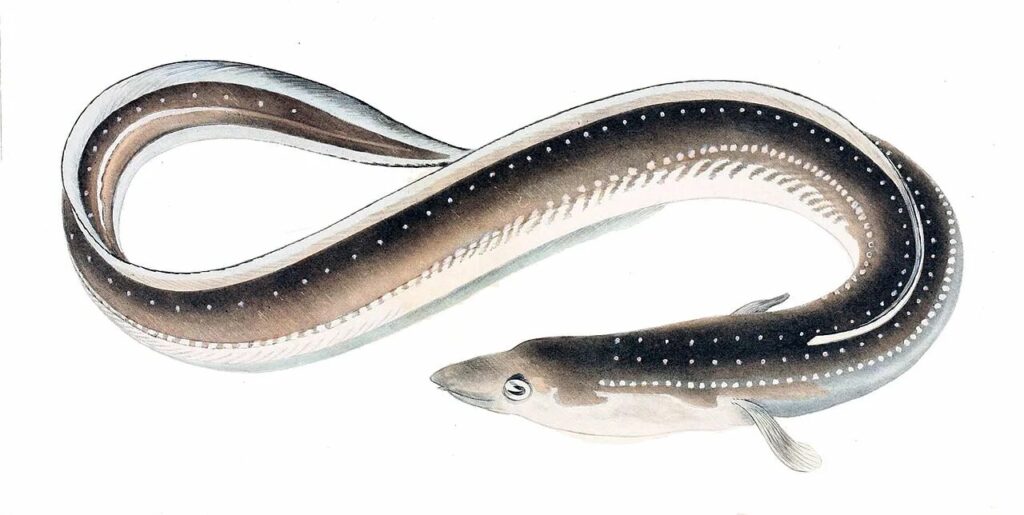
Japanese freshwater eel. Image source: wikipedia.org
Two Types of Eel Sperm
In a study published in the scientific journal Biology, researchers examined 20 wild male Japanese eels caught in China’s Pearl River (Zhujiang). To trigger the maturation of reproductive cells, the fish were given weekly hormonal injections — carp pituitary extract and human chorionic gonadotropin. This is standard practice because in captivity, eels do not mature on their own and must be supplemented with hormones.
When the males had matured, the scientists collected the seminal glands and examined the sperm cells under light and electron microscopes. That’s where two completely different cell types were discovered:
- The first type — with a rounded head. The nucleus is almost circular, measuring about 2.6 by 2.1 micrometers. The tail is about 37 micrometers long. These sperm cells more closely resemble what is typically found in fish;
- The second type — with a sickle-shaped head. The nucleus is elongated, about 7.7 micrometers long, three times longer than the first type. The tail is approximately the same length but structured differently on the inside.
The difference isn’t just in appearance. Electron microscopy showed that in sickle-shaped sperm cells, part of the central supporting structure is missing inside the tail. This is a fundamentally different design that could affect motility and fertilization ability.
Two Types of Sperm in Vertebrates
The phenomenon in which a single male produces two or more types of sperm cells is called sperm heterodimorphism. It occurs in some animal groups — in nearly all butterflies and moths, in fruit flies, and in some gastropod mollusks. But among vertebrates, this is an extremely rare phenomenon.
Usually, one type is fertile, meaning capable of fertilizing an egg, while the other is not. The non-fertile type may play a supporting role — for example, in some snails, males produce large infertile cells that help protect the fertile sperm.
Something similar may be happening in eels. But the study authors honestly note that there is no definitive answer yet.
Why Eels Are Hard to Farm
In Japan, eel is considered a cultural staple. The country consumes more than 70% of the world’s freshwater eels. The industry is valued at billions of dollars. But all eels raised on farms are wild juveniles caught in nature and grown to maturity in captivity.
Artificial breeding of eels from egg to adult has not yet moved beyond laboratories and has not become commercially viable. Current capacity allows growing fewer than a thousand eels per year, while the demand is at least 200 million juveniles annually.
One of the key problems is sexual maturation of eels in captivity. In the wild, it occurs during the long oceanic journey, under the influence of water pressure, temperature, salinity, and light conditions. These conditions don’t exist in an aquarium, so scientists have to administer hormones manually.
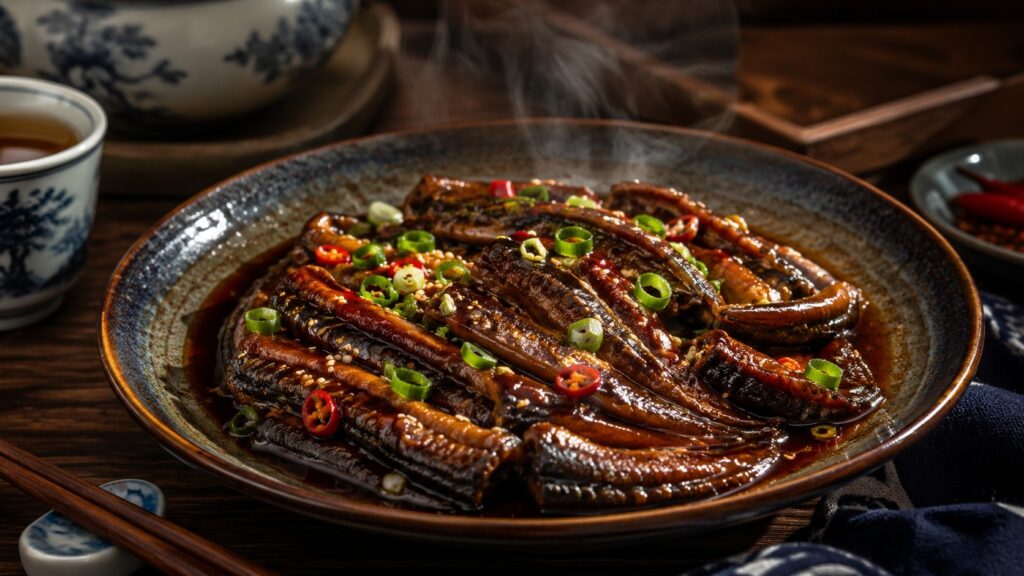
Grilled eel in China
How the New Discovery Could Help Eel Conservation
The new study does not solve the eel breeding problem. But it adds an important detail. If one type of sperm swims better, fertilizes more reliably, or indicates healthier maturation, this could help at least simplify captive eel breeding.
It is also possible that this isn’t simply about “good” or “bad” sperm. The ejaculate may contain different types of cells with different functions. Understanding this could explain why artificial fertilization of eel eggs is so unpredictable.
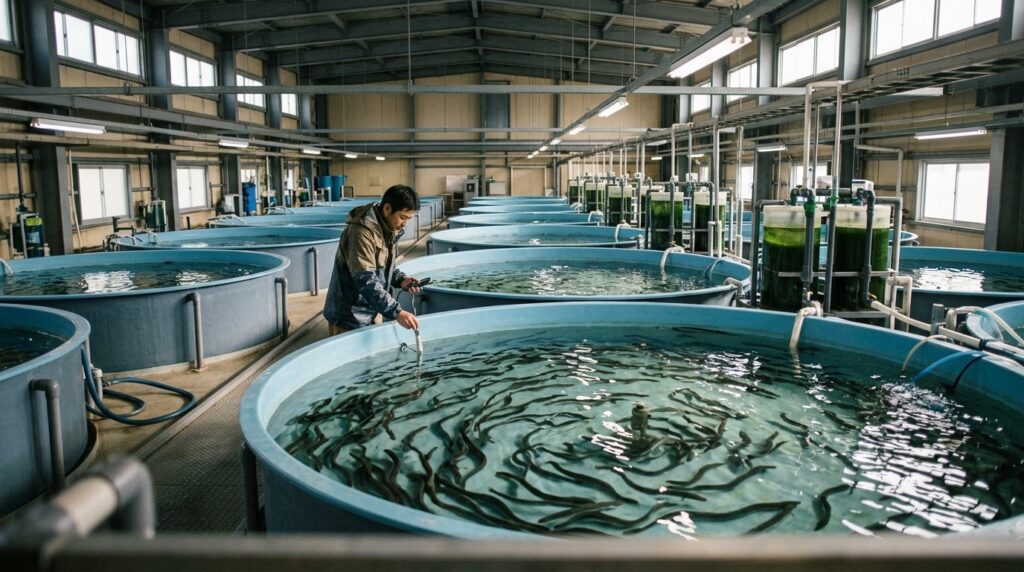
An eel farm in Japan
And this is directly related to species conservation. The Japanese eel is listed in the IUCN Red List as endangered due to habitat loss, overfishing, pollution, dams, and changes in ocean currents. The European eel is in an even worse situation, with its status listed as “critically endangered.”
The better scientists understand eel reproduction, the greater the chances that fish farms will someday stop depending on the catch of wild juveniles. And that would reduce pressure on already vulnerable populations.
What Scientists Don’t Know About Eels
Eels are, one could say, champions of secrecy. After decades of research, no one has observed their spawning in the wild. Scientists know it happens somewhere in the depths of the Pacific Ocean, but the exact conditions are known only hypothetically.
It is believed that after spawning, eels die — meaning they reproduce only once in their lifetime. Their bodies undergo several transformations, from a transparent larva to a “glass” juvenile, then to a yellow eel, and before migration — to a silver eel.
Now another mystery is added to this list: why does a single male produce two types of sperm cells? Does the second type work as a helper? Could this be an ancient mechanism inherited from distant ancestors?
The authors of the study discuss possible explanations but emphasize that there is not yet enough data for definitive conclusions. The next step is to determine whether the sickle-shaped sperm type is capable of fertilizing eggs and to repeat the experiment with eels that matured without hormones.