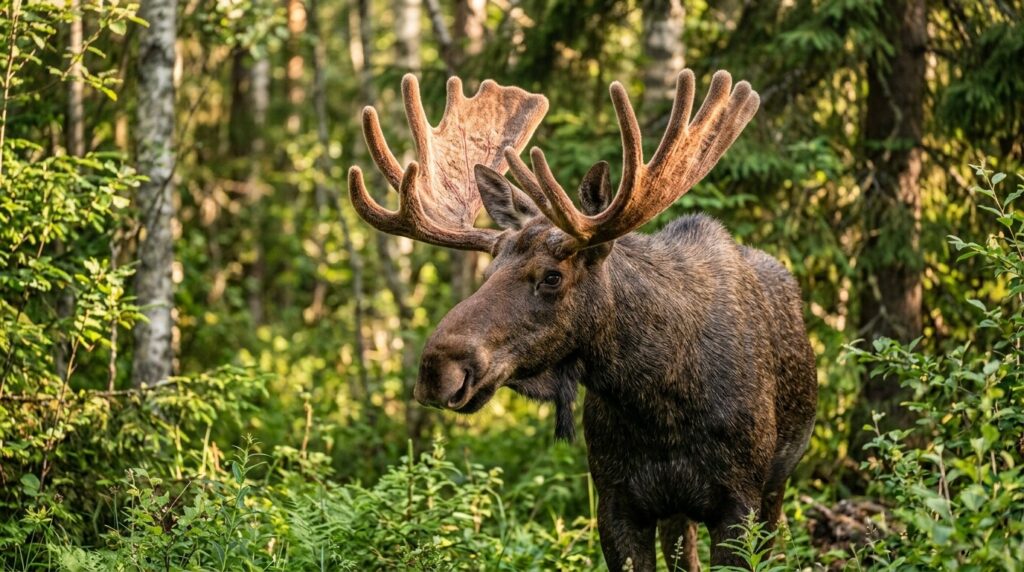
Scientists can share many amazing facts about deer antlers
The fastest-growing tissue among all mammals is not skin, not hair, and not even cancer cells. The record belongs to deer antlers, which regrow every spring and can add up to 2.5 centimeters in length per day. The Guinness Book of World Records has officially confirmed this status, and scientists are still trying to figure out how this is even possible.
Why Deer Antlers Grow Faster Than Any Other Mammalian Tissue
Imagine a bone starting to grow from your forehead. Two weeks later, it’s already the length of a bowling pin. It sounds like a horror movie plot, but for deer this is perfectly normal, and they go through it every year.
According to the Guinness Book of World Records, deer antlers grow at a rate of up to 2.5 centimeters per day in large species. Antlers are not keratin, like in cows or goats, but genuine bone tissue — an extension of the skull, only with a cellular, “honeycomb” structure inside. And they are completely renewed every year: the old ones are shed in spring, and new ones grow back over the summer.
The absolute record holder among deer is the moose, the largest member of the deer family. A large bull moose can grow a pair of antlers weighing up to 36 kilograms in a single summer, adding about half a kilogram of bone daily. With a body mass of around 700 kg, this adds approximately five percent to the animal’s total weight. For comparison: it’s as if an adult man grew a bony structure on his head weighing as much as a large house cat.
What Is Velvet and How Does It Help Antlers Grow
The speed at which antlers grow seems impossible for bone tissue. The key to the mystery is velvet. This is not fabric from a store, but a special skin densely laced with blood vessels and covered with short, dense fur. It envelops the growing antler and serves as a life-support system.
Velvet delivers oxygen and nutrients to the growing bone through a branching network of arteries. Antlers at this stage are living tissue — soft and sensitive, consisting of cartilage that gradually transforms into bone. Damage to the velvet can lead to antler deformation, showing how critical its blood supply is.
When the antlers are fully ossified, the male’s testosterone levels rise, blood supply ceases, and the velvet dies. The deer strips it off by rubbing the antlers against trees. The sight looks rather gruesome, but for the animal this is a normal and virtually painless process. Beneath the dried strips, hard bone ready for combat is revealed.
Why Deer Destroy Their Own Bones for the Sake of Antlers
Growing antlers costs the deer’s body an incredible amount. A normal diet cannot provide enough minerals for such rapid bone formation. So the body takes a radical step: it withdraws calcium and phosphorus from its own skeleton — primarily from the ribs and sternum.
Scientists call this “cyclic physiological osteoporosis.” According to research, antlers receive more than 60% of their minerals directly from the deer’s skeleton. In humans, osteoporosis is a serious chronic disease. In deer, however, it is a temporary condition: after antler growth is complete, bone density fully recovers in about a month.
A moose spends a quarter of the energy from the 15 kilograms of vegetation it eats daily specifically on antler growth. Female moose direct this energy toward winter preparation, and this may be exactly why they live longer than males.
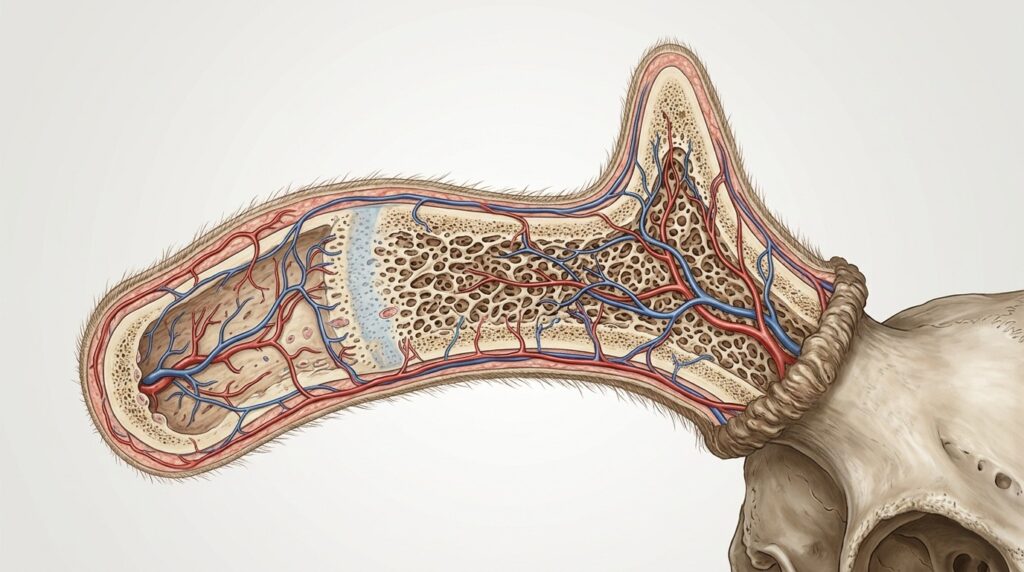
Schematic illustration of a growing antler structure: bone, cartilage, and a network of blood vessels
Why Rapid Antler Growth Doesn’t Lead to Cancer
Here’s what truly puzzles biologists. Cells in the antler growth zone divide at a furious rate — faster than in many tumors. The genetic profile of these cells more closely resembles osteosarcoma (bone cancer) cells than normal bone tissue. By all indications, such growth should lead to cancer. But it doesn’t.
As one study showed, deer have evolved unique cancer defense mechanisms at the genetic level. In the antler growth zone, an exceptionally efficient apoptosis system operates — programmed cell death that eliminates potentially dangerous cells. Additionally, deer have been found to have enhanced tumor suppressor genes, including regulators of the p53 protein.
Another safeguard is the annual shedding of antlers. Even if abnormal cells were to accumulate in the bone tissue, every spring the deer discards the entire structure and starts from scratch. This is a kind of “reboot” that prevents potential problems from building up. Interestingly, cancer rates in deer overall are approximately five times lower than in other mammals.
What Deer Antler Growth Offers Medicine
Deer antlers are the only complex organ in mammals capable of full regeneration after loss. No other bone, no other organ in mammals can reproduce itself from scratch every year. For scientists, this is a potentially valuable model for several areas of medicine:
- Regenerative medicine — understanding how antler stem cells trigger the growth of an entire organ could help develop methods for restoring bones and tissues in humans;
- Oncology — the mechanisms that allow antlers to grow faster than tumors without turning cancerous provide clues for studying tumor growth suppression;
- Osteoporosis treatment — the ability of the deer skeleton to fully recover after mineral loss interests researchers as a model for reversing osteoporosis in humans.

A deer shedding velvet from its antlers — the process looks impressive but is painless for the animal
All of this remains an area of active research. Extracts from velvet antlers are already being tested in experiments on cell cultures and animal models — in the context of anti-tumor effects and wound healing. However, clinical application is still far off, and these results should be considered preliminary.
Deer antlers remain one of the most astonishing examples of what mammalian biology is capable of. Bone tissue that grows faster than cancer, renews itself from scratch every year, and doesn’t cause oncological diseases — this is not science fiction, but a reality that unfolds in the forests of Europe and North America every summer. And the deeper scientists study this process, the more hope it gives for solving distinctly human medical problems.